QUESTION IMAGE
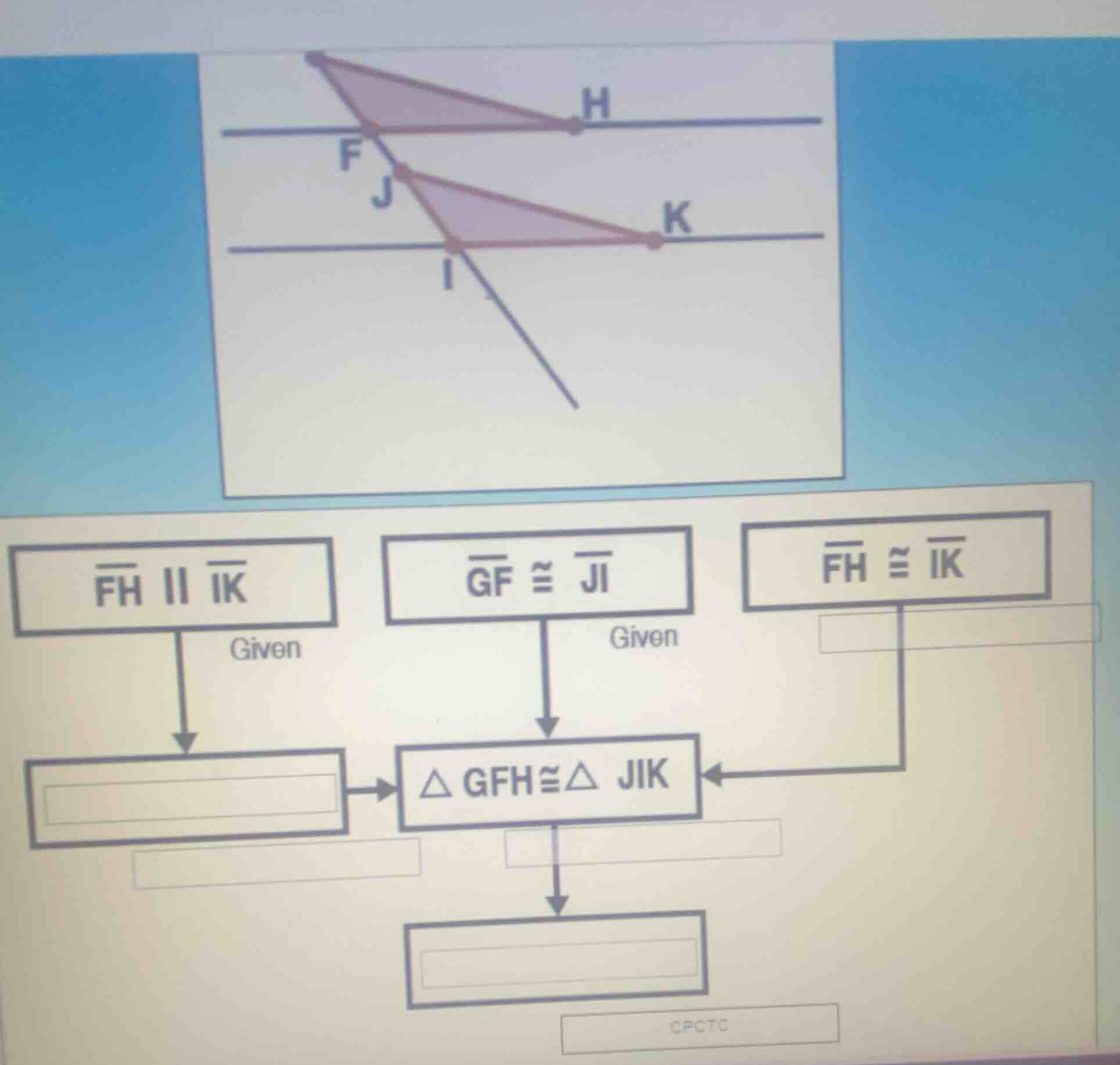
Question
given:
\\(\overline{fh} \parallel \overline{ik}\\)
\\(\overline{gf} \cong \overline{ji}\\)
\\(\overline{fh} \cong \overline{ik}\\)
prove: \\(\delta gfh \cong \delta jik\\)
⚡ Using what you learned: proofs involving angles, segments, triangles, and parallelograms
Step 1: Identify the missing angle relationship
The parallel lines \(\overline{FH} \parallel \overline{IK}\) are cut by the transversal line containing points \(G\), \(F\), \(J\), and \(I\).
This transversal creates corresponding angles at the intersections:
The reason for this statement is the Corresponding Angles Postulate.
Step 2: Determine the triangle congruence criteria
We are given:
- \(\overline{GF} \cong \overline{JI}\) (Side)
- \(\angle GFH \cong \angle JIK\) (Included Angle)
- \(\overline{FH} \cong \overline{IK}\) (Side)
Using these three pieces of information, the triangles are congruent by the SAS (Side-Angle-Side) Congruence Postulate.
Step 3: Identify the final CPCTC statement
Once the triangles are proven congruent (\(\Delta GFH \cong \Delta JIK\)), any remaining corresponding parts are congruent by CPCTC (Corresponding Parts of Congruent Triangles are Congruent).
The remaining corresponding sides or angles that can be concluded are:
- \(\overline{GH} \cong \overline{JK}\)
- \(\angle G \cong \angle J\)
- \(\angle H \cong \angle K\)
Typically, in these geometric proofs, we prove the congruence of the third side:

Snap & solve any problem in the app
Get step-by-step solutions on Sovi AI
Photo-based solutions with guided steps
Explore more problems and detailed explanations
- First empty box (under \(\overline{FH} \parallel \overline{IK}\)):
- Statement: \(\angle GFH \cong \angle JIK\)
- Reason: Corresponding Angles Postulate
- Reason box under \(\Delta GFH \cong \Delta JIK\):
- Reason: SAS Congruence Postulate
- Bottom empty box (above CPCTC):
- Statement: \(\overline{GH} \cong \overline{JK}\) (or \(\angle G \cong \angle J\), or \(\angle H \cong \angle K\))