QUESTION IMAGE
Question
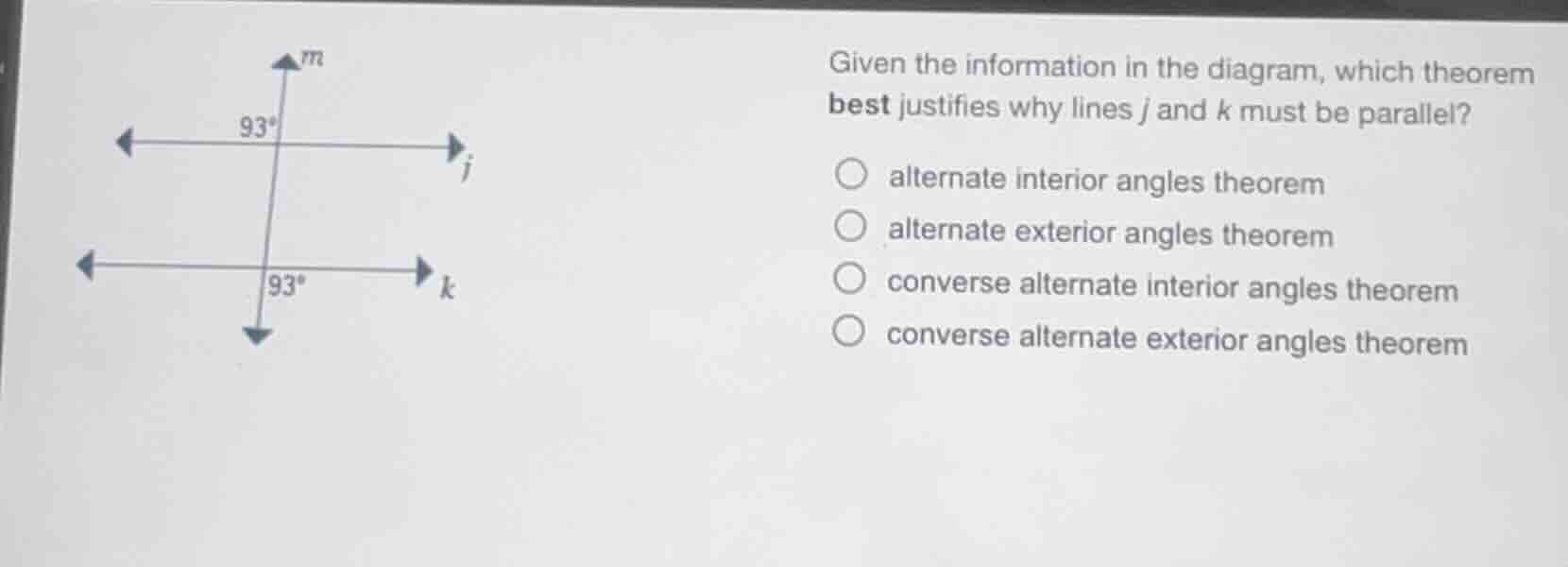
given the information in the diagram, which theorem best justifies why lines \\(j\\) and \\(k\\) must be parallel?
alternate interior angles theorem
alternate exterior angles theorem
converse alternate interior angles theorem
converse alternate exterior angles theorem
Identify the given angles
The diagram shows two lines, \(j\) and \(k\), intersected by a transversal line \(m\). Two angles are labeled with a measure of \(93^\circ\).
Analyze the angle positions
The two \(93^\circ\) angles lie on opposite sides of the transversal line \(m\) and are outside the region between lines \(j\) and \(k\). This position defines them as alternate exterior angles.
Apply the correct geometric theorem
Using the Alternate Interior Angles concept as a reference for parallel line relationships, we look at the converse theorems. Since we are given that the alternate exterior angles are equal (\(93^\circ = 93^\circ\)) and we want to prove that the lines \(j\) and \(k\) are parallel, we must use a converse theorem. The theorem stating that equal alternate exterior angles imply parallel lines is the converse alternate exterior angles theorem.

Snap & solve any problem in the app
Get step-by-step solutions on Sovi AI
Photo-based solutions with guided steps
Explore more problems and detailed explanations
- alternate interior angles theorem
- alternate exterior angles theorem
- converse alternate interior angles theorem
- converse alternate exterior angles theorem (Correct answer)