QUESTION IMAGE
Question
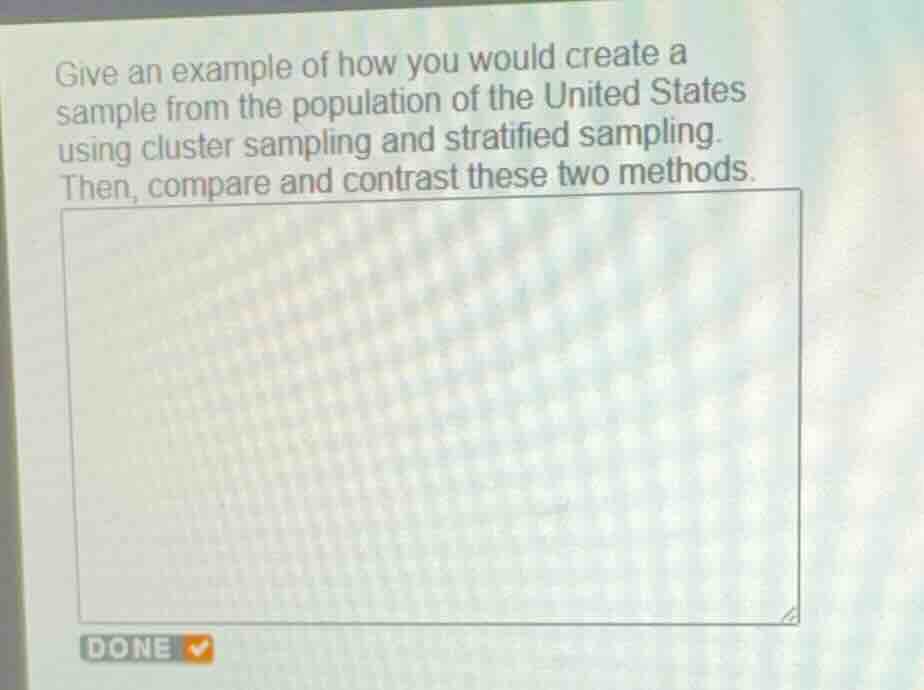
give an example of how you would create a sample from the population of the united states using cluster sampling and stratified sampling. then, compare and contrast these two methods.
Example of Stratified Sampling
Using the Stratified Sampling knowledge point
- Divide the population into strata: Divide the US population into mutually exclusive subgroups (strata) based on a characteristic like geographic region (e.g., Northeast, Midwest, South, West).
- Sample from every stratum: Randomly select a proportional number of individuals from each of the four regions to form the final sample.
Example of Cluster Sampling
- Divide the population into clusters: Divide the US population into naturally occurring, heterogeneous groups (clusters) such as zip codes or counties.
- Sample entire clusters: Randomly select a few of these zip codes/counties, and include all individuals living within those selected clusters in the final sample.
Compare and Contrast the Methods
- Similarity: Both methods divide the target population into distinct subgroups before selecting the sample.
- Difference in Selection: Stratified sampling selects a random sample of individuals from every subgroup (all strata are represented). Cluster sampling randomly selects entire subgroups (only some clusters are represented, but everyone within those selected clusters is surveyed).
- Difference in Subgroup Composition: Strata are homogeneous internally (members share a specific trait), while clusters are heterogeneous internally (each cluster is a mini-representation of the diverse population).

Snap & solve any problem in the app
Get step-by-step solutions on Sovi AI
Photo-based solutions with guided steps
Explore more problems and detailed explanations
Stratified Sampling Example:
To sample the US population, you divide the country into four geographic regions (Northeast, Midwest, South, and West) as strata. You then randomly select a proportional number of individuals from each of the four regions to ensure all regions are represented in your sample.
Cluster Sampling Example:
You divide the US population into clusters based on counties. You randomly select 10 counties from across the nation and survey every single resident living within those 10 selected counties.
Comparison:
- Similarity: Both methods categorize the population into subgroups before sampling.
- Difference in Selection: Stratified sampling takes a random sample of individuals from every subgroup (all strata are represented). Cluster sampling randomly selects entire subgroups and surveys everyone inside them (only selected clusters are represented).
- Difference in Subgroup Nature: Strata are homogeneous (members share a specific characteristic like age or region), whereas clusters are heterogeneous (each cluster is a diverse, mini-representation of the overall population).