QUESTION IMAGE
Question
gcse maths revision | geometry and measure
angles in parallel lines - worksheet
skill
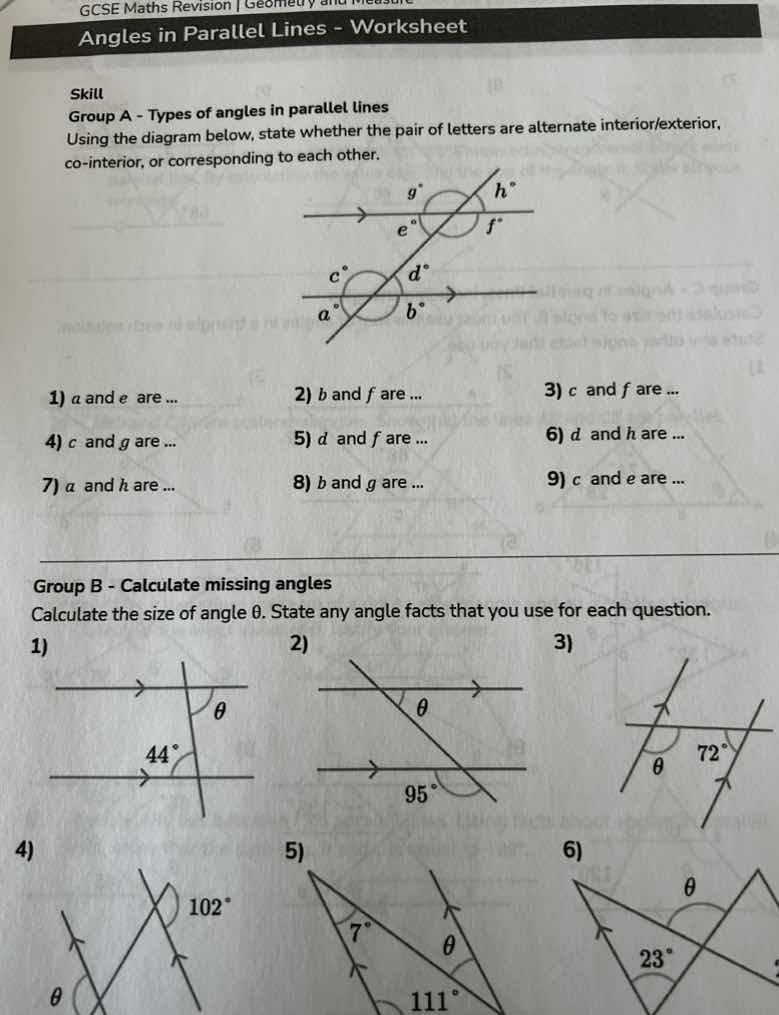
group a - types of angles in parallel lines
using the diagram below, state whether the pair of letters are alternate interior/exterior, co-interior, or corresponding to each other.
- a and e are ...
- b and f are ...
- c and f are ...
- c and g are ...
- d and f are ...
- d and h are ...
- a and h are ...
- b and g are ...
- c and e are ...
group b - calculate missing angles
calculate the size of angle \\(\theta\\). state any angle facts that you use for each question.
1)
2)
3)
4)
5)
6)
Identify angle relationships in Group A
We analyze the positions of each pair of angles relative to the parallel lines and the transversal line:
- Corresponding angles lie in the same relative position at each intersection (e.g., top-left, bottom-right).
- Alternate interior angles lie between the parallel lines on opposite sides of the transversal.
- Alternate exterior angles lie outside the parallel lines on opposite sides of the transversal.
- Co-interior angles (consecutive interior) lie between the parallel lines on the same side of the transversal.
Let's classify each pair:
- \(a\) and \(e\): Both are in the bottom-left position of their respective intersections. They are corresponding angles.
- \(b\) and \(f\): Both are in the bottom-right position of their respective intersections. They are corresponding angles.
- \(c\) and \(f\): Both are inside the parallel lines on opposite sides of the transversal. They are alternate interior angles.
- \(c\) and \(g\): Both are in the top-left position of their respective intersections. They are corresponding angles.
- \(d\) and \(f\): Both are inside the parallel lines on the same side of the transversal. They are co-interior angles.
- \(d\) and \(h\): Both are in the top-right position of their respective intersections. They are corresponding angles.
- \(a\) and \(h\): Both are outside the parallel lines on opposite sides of the transversal. They are alternate exterior angles.
- \(b\) and \(g\): Both are outside the parallel lines on opposite sides of the transversal. They are alternate exterior angles.
- \(c\) and \(e\): Both are inside the parallel lines on the same side of the transversal. They are co-interior angles.
Solve Group B, Question 1
- Given: An angle of \(44^\circ\) and an angle \(\theta\).
- Analysis: The angle \(44^\circ\) and the angle vertically opposite to it are equal. The interior angle on the same side as \(\theta\) is \(44^\circ\). Thus, \(\theta\) and the \(44^\circ\) angle are co-interior angles, which are supplementary.
- Calculation:
$$
\theta = 180^\circ - 44^\circ = 136^\circ
$$
Solve Group B, Question 2
- Given: An angle of \(95^\circ\) and an angle \(\theta\).
- Analysis: The angle vertically opposite to \(95^\circ\) is \(95^\circ\). This angle and \(\theta\) are alternate interior angles, which are equal.
- Calculation:
$$
\theta = 95^\circ
$$
Solve Group B, Question 3
- Given: An angle of \(72^\circ\) and an angle \(\theta\).
- Analysis: The two lines with arrows are parallel. The transversal line intersects them. The angle \(\theta\) and the angle \(72^\circ\) are corresponding angles, which are equal.
- Calculation:
$$
\theta = 72^\circ
$$
Solve Group B, Question 4
- Given: An angle of \(102^\circ\) and an angle \(\theta\).
- Analysis: The two lines with arrows are parallel. The angle alternate to \(102^\circ\) is inside, and \(\theta\) is supplementary to the corresponding angle. Specifically, the angle corresponding to \(102^\circ\) is supplementary to \(\thet…

Snap & solve any problem in the app
Get step-by-step solutions on Sovi AI
Photo-based solutions with guided steps
Explore more problems and detailed explanations
Group A - Types of angles in parallel lines
| No. | Problem | Answer |
|---|---|---|
| 2 | \(b\) and \(f\) are ... | corresponding |
| 3 | \(c\) and \(f\) are ... | alternate interior |
| 4 | \(c\) and \(g\) are ... | corresponding |
| 5 | \(d\) and \(f\) are ... | co-interior |
| 6 | \(d\) and \(h\) are ... | corresponding |
| 7 | \(a\) and \(h\) are ... | alternate exterior |
| 8 | \(b\) and \(g\) are ... | alternate exterior |
| 9 | \(c\) and \(e\) are ... | co-interior |
Group B - Calculate missing angles
| No. | Answer |
|---|---|
| 2 | \(\theta = 95^\circ\) (Alternate interior angles are equal) |
| 3 | \(\theta = 72^\circ\) (Corresponding angles are equal) |
| 4 | \(\theta = 78^\circ\) (Co-interior angles sum to \(180^\circ\)) |
| 5 | \(\theta = 104^\circ\) (Exterior angle theorem / Alternate interior angles) |
| 6 | \(\theta = 157^\circ\) (Angles on a straight line / Alternate interior angles) |