QUESTION IMAGE
Question
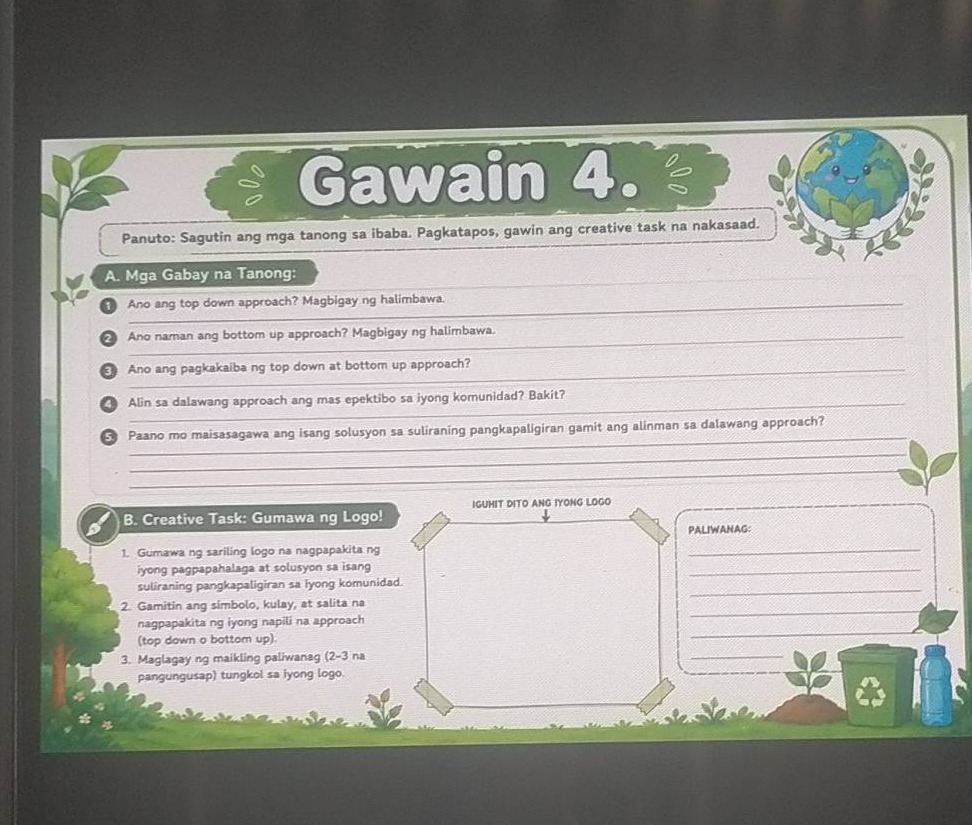
gawain 4.
panuto: sagutin ang mga tanong sa ibaba. pagkatapos, gawin ang creative task na nakasaad.
a. mga gabay na tanong:
- ano ang top down approach? magbigay ng halimbawa.
- ano naman ang bottom up approach? magbigay ng halimbawa.
- ano ang pagkakaiba ng top down at bottom up approach?
- alin sa dalawang approach ang mas epektibo sa iyong komunidad? bakit?
- paano mo maisasagawa ang isang solusyon sa suliraning pangkapaligiran gamit ang alinman sa dalawang approach?
b. creative task: gumawa ng logo!
- gumawa ng sariling logo na nagpapakita ng iyong pagpapahalaga at solusyon sa isang suliraning pangkapaligiran sa iyong komunidad.
- gamitin ang simbolo, kulay, at salita na nagpapakita ng iyong napili na approach (top down o bottom up).
- maglagay ng maikling paliwanag (2-3 na pangungusap) tungkol sa iyong logo.
🆕 New Concept Discovered: Disaster Risk Reduction and Management (DRRM) Approaches
How communities plan for and respond to disasters using different levels of authority.
---
Step 1: Understanding the Top-Down Approach (Question 1)
The Top-Down Approach in disaster management refers to a planning and decision-making process that originates from higher levels of authority (such as national government agencies, leaders, or experts) and is passed down to the local communities.
- What this means: The leaders make the plans, set the policies, and tell the citizens what to do.
- Example: The national government (like NDRRMC in the Philippines) issues a mandatory evacuation order and deploys national military forces to assist a local province before a typhoon hits.
---
Step 2: Understanding the Bottom-Up Approach (Question 2)
The Bottom-Up Approach begins at the grassroots level. It involves local community members, barangay officials, and local organizations identifying their own vulnerabilities, needs, and solutions, which are then integrated into higher-level planning.
- What this means: The people living in the community are the ones who identify the problems and suggest solutions because they know their area best.
- Example: A local barangay organizes its own community-based flood monitoring system using local volunteers and recycled materials to warn residents of rising river levels.
---
Step 3: Comparing the Two Approaches (Question 3)
The main differences lie in who makes the decisions and how information flows:
| Feature | Top-Down Approach | Bottom-Up Approach |
|---|---|---|
| Direction of Flow | From top to bottom (Command and Control) | From bottom to top (Participatory) |
| Strength | Fast mobilization of large resources and standardized plans | Highly customized to local needs; empowers citizens |
| Weakness | May overlook specific, unique needs of local communities | May lack large-scale funding or technical expertise |
---
Step 4: Evaluating Effectiveness in Your Community (Question 4)
For most local communities, a combination of both (an integrated approach) is the most effective, but if you must choose one as a primary driver, the Bottom-Up Approach is often highly effective for daily community resilience.
- Why: Local residents are the first responders during a disaster. They know who the vulnerable members are (such as the elderly or disabled) and which streets flood first. However, it needs to be supported by the Top-Down resources (funding, heavy equipment, and national warning systems) to be fully successful.
---
Step 5: Implementing a Solution for an Environmental Issue (Question 5)
Let us take the environmental issue of improper waste management (solid waste) in a community as an example:
- Using a Bottom-Up Approach:
- Community members hold a barangay assembly to discuss the garbage problem.
- They agree to establish a community-led composting program and a materials recovery facility (MRF).
- Volunteers monitor compliance per household.
- Using a Top-Down Approach:
- The municipal government passes an ordinance banning single-use plastics.
- Local police and sanitary inspectors enforce fines on violators.
- The government provides official garbage trucks to collect segregated waste on scheduled days.
---
Step 6: Creative Task - Logo Design and Explanation (Part…

Snap & solve any problem in the app
Get step-by-step solutions on Sovi AI
Photo-based solutions with guided steps
Explore more problems and detailed explanations
A. Mga Gabay na Tanong:
- Top-Down Approach: Ito ay ang sistema kung saan ang pagpaplano, pagpapasya, at pagpapatupad ng mga hakbang sa pagtugon sa kalamidad ay nagmumula sa pambansang pamahalaan o matataas na pinuno pababa sa mga lokal na komunidad.
- Halimbawa: Ang pagpapatupad ng pambansang pamahalaan ng mandatory evacuation bago manalasa ang isang malakas na bagyo.
- Bottom-Up Approach: Ito ay ang proseso kung saan ang pagpaplano at paglutas sa mga suliranin ay nagmumula sa mismong mga mamamayan at lokal na pamunuan ng barangay dahil sila ang higit na nakakaalam ng pangangailangan ng kanilang lugar.
- Halimbawa: Ang pagbuo ng mga mamamayan ng sarili nilang "community disaster response team" at pagtukoy sa mga ligtas na evacuation center sa kanilang barangay.
- Pagkakaiba: Ang Top-Down ay nagmumula sa itaas (pamahalaan) patungo sa ibaba (mamamayan), kung saan ang desisyon ay sentralisado. Ang Bottom-Up naman ay nagmumula sa ibaba (mamamayan) patungo sa itaas (pamahalaan), na nagbibigay-diin sa partisipasyon ng komunidad.
- Mas Epektibo: Ang Bottom-Up Approach na sinusuportahan ng Top-Down ay mas epektibo. Mas epektibo ang Bottom-Up dahil ang mga lokal na mamamayan ang unang nakararanas ng epekto ng kalamidad at sila ang unang makatutugon dito gamit ang kanilang sariling kaalaman sa kanilang lugar.
- Pagsasagawa ng Solusyon: Sa suliranin ng basura, magagamit ang Bottom-Up Approach sa pamamagitan ng pag-oorganisa ng mga mamamayan ng isang "Community Clean-up Drive" at paggawa ng sariling compost pit sa bawat bakuran upang mabawasan ang basurang itinatapon.
---
B. Creative Task (Paliwanag para sa iguguhit na Logo):
(Iguhit sa kahon ang dalawang kamay na may hawak na sumisibol na halaman na may background ng mundo)
Paliwanag:
Ang logo na ito ay nagpapakita ng Bottom-Up Approach sa pamamagitan ng mga kamay na nagtutulungang mag-alaga sa halaman at sa mundo. Ipinapakita nito na ang solusyon sa suliraning pangkapaligiran ay nagsisimula sa pagkakaisa ng mga mamamayan sa komunidad. Ang kulay berde at asul ay sumisimbolo sa malinis at ligtas na kalikasan na ating makakamit kung tayo ay magtutulungan.