QUESTION IMAGE
Question
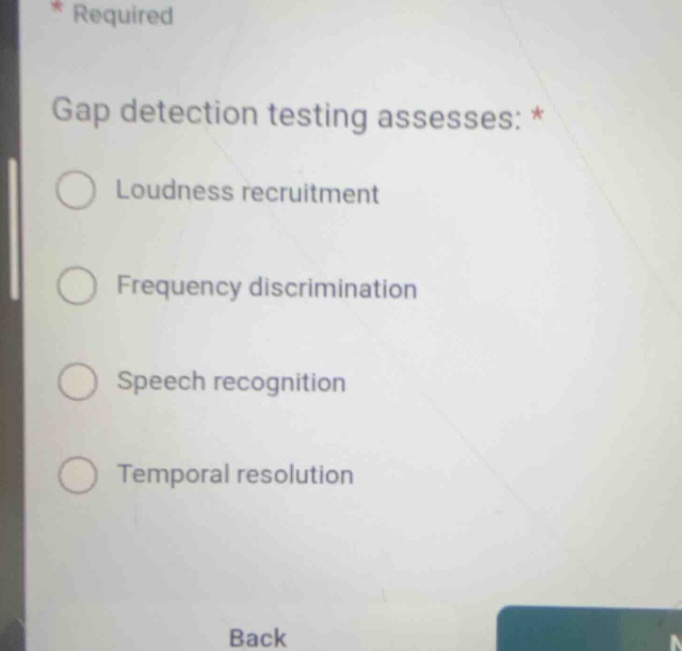
gap detection testing assesses: *
loudness recruitment
frequency discrimination
speech recognition
temporal resolution
<pre_analysis>
{
"quality": "clear",
"question_count": 1,
"skills_matched": [
"direct_cot",
"multiple_choice_formatter",
"explain_then_answer",
"tutor"
],
"needs_drawing": false,
"concepts_used": [],
"new_concepts": [
"Gap Detection Testing",
"Temporal Resolution"
],
"current_concepts": [
"Gap Detection Testing",
"Temporal Resolution",
"Auditory Processing"
]
}
</pre_analysis>
<reasoning>
Define gap detection testing
Gap detection testing is a psychoacoustic measure used to evaluate the auditory system's ability to detect a brief silent interval (the "gap") between two acoustic stimuli. The shortest gap duration that a listener can reliably detect is known as the gap detection threshold.
Relate gap detection to auditory processing domains
Auditory processing can be categorized into different domains:
- Loudness recruitment refers to an abnormal rapid growth of loudness perception, typically associated with cochlear hearing loss.
- Frequency discrimination is the ability to detect differences in pitch or frequency between sounds.
- Speech recognition is the ability to identify and understand spoken words.
- Temporal resolution (or temporal processing) is the auditory system's ability to perceive rapid changes in acoustic signals over time, such as detecting brief silent intervals.
Identify the correct assessment domain
Because gap detection testing specifically measures the precision of the auditory system in the time domain (detecting a brief pause in a continuous sound), it directly assesses temporal resolution.
</reasoning>
<answer>
<mcq-option>(A) Loudness recruitment</mcq-option>
<mcq-option>(B) Frequency discrimination</mcq-option>
<mcq-option>(C) Speech recognition</mcq-option>
<mcq-correct>(D) Temporal resolution</mcq-correct>
</answer>
<post_analysis>
{
"subject": "Natural Science",
"question_type": "Multiple Choice",
"knowledge_point": [
"Natural Science",
"Audiology",
"Temporal Resolution"
]
}
</post_analysis>
Snap & solve any problem in the app
Get step-by-step solutions on Sovi AI
Photo-based solutions with guided steps
Explore more problems and detailed explanations
<pre_analysis>
{
"quality": "clear",
"question_count": 1,
"skills_matched": [
"direct_cot",
"multiple_choice_formatter",
"explain_then_answer",
"tutor"
],
"needs_drawing": false,
"concepts_used": [],
"new_concepts": [
"Gap Detection Testing",
"Temporal Resolution"
],
"current_concepts": [
"Gap Detection Testing",
"Temporal Resolution",
"Auditory Processing"
]
}
</pre_analysis>
<reasoning>
Define gap detection testing
Gap detection testing is a psychoacoustic measure used to evaluate the auditory system's ability to detect a brief silent interval (the "gap") between two acoustic stimuli. The shortest gap duration that a listener can reliably detect is known as the gap detection threshold.
Relate gap detection to auditory processing domains
Auditory processing can be categorized into different domains:
- Loudness recruitment refers to an abnormal rapid growth of loudness perception, typically associated with cochlear hearing loss.
- Frequency discrimination is the ability to detect differences in pitch or frequency between sounds.
- Speech recognition is the ability to identify and understand spoken words.
- Temporal resolution (or temporal processing) is the auditory system's ability to perceive rapid changes in acoustic signals over time, such as detecting brief silent intervals.
Identify the correct assessment domain
Because gap detection testing specifically measures the precision of the auditory system in the time domain (detecting a brief pause in a continuous sound), it directly assesses temporal resolution.
</reasoning>
<answer>
<mcq-option>(A) Loudness recruitment</mcq-option>
<mcq-option>(B) Frequency discrimination</mcq-option>
<mcq-option>(C) Speech recognition</mcq-option>
<mcq-correct>(D) Temporal resolution</mcq-correct>
</answer>
<post_analysis>
{
"subject": "Natural Science",
"question_type": "Multiple Choice",
"knowledge_point": [
"Natural Science",
"Audiology",
"Temporal Resolution"
]
}
</post_analysis>