QUESTION IMAGE
Question
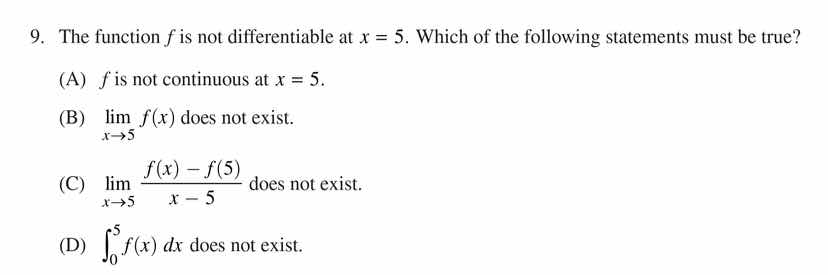
- the function (f) is not differentiable at (x = 5). which of the following statements must be true?
(a) (f) is not continuous at (x = 5).
(b) (\lim_{x \to 5} f(x)) does not exist.
(c) (\lim_{x \to 5} \frac{f(x) - f(5)}{x - 5}) does not exist.
(d) (\int_{0}^{5} f(x) \\, dx) does not exist.
Analyze the definition of differentiability
Using the Differentiability Definition knowledge point
Since \(f\) is not differentiable at \(x = 5\), this limit does not exist.
Analyze the relationship between differentiability and continuity
Using the Differentiability and Continuity knowledge point
The contrapositive is:
However, a function can be continuous but not differentiable (e.g., \(f(x) = |x-5|\) at \(x=5\)). Thus, \(f\) does not have to be discontinuous, and the limit \(\lim_{x \to 5} f(x)\) can exist.
Evaluate the remaining options
Using the Differentiability and Continuity knowledge point
- For (A): \(f(x) = |x-5|\) is continuous at \(x=5\) but not differentiable. Thus, (A) is not necessarily true.
- For (B): For \(f(x) = |x-5|\), \(\lim_{x \to 5} f(x) = 0\), which exists. Thus, (B) is not necessarily true.
- For (D): For \(f(x) = |x-5|\), the integral \(\int_0^5 |x-5| \, dx\) exists and equals \(12.5\). Thus, (D) is not necessarily true.
- For (C): This is the exact definition of the derivative at \(x=5\). Since \(f\) is not differentiable, this limit must not exist.

Snap & solve any problem in the app
Get step-by-step solutions on Sovi AI
Photo-based solutions with guided steps
Explore more problems and detailed explanations
- (A) \(f\) is not continuous at \(x = 5\).
- (B) \(\lim_{x \to 5} f(x)\) does not exist.
- (C) \(\lim_{x \to 5} \frac{f(x) - f(5)}{x - 5}\) does not exist. (Correct answer)
- (D) \(\int_{0}^{5} f(x) \, dx\) does not exist.