QUESTION IMAGE
Question
the fourth amendment
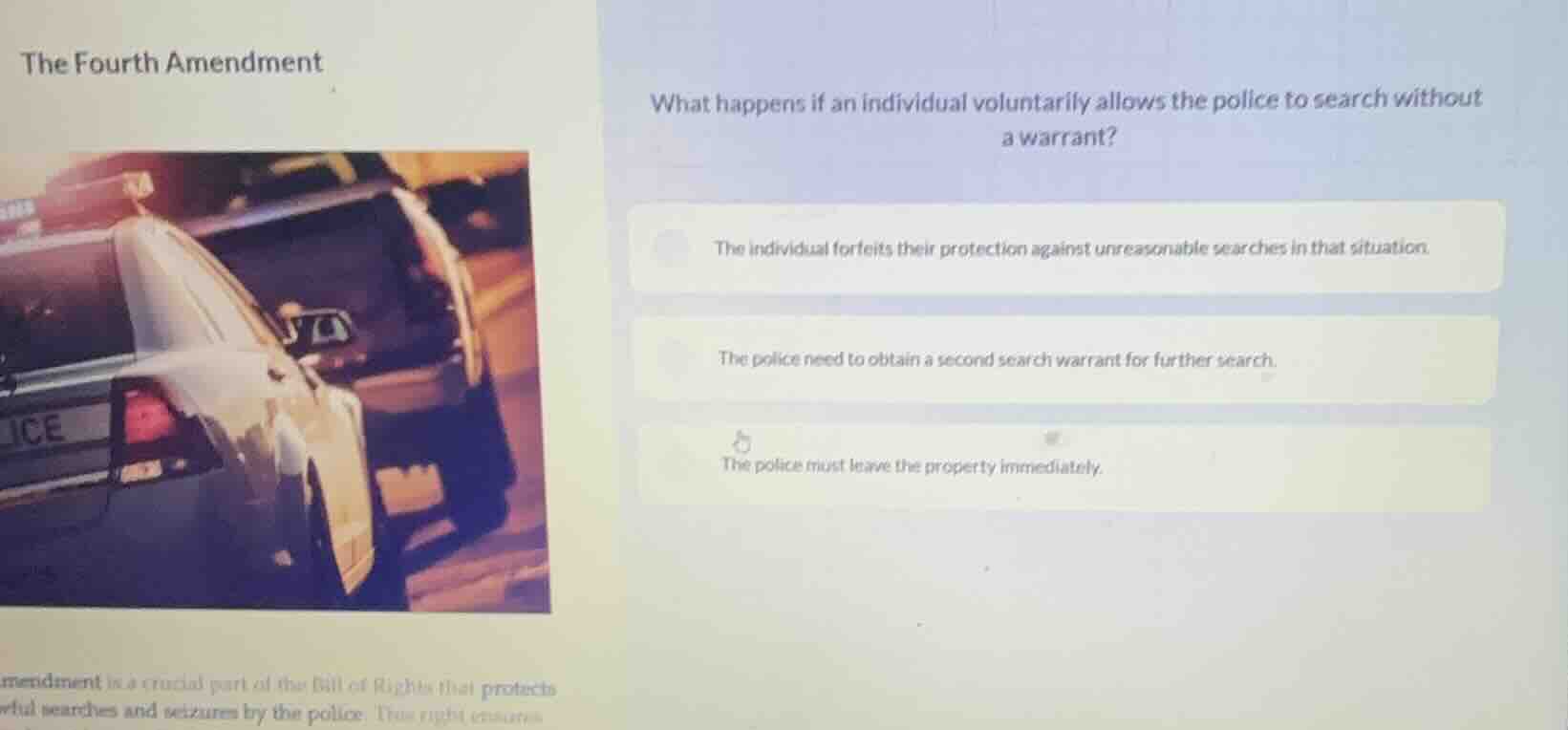
what happens if an individual voluntarily allows the police to search without a warrant?
- the individual forfeits their protection against unreasonable searches in that situation.
- the police need to obtain a second search warrant for further search.
- the police must leave the property immediately.
Analyze the Fourth Amendment context
Using the Fourth Amendment Rights knowledge point, we examine the constitutional protections against unreasonable searches and seizures. Generally, law enforcement officers must obtain a search warrant based on probable cause to conduct a search.
Evaluate the consent exception
Using the Search Warrant Exceptions knowledge point, we identify that voluntary consent is a well-established exception to the warrant requirement. When an individual voluntarily allows the police to search, a warrant is no longer legally required for that specific search.
Determine the legal consequence
By voluntarily consenting to a search, the individual waives their constitutional protection for that specific instance. Therefore, the individual forfeits their protection against unreasonable searches in that situation.

Snap & solve any problem in the app
Get step-by-step solutions on Sovi AI
Photo-based solutions with guided steps
Explore more problems and detailed explanations
- The individual forfeits their protection against unreasonable searches in that situation. (Correct answer)
- The police need to obtain a second search warrant for further search.
- The police must leave the property immediately.