QUESTION IMAGE
Question
four relations are shown below. click on the tabs to see them.
relation 1 relation 2 relation 3 relation 4
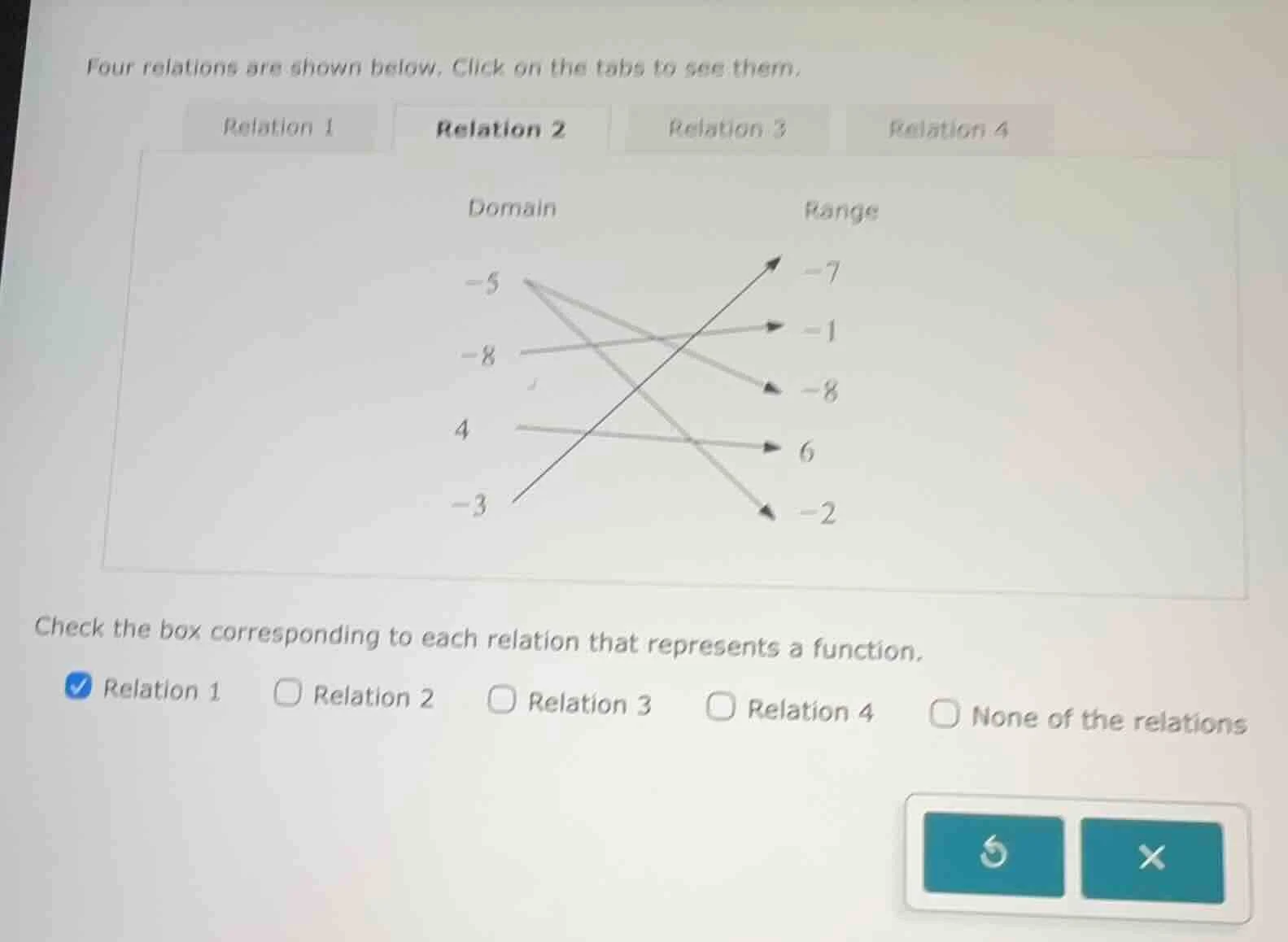
image of relation 2s mapping diagram
check the box corresponding to each relation that represents a function.
☑️ relation 1 ☐ relation 2 ☐ relation 3 ☐ relation 4 ☐ none of the relations
Step1: Recall the definition of a function
A relation is a function if each element in the domain is paired with exactly one element in the range.
Step2: Analyze Relation 2
- Domain elements: \(-5\), \(-8\), \(4\), \(-3\)
- For \(-5\): It is paired with \(-1\), \(-8\), \(-2\) (multiple range values). So, \(-5\) has more than one range value. Thus, Relation 2 is not a function. Wait, but maybe we need to check other relations too. Wait, the original check has Relation 1 checked, but let's re - evaluate. Wait, maybe the user made a mistake in the initial check. Wait, no, let's re - do. Wait, the problem is about Relation 2. Wait, the domain elements: \(-5\) (from domain) is connected to \(-1\), \(-8\), \(-2\) (three range elements). \(-8\) is connected to \(-1\) (one), \(4\) is connected to \(6\) (one), \(-3\) is connected to \(-7\) (one). But since \(-5\) has multiple range values, Relation 2 is not a function. Wait, but maybe the question is to check which relations are functions. Wait, the initial check in the image has Relation 1 checked, but maybe that's incorrect. Wait, no, let's start over.
Wait, the definition of a function: each input (domain) has exactly one output (range). So for a relation represented by a mapping diagram, we check if any domain element has more than one arrow (i.e., more than one range element).
For Relation 2 (the one in the diagram):
- Domain element \(-5\): has arrows to \(-1\), \(-8\), \(-2\) (three range elements) → so \(-5\) is mapped to multiple range values.
- Domain element \(-8\): has an arrow to \(-1\) (one range element)
- Domain element \(4\): has an arrow to \(6\) (one range element)
- Domain element \(-3\): has an arrow to \(-7\) (one range element)
Since at least one domain element (\(-5\)) is mapped to more than one range element, Relation 2 is not a function. But maybe the other relations (1,3,4) need to be checked. But the user's question is about the relations, and the initial check in the image has Relation 1 checked, but maybe that's wrong. Wait, perhaps the user made a mistake in the initial check. But according to the function definition, a relation is a function if each domain element has exactly one range element.
Wait, maybe the original problem's Relation 1 (not shown here) is a function, but for Relation 2, since \(-5\) has multiple outputs, it's not a function. So the correct answer for Relation 2 is that it is not a function. But the question is to check the box for each relation that represents a function. So Relation 2 is not a function, so its box should not be checked.

Snap & solve any problem in the app
Get step-by-step solutions on Sovi AI
Photo-based solutions with guided steps
Explore more problems and detailed explanations
The box for Relation 2 should not be checked (since it is not a function as the domain element \(-5\) is paired with multiple range elements). If we consider the options, the correct answer is that Relation 2 is not a function, so the box for Relation 2 remains unchecked.