QUESTION IMAGE
Question
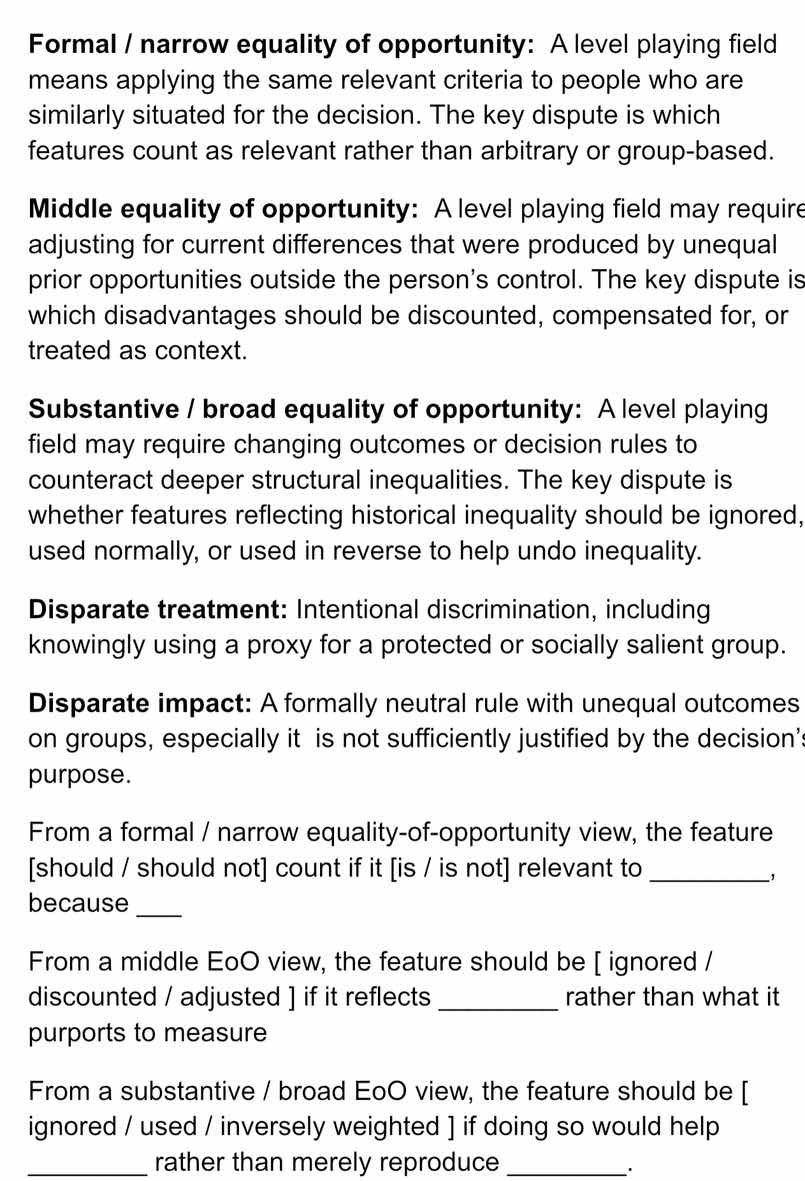
formal / narrow equality of opportunity: a level playing field means applying the same relevant criteria to people who are similarly situated for the decision. the key dispute is which features count as relevant rather than arbitrary or group-based.
middle equality of opportunity: a level playing field may require adjusting for current differences that were produced by unequal prior opportunities outside the persons control. the key dispute is which disadvantages should be discounted, compensated for, or treated as context.
substantive / broad equality of opportunity: a level playing field may require changing outcomes or decision rules to counteract deeper structural inequalities. the key dispute is whether features reflecting historical inequality should be ignored, used normally, or used in reverse to help undo inequality.
disparate treatment: intentional discrimination, including knowingly using a proxy for a protected or socially salient group.
disparate impact: a formally neutral rule with unequal outcomes on groups, especially it is not sufficiently justified by the decisions purpose.
from a formal / narrow equality-of-opportunity view, the feature should / should not count if it is / is not relevant to ______, because _
from a middle eoo view, the feature should be ignored / discounted / adjusted if it reflects ________ rather than what it purports to measure
from a substantive / broad eoo view, the feature should be ignored / used / inversely weighted if doing so would help ______ rather than merely reproduce ______.
Analyze formal equality of opportunity
The text defines formal/narrow equality of opportunity (EoO) as applying the same relevant criteria to similarly situated people. The key dispute is which features count as relevant rather than arbitrary or group-based. Thus, from this view, a feature should count if it is relevant to the decision, because it ensures decisions are based on merit rather than arbitrary factors.
Analyze middle equality of opportunity
The text defines middle EoO as adjusting for differences produced by unequal prior opportunities outside a person's control. The key dispute is which disadvantages should be discounted, compensated for, or treated as context. Thus, from this view, a feature should be discounted or adjusted if it reflects unequal prior opportunities (or structural disadvantages outside control) rather than what it purports to measure (such as actual potential or merit).
Analyze substantive equality of opportunity
The text defines substantive/broad EoO as changing outcomes or decision rules to counteract deeper structural inequalities. The key dispute is whether features reflecting historical inequality should be ignored, used normally, or used in reverse. Thus, from this view, a feature should be ignored, used, or inversely weighted if doing so would help undo inequality rather than merely reproduce historical inequality (or structural disadvantage).

Snap & solve any problem in the app
Get step-by-step solutions on Sovi AI
Photo-based solutions with guided steps
Explore more problems and detailed explanations
Question 1
From a formal / narrow equality-of-opportunity view, the feature <blank>should</blank> count if it <blank>is</blank> relevant to <blank>the decision</blank>, because <blank>it ensures decisions are based on merit rather than arbitrary or group-based factors</blank>.
Question 2
From a middle EoO view, the feature should be <blank>discounted / adjusted</blank> if it reflects <blank>unequal prior opportunities</blank> rather than what it purports to measure.
Question 3
From a substantive / broad EoO view, the feature should be <blank>ignored / used / inversely weighted</blank> if doing so would help <blank>undo inequality</blank> rather than merely reproduce <blank>historical inequality</blank>.