QUESTION IMAGE
Question
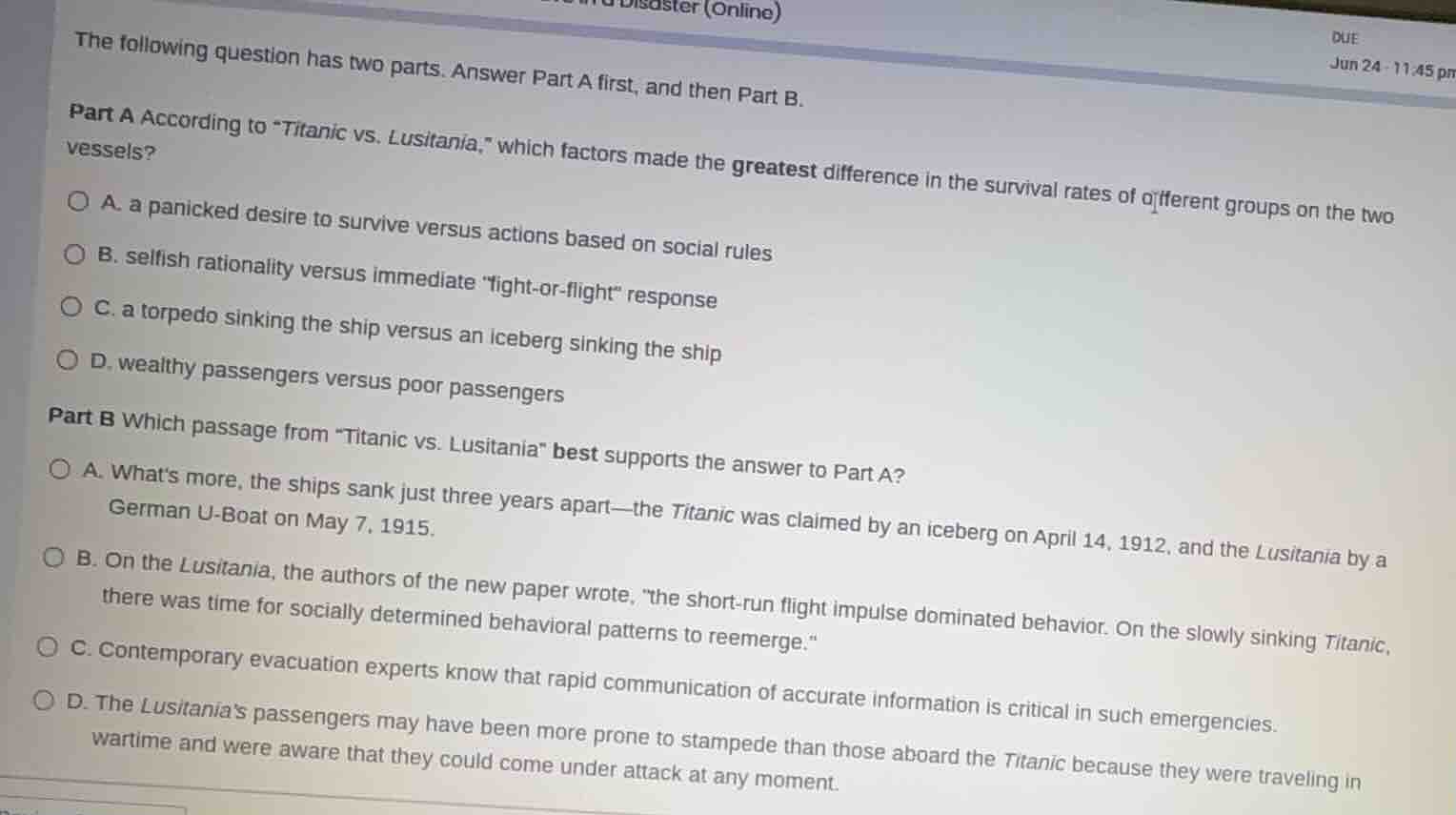
the following question has two parts. answer part a first, and then part b.
part a according to \titanic vs. lusitania,\ which factors made the greatest difference in the survival rates of different groups on the two vessels?
a. a panicked desire to survive versus actions based on social rules
b. selfish rationality versus immediate \fight-or-flight\ response
c. a torpedo sinking the ship versus an iceberg sinking the ship
d. wealthy passengers versus poor passengers
part b which passage from \titanic vs. lusitania\ best supports the answer to part a?
a. whats more, the ships sank just three years apart-the titanic was claimed by an iceberg on april 14, 1912, and the lusitania by a german u-boat on may 7, 1915.
b. on the lusitania, the authors of the new paper wrote, \the short-run flight impulse dominated behavior. on the slowly sinking titanic, there was time for socially determined behavioral patterns to reemerge.\
c. contemporary evacuation experts know that rapid communication of accurate information is critical in such emergencies.
d. the lusitanias passengers may have been more prone to stampede than those aboard the titanic because they were traveling in wartime and were aware that they could come under attack at any moment.
Analyze Part A
The question asks which factors made the greatest difference in survival rates of different groups on the Titanic and Lusitania. The text compares the rapid sinking of the Lusitania (where "flight impulse" dominated) with the slow sinking of the Titanic (where "socially determined behavioral patterns" or social rules had time to reemerge). This corresponds to option A: "a panicked desire to survive versus actions based on social rules."
Analyze Part B
We need the passage that best supports the answer to Part A. Option B directly contrasts the behavior on the two ships: on the Lusitania, the "short-run flight impulse dominated behavior," whereas on the slowly sinking Titanic, "there was time for socially determined behavioral patterns to reemerge." This directly supports the contrast between panicked survival instincts and social rules.

Snap & solve any problem in the app
Get step-by-step solutions on Sovi AI
Photo-based solutions with guided steps
Explore more problems and detailed explanations
Question 1
- A. a panicked desire to survive versus actions based on social rules (Correct answer)
- B. selfish rationality versus immediate "fight-or-flight" response
- C. a torpedo sinking the ship versus an iceberg sinking the ship
- D. wealthy passengers versus poor passengers
Question 2
- A. What's more, the ships sank just three years apart—the Titanic was claimed by an iceberg on April 14, 1912, and the Lusitania by a German U-Boat on May 7, 1915.
- B. On the Lusitania, the authors of the new paper wrote, "the short-run flight impulse dominated behavior. On the slowly sinking Titanic, there was time for socially determined behavioral patterns to reemerge." (Correct answer)
- C. Contemporary evacuation experts know that rapid communication of accurate information is critical in such emergencies.
- D. The Lusitania's passengers may have been more prone to stampede than those aboard the Titanic because they were traveling in wartime and were aware that they could come under attack at any moment.