QUESTION IMAGE
Question
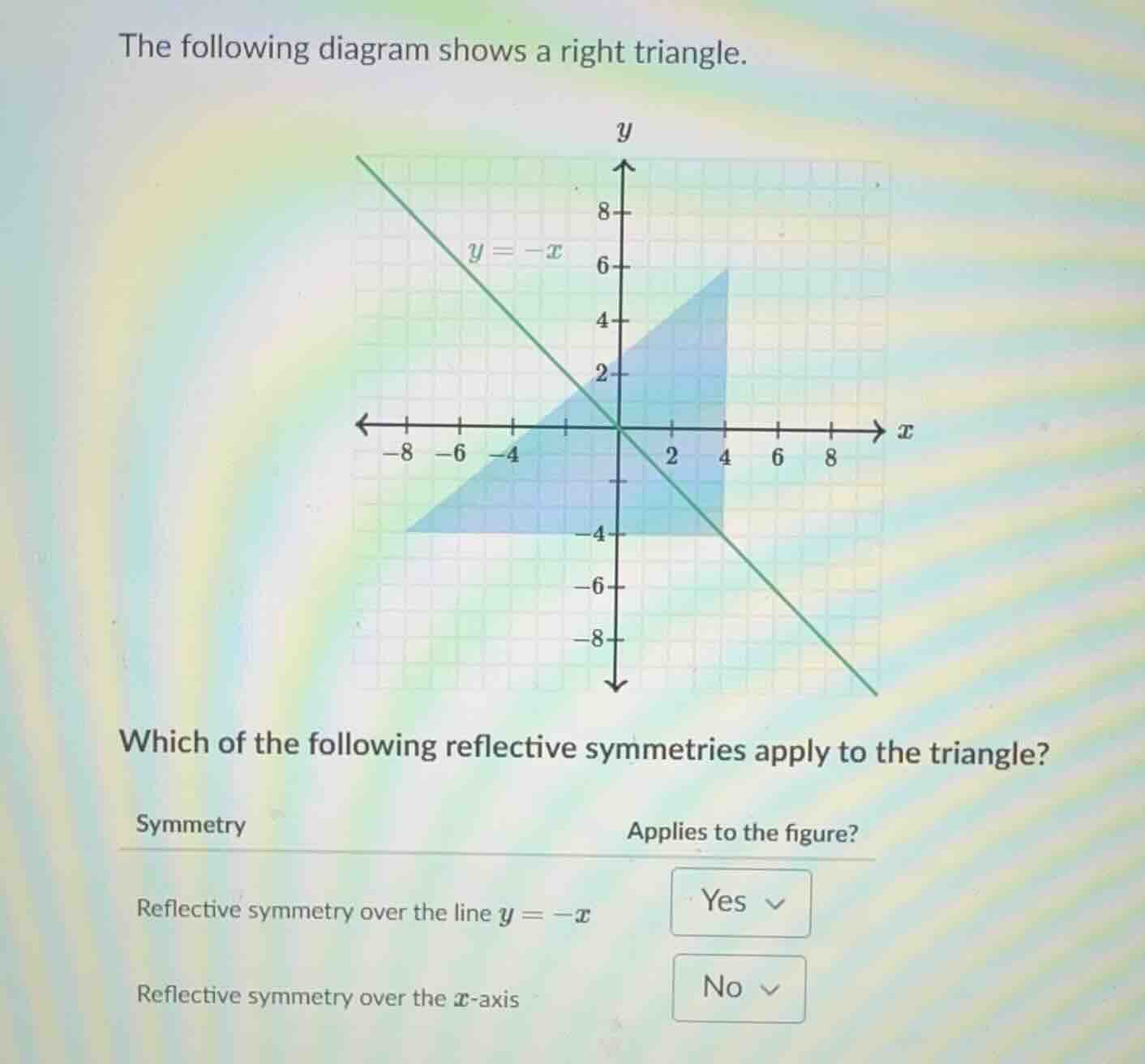
the following diagram shows a right triangle.
which of the following reflective symmetries apply to the triangle?
symmetry | applies to the figure?
reflective symmetry over the line \\(y = -x\\) | yes/no
reflective symmetry over the \\(x\\)-axis | yes/no
<pre_analysis>
{
"quality": "clear",
"question_count": 2,
"skills_matched": [
"step_cot",
"explain_then_answer",
"tutor"
],
"needs_drawing": false,
"concepts_used": [
"Geometric Transformations",
"Definition of Reflection",
"Reflective Symmetry"
],
"new_concepts": [],
"current_concepts": [
"Geometric Transformations",
"Definition of Reflection",
"Reflective Symmetry"
]
}
</pre_analysis>
<reasoning>
Identify the vertices of the triangle
We first locate the coordinates of the three vertices of the right triangle shown in the grid:
- The top-right vertex is at \( (4, 6) \).
- The bottom-right vertex is at \( (4, -4) \).
- The bottom-left vertex is at \( (-5, -4) \).
Using the Geometric Transformations concept, we can analyze how these points behave under reflections.
Test reflective symmetry over the line \( y = -x \)
Using the Definition of Reflection, the rule for reflecting a point \( (x, y) \) over the line \( y = -x \) is:
\[ (x, y) \to (-y, -x) \]
Let's apply this rule to each vertex of our triangle:
- For \( (4, 6) \): the reflection is \( (-6, -4) \). However, our third vertex is at \( (-5, -4) \), not \( (-6, -4) \).
- For \( (4, -4) \): the reflection is \( (-(-4), -4) = (4, -4) \), which lies on the line \( y = -x \) and maps to itself.
- For \( (-5, -4) \): the reflection is \( (-(-4), -(-5)) = (4, 5) \), which is not a vertex of the triangle (the vertex is at \( (4, 6) \)).
Since the reflected vertices do not map exactly onto the original vertices, the figure does not have Reflective Symmetry over the line \( y = -x \).
Test reflective symmetry over the x-axis
The rule for reflecting a point \( (x, y) \) over the \( x \)-axis is:
\[ (x, y) \to (x, -y) \]
Let's apply this rule to the vertices:
- For \( (4, 6) \): the reflection is \( (4, -6) \). This point is not a vertex of the triangle (the bottom-right vertex is at \( (4, -4) \)).
- For \( (4, -4) \): the reflection is \( (4, 4) \), which is not a vertex of the triangle.
- For \( (-5, -4) \): the reflection is \( (-5, 4) \), which is not a vertex of the triangle.
Since the reflected points do not map onto the original triangle, the figure does not have Reflective Symmetry over the \( x \)-axis.
</reasoning>
<answer>
Question 1
Reflective symmetry over the line \( y = -x \): No
Question 2
Reflective symmetry over the \( x \)-axis: No
</answer>
<post_analysis>
{
"subject": "Mathematics",
"question_type": "Multi-part",
"knowledge_point": [
"Mathematics",
"Geometry",
"Reflective Symmetry"
]
}
</post_analysis>
Snap & solve any problem in the app
Get step-by-step solutions on Sovi AI
Photo-based solutions with guided steps
Explore more problems and detailed explanations
<pre_analysis>
{
"quality": "clear",
"question_count": 2,
"skills_matched": [
"step_cot",
"explain_then_answer",
"tutor"
],
"needs_drawing": false,
"concepts_used": [
"Geometric Transformations",
"Definition of Reflection",
"Reflective Symmetry"
],
"new_concepts": [],
"current_concepts": [
"Geometric Transformations",
"Definition of Reflection",
"Reflective Symmetry"
]
}
</pre_analysis>
<reasoning>
Identify the vertices of the triangle
We first locate the coordinates of the three vertices of the right triangle shown in the grid:
- The top-right vertex is at \( (4, 6) \).
- The bottom-right vertex is at \( (4, -4) \).
- The bottom-left vertex is at \( (-5, -4) \).
Using the Geometric Transformations concept, we can analyze how these points behave under reflections.
Test reflective symmetry over the line \( y = -x \)
Using the Definition of Reflection, the rule for reflecting a point \( (x, y) \) over the line \( y = -x \) is:
\[ (x, y) \to (-y, -x) \]
Let's apply this rule to each vertex of our triangle:
- For \( (4, 6) \): the reflection is \( (-6, -4) \). However, our third vertex is at \( (-5, -4) \), not \( (-6, -4) \).
- For \( (4, -4) \): the reflection is \( (-(-4), -4) = (4, -4) \), which lies on the line \( y = -x \) and maps to itself.
- For \( (-5, -4) \): the reflection is \( (-(-4), -(-5)) = (4, 5) \), which is not a vertex of the triangle (the vertex is at \( (4, 6) \)).
Since the reflected vertices do not map exactly onto the original vertices, the figure does not have Reflective Symmetry over the line \( y = -x \).
Test reflective symmetry over the x-axis
The rule for reflecting a point \( (x, y) \) over the \( x \)-axis is:
\[ (x, y) \to (x, -y) \]
Let's apply this rule to the vertices:
- For \( (4, 6) \): the reflection is \( (4, -6) \). This point is not a vertex of the triangle (the bottom-right vertex is at \( (4, -4) \)).
- For \( (4, -4) \): the reflection is \( (4, 4) \), which is not a vertex of the triangle.
- For \( (-5, -4) \): the reflection is \( (-5, 4) \), which is not a vertex of the triangle.
Since the reflected points do not map onto the original triangle, the figure does not have Reflective Symmetry over the \( x \)-axis.
</reasoning>
<answer>
Question 1
Reflective symmetry over the line \( y = -x \): No
Question 2
Reflective symmetry over the \( x \)-axis: No
</answer>
<post_analysis>
{
"subject": "Mathematics",
"question_type": "Multi-part",
"knowledge_point": [
"Mathematics",
"Geometry",
"Reflective Symmetry"
]
}
</post_analysis>