Sovi.AI - AI Math Tutor

Scan to solve math questions

QUESTION IMAGE

follow the steps to find the area of the shaded region. the height (h) …

Question

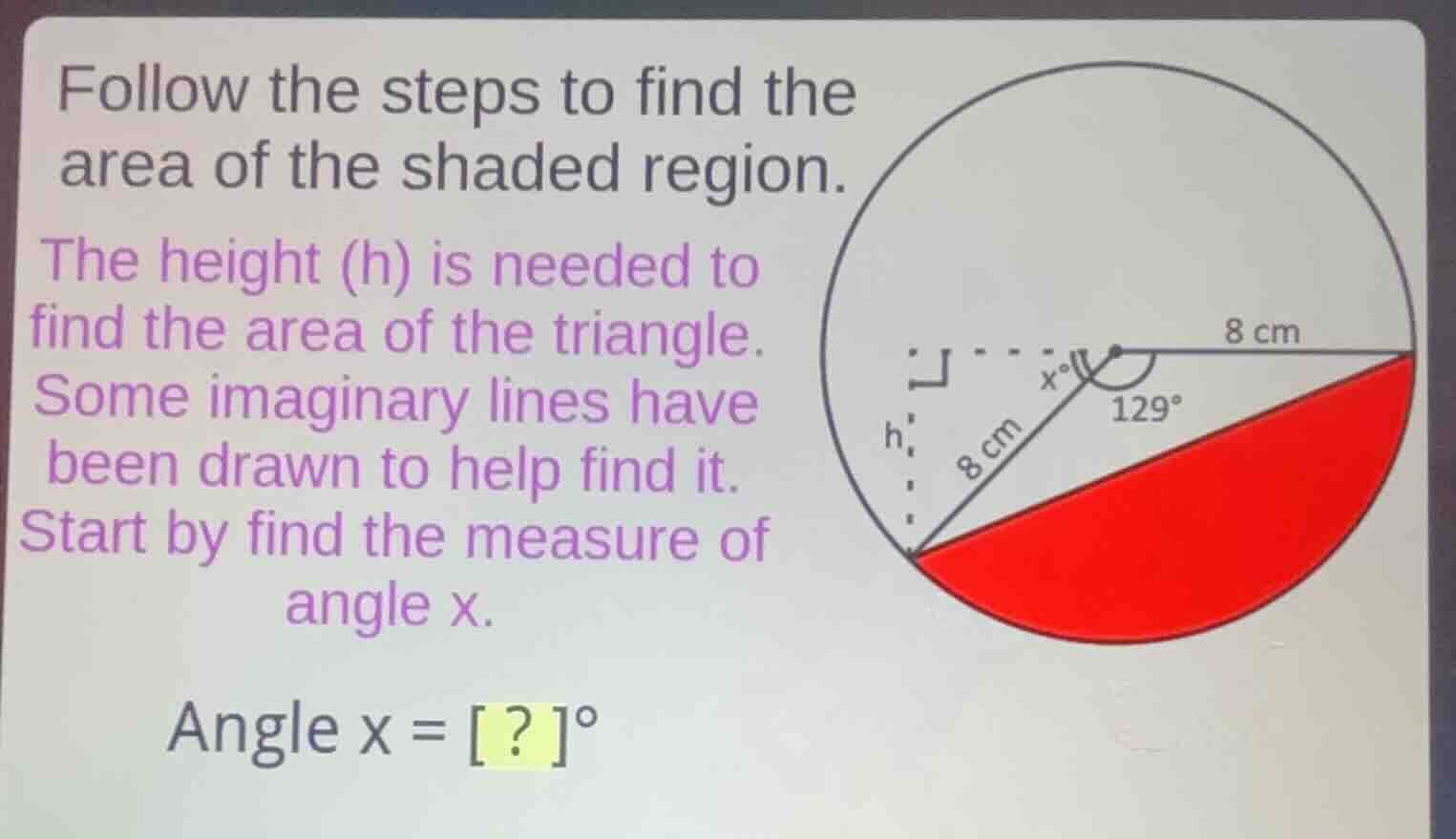
follow the steps to find the area of the shaded region.

the height (h) is needed to find the area of the triangle. some imaginary lines have been drawn to help find it. start by find the measure of angle x.

angle x = ? °

Explanation:

Response

<pre_analysis>
{
"quality": "clear",
"question_count": 1,
"skills_matched": [
"step_cot",
"blank_filling_formatter",
"explain_then_answer",
"tutor"
],
"needs_drawing": false,
"concepts_used": [],
"new_concepts": [
"Supplementary Angles",
"Linear Pair Postulate"
],
"current_concepts": [
"Supplementary Angles",
"Linear Pair Postulate"
]
}
</pre_analysis>

<reasoning>

Identify the geometric relationship

The angle \(x^\circ\) and the given angle \(129^\circ\) lie on a straight line, forming a linear pair.

Apply the linear pair postulate

Since angles on a straight line are supplementary, their measures add up to \(180^\circ\).
\[
x^\circ + 129^\circ = 180^\circ
\]

Solve for the unknown angle

Subtract \(129^\circ\) from both sides to find the value of \(x\).
\[
x = 180 - 129 = 51
\]
</reasoning>

<answer>
Follow the steps to find the area of the shaded region.
The height (h) is needed to find the area of the triangle.
Some imaginary lines have been drawn to help find it.
Start by find the measure of angle x.

Angle x = <blank>51</blank>\(^\circ\)
</answer>

<post_analysis>
{
"subject": "Mathematics",
"question_type": "Fill-in-the-blank",
"knowledge_point": [
"Mathematics",
"Geometry",
"Supplementary Angles"
]
}
</post_analysis>

Answer:

<pre_analysis>
{
"quality": "clear",
"question_count": 1,
"skills_matched": [
"step_cot",
"blank_filling_formatter",
"explain_then_answer",
"tutor"
],
"needs_drawing": false,
"concepts_used": [],
"new_concepts": [
"Supplementary Angles",
"Linear Pair Postulate"
],
"current_concepts": [
"Supplementary Angles",
"Linear Pair Postulate"
]
}
</pre_analysis>

<reasoning>

Identify the geometric relationship

The angle \(x^\circ\) and the given angle \(129^\circ\) lie on a straight line, forming a linear pair.

Apply the linear pair postulate

Since angles on a straight line are supplementary, their measures add up to \(180^\circ\).
\[
x^\circ + 129^\circ = 180^\circ
\]

Solve for the unknown angle

Subtract \(129^\circ\) from both sides to find the value of \(x\).
\[
x = 180 - 129 = 51
\]
</reasoning>

<answer>
Follow the steps to find the area of the shaded region.
The height (h) is needed to find the area of the triangle.
Some imaginary lines have been drawn to help find it.
Start by find the measure of angle x.

Angle x = <blank>51</blank>\(^\circ\)
</answer>

<post_analysis>
{
"subject": "Mathematics",
"question_type": "Fill-in-the-blank",
"knowledge_point": [
"Mathematics",
"Geometry",
"Supplementary Angles"
]
}
</post_analysis>