QUESTION IMAGE
Question
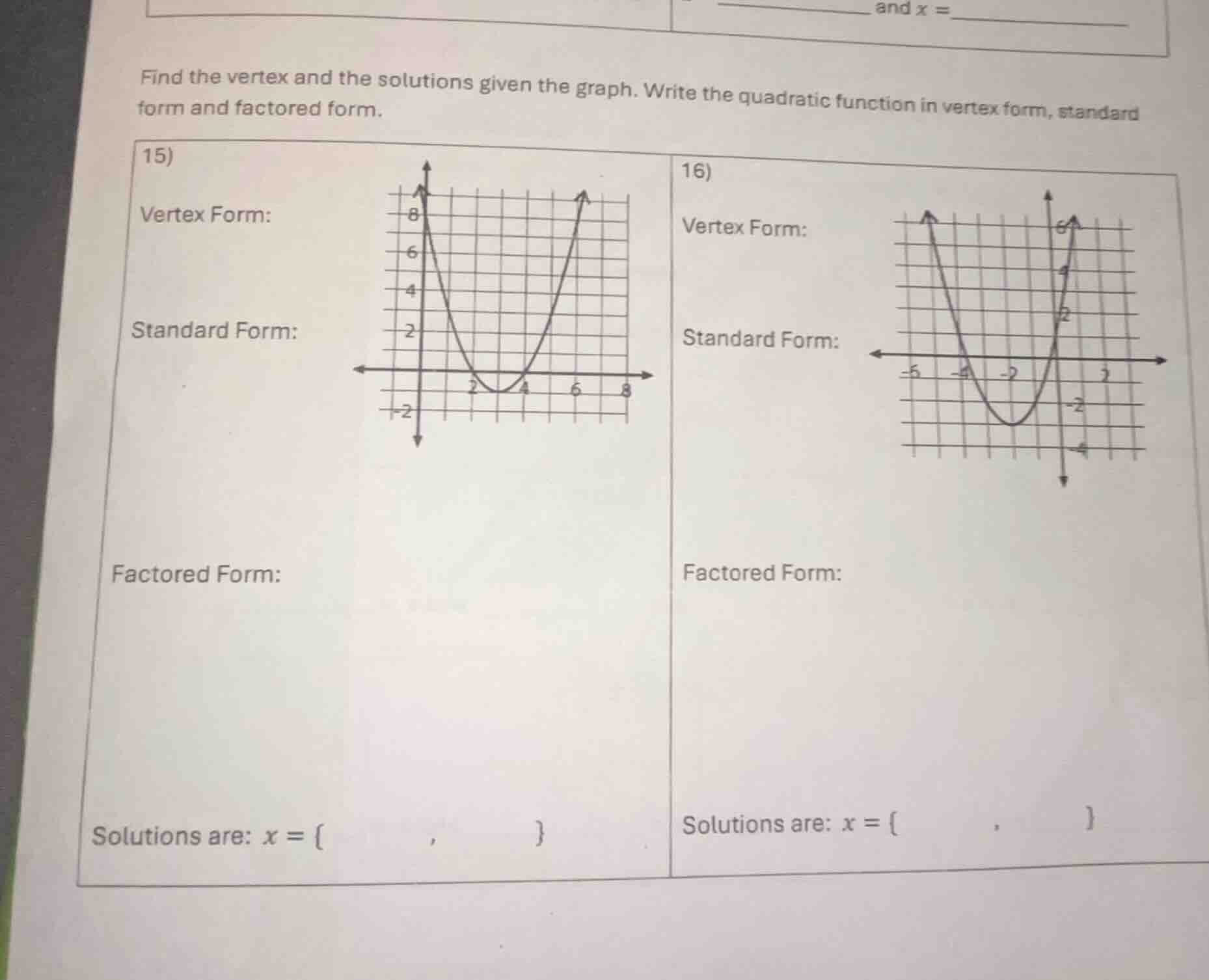
find the vertex and the solutions given the graph. write the quadratic function in vertex form, standard form and factored form.
15)
vertex form:
standard form:
factored form:
solutions are: ( x = { quad, quad } )
16)
vertex form:
standard form:
factored form:
solutions are: ( x = { quad, quad } )
Problem 15
Step1: Identify the vertex
The vertex of a parabola is the minimum or maximum point. From the graph, the vertex is at \((3, -1)\) (midpoint of \(x = 2\) and \(x = 4\), and \(y=-1\)). The vertex form of a quadratic is \(y = a(x - h)^2 + k\), where \((h,k)\) is the vertex. So \(h = 3\), \(k=-1\), so \(y = a(x - 3)^2 - 1\).
Step2: Find \(a\) using the y-intercept
The y-intercept is \((0, 8)\). Plug \(x = 0\), \(y = 8\) into vertex form:
\(8 = a(0 - 3)^2 - 1\)
\(8 = 9a - 1\)
\(9a = 9\)
\(a = 1\)
Step3: Vertex Form
Now that \(a = 1\), \(h = 3\), \(k=-1\), vertex form is \(y=(x - 3)^2 - 1\).
Step4: Standard Form (expand vertex form)
Expand \((x - 3)^2 - 1\):
\((x^2 - 6x + 9) - 1 = x^2 - 6x + 8\). So standard form is \(y = x^2 - 6x + 8\).
Step5: Factored Form (factor standard form)
Factor \(x^2 - 6x + 8\):
\(x^2 - 6x + 8 = (x - 2)(x - 4)\) (since \(-2 \times -4 = 8\) and \(-2 + -4 = -6\)).
Step6: Solutions (x-intercepts)
The solutions are the x-intercepts, which are \(x = 2\) and \(x = 4\) (from the graph, where the parabola crosses the x-axis).
Step1: Identify the vertex
The vertex is at \((-2, -3)\) (from the graph, the minimum point). Vertex form: \(y = a(x - h)^2 + k\), so \(h=-2\), \(k = -3\), so \(y = a(x + 2)^2 - 3\).
Step2: Find \(a\) using the y-intercept
The y-intercept is \((0, 1)\). Plug \(x = 0\), \(y = 1\) into vertex form:
\(1 = a(0 + 2)^2 - 3\)
\(1 = 4a - 3\)
\(4a = 4\)
\(a = 1\)
Step3: Vertex Form
With \(a = 1\), \(h=-2\), \(k=-3\), vertex form is \(y=(x + 2)^2 - 3\).
Step4: Standard Form (expand vertex form)
Expand \((x + 2)^2 - 3\):
\((x^2 + 4x + 4) - 3 = x^2 + 4x + 1\)? Wait, no, wait the y-intercept in the graph looks like (0,1)? Wait, no, looking at the graph, the parabola crosses the y-axis at (0,1)? Wait, no, maybe I misread. Wait the graph for 16: x-intercepts at \(x = -4\) and \(x = 0\)? Wait, no, let's re-examine. Wait the graph for 16: the parabola crosses the x-axis at \(x = -4\) and \(x = 0\)? Wait, no, the vertex is at \((-2, -3)\), and it crosses the x-axis at \(x = -4\) and \(x = 0\)? Wait, maybe my initial y-intercept was wrong. Let's correct.
Wait, let's start over for 16. The vertex is \((-2, -3)\), so vertex form \(y = a(x + 2)^2 - 3\). The x-intercepts are \(x = -4\) and \(x = 0\) (from the graph: it crosses x-axis at -4 and 0). So the factored form is \(y = a(x + 4)(x - 0) = a x(x + 4)\). Now, use the vertex \((-2, -3)\) to find \(a\). Plug \(x = -2\), \(y = -3\) into factored form:
\(-3 = a(-2)(-2 + 4)\)
\(-3 = a(-2)(2)\)
\(-3 = -4a\)
\(a = \frac{3}{4}\)? Wait, no, maybe the y-intercept is (0,0)? Wait, the graph shows the parabola crossing the y-axis at (0,0)? Wait, the original graph for 16: the parabola has vertex at (-2, -3), crosses x-axis at -4 and 0, and y-axis at 0. So let's use factored form first. Factored form: roots at \(x = -4\) and \(x = 0\), so \(y = a(x + 4)x\). Vertex is at \(x = -2\) (midpoint of -4 and 0). Plug \(x = -2\) into factored form: \(y = a(-2 + 4)(-2) = a(2)(-2) = -4a\). The vertex y-coordinate is -3, so \(-4a = -3\) → \(a = \frac{3}{4}\). Wait, but maybe the graph is scaled? Wait, maybe I made a mistake earlier. Let's check the grid. The graph for 16: each grid square is 1 unit. The vertex is at (-2, -3), x-intercepts at -4 and 0, y-intercept at 0. So let's do it properly.
Alternative approach: vertex form \(y = a(x + 2)^2 - 3\). The parabola passes through (0, 0) (since it crosses y-axis at 0). Plug x=0, y=0:
\(0 = a(0 + 2)^2 - 3\)
\(0 = 4a - 3\)
\(4a = 3\)
\(a = \frac{3}{4}\). So vertex form is \(y = \frac{3}{4}(x + 2)^2 - 3\).
Standard form: expand \(\frac{3}{4}(x^2 + 4x + 4) - 3 = \frac{3}{4}x^2 + 3x + 3 - 3 = \frac{3}{4}x^2 + 3x\).
Factored form: \(y = \frac{3}{4}x(x + 4)\) (since roots at 0 and -4).
Solutions: x-intercepts are \(x = -4\) and \(x = 0\).
Wait, maybe the original graph for 16 has vertex at (-2, -3), and when x=0, y=0 (since it crosses y-axis at 0). So let's redo:
Step1 (Problem 16): Identify vertex and roots
Vertex: \((-2, -3)\), roots (solutions) at \(x = -4\) and \(x = 0\).
Step2: Factored Form
Factored form: \(y = a(x + 4)(x - 0) = a x(x + 4)\).
Step3: Find \(a\) using vertex
Vertex is at \(x = -2\), so plug \(x = -2\) into factored form:
\(y = a(-2)(-2 + 4) = a(-2)(2) = -4a\). The vertex y is -3, so \(-4a = -3\) → \(a = \frac{3}{4}\). So factored form: \(y = \frac{3}{4}x(x + 4)\).
Step4: Vertex Form
From factored form, or from vertex: \(y = \frac{3}{4}(x + 2)^2 - 3\) (since \(h = -2\), \(k = -3\), \(a = \frac{3}{4}\)).
Step5: Standard Form (expand vertex form)
Expand \(\frac{3}{4}(x + 2)^2 - 3\):
\(\frac{3}{4}(x^2 + 4x + 4) - 3 = \frac{3}{4}x^…

Snap & solve any problem in the app
Get step-by-step solutions on Sovi AI
Photo-based solutions with guided steps
Explore more problems and detailed explanations
Vertex Form: \(y=(x - 3)^2 - 1\)
Standard Form: \(y = x^2 - 6x + 8\)
Factored Form: \(y=(x - 2)(x - 4)\)
Solutions are: \(x=\{2, 4\}\)