QUESTION IMAGE
Question
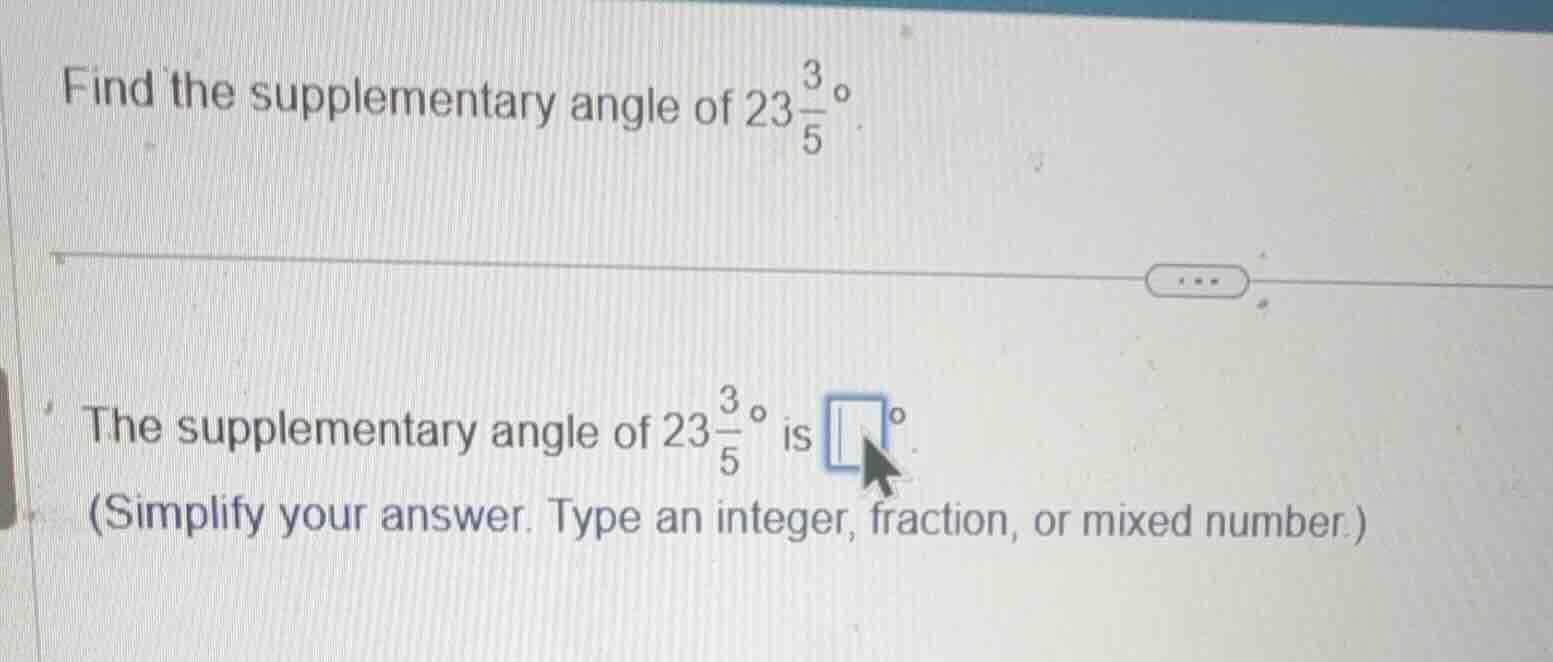
find the supplementary angle of \\(23\frac{3}{5}^{\circ}\\).
the supplementary angle of \\(23\frac{3}{5}^{\circ}\\) is \\(\box^{\circ}\\).
(simplify your answer. type an integer, fraction, or mixed number.)
<pre_analysis>
{
"quality": "clear",
"question_count": 1,
"skills_matched": [
"step_cot",
"blank_filling_formatter",
"explain_then_answer",
"tutor"
],
"needs_drawing": false,
"concepts_used": [
"Supplementary Angles"
],
"new_concepts": [],
"current_concepts": [
"Supplementary Angles"
]
}
</pre_analysis>
<reasoning>
Define supplementary angles
Two angles are supplementary if their sum is exactly \(180^\circ\). Using the Supplementary Angles concept, if we have a given angle \(\theta\), its supplementary angle \(S\) is calculated by subtracting \(\theta\) from \(180^\circ\):
\[S = 180^\circ - \theta\]
Set up the subtraction
The given angle is \(\theta = 23\frac{3}{5}^\circ\). We need to find:
\[S = 180 - 23\frac{3}{5}\]
Perform the calculation
To subtract the mixed number from the integer, we can rewrite \(180\) as \(179\frac{5}{5}\):
\[S = 179\frac{5}{5} - 23\frac{3}{5}\]
Subtract the whole numbers and the fractions separately:
\[179 - 23 = 156\]
\[\frac{5}{5} - \frac{3}{5} = \frac{2}{5}\]
Combining these gives:
\[S = 156\frac{2}{5}\]
</reasoning>
<answer>
The supplementary angle of \(23\frac{3}{5}^\circ\) is <blank>\(156\frac{2}{5}\)</blank>\(^\circ\).
</answer>
<post_analysis>
{
"subject": "Mathematics",
"question_type": "Fill-in-the-blank",
"knowledge_point": [
"Mathematics",
"Geometry",
"Supplementary Angles"
]
}
</post_analysis>
Snap & solve any problem in the app
Get step-by-step solutions on Sovi AI
Photo-based solutions with guided steps
Explore more problems and detailed explanations
<pre_analysis>
{
"quality": "clear",
"question_count": 1,
"skills_matched": [
"step_cot",
"blank_filling_formatter",
"explain_then_answer",
"tutor"
],
"needs_drawing": false,
"concepts_used": [
"Supplementary Angles"
],
"new_concepts": [],
"current_concepts": [
"Supplementary Angles"
]
}
</pre_analysis>
<reasoning>
Define supplementary angles
Two angles are supplementary if their sum is exactly \(180^\circ\). Using the Supplementary Angles concept, if we have a given angle \(\theta\), its supplementary angle \(S\) is calculated by subtracting \(\theta\) from \(180^\circ\):
\[S = 180^\circ - \theta\]
Set up the subtraction
The given angle is \(\theta = 23\frac{3}{5}^\circ\). We need to find:
\[S = 180 - 23\frac{3}{5}\]
Perform the calculation
To subtract the mixed number from the integer, we can rewrite \(180\) as \(179\frac{5}{5}\):
\[S = 179\frac{5}{5} - 23\frac{3}{5}\]
Subtract the whole numbers and the fractions separately:
\[179 - 23 = 156\]
\[\frac{5}{5} - \frac{3}{5} = \frac{2}{5}\]
Combining these gives:
\[S = 156\frac{2}{5}\]
</reasoning>
<answer>
The supplementary angle of \(23\frac{3}{5}^\circ\) is <blank>\(156\frac{2}{5}\)</blank>\(^\circ\).
</answer>
<post_analysis>
{
"subject": "Mathematics",
"question_type": "Fill-in-the-blank",
"knowledge_point": [
"Mathematics",
"Geometry",
"Supplementary Angles"
]
}
</post_analysis>