QUESTION IMAGE
Question
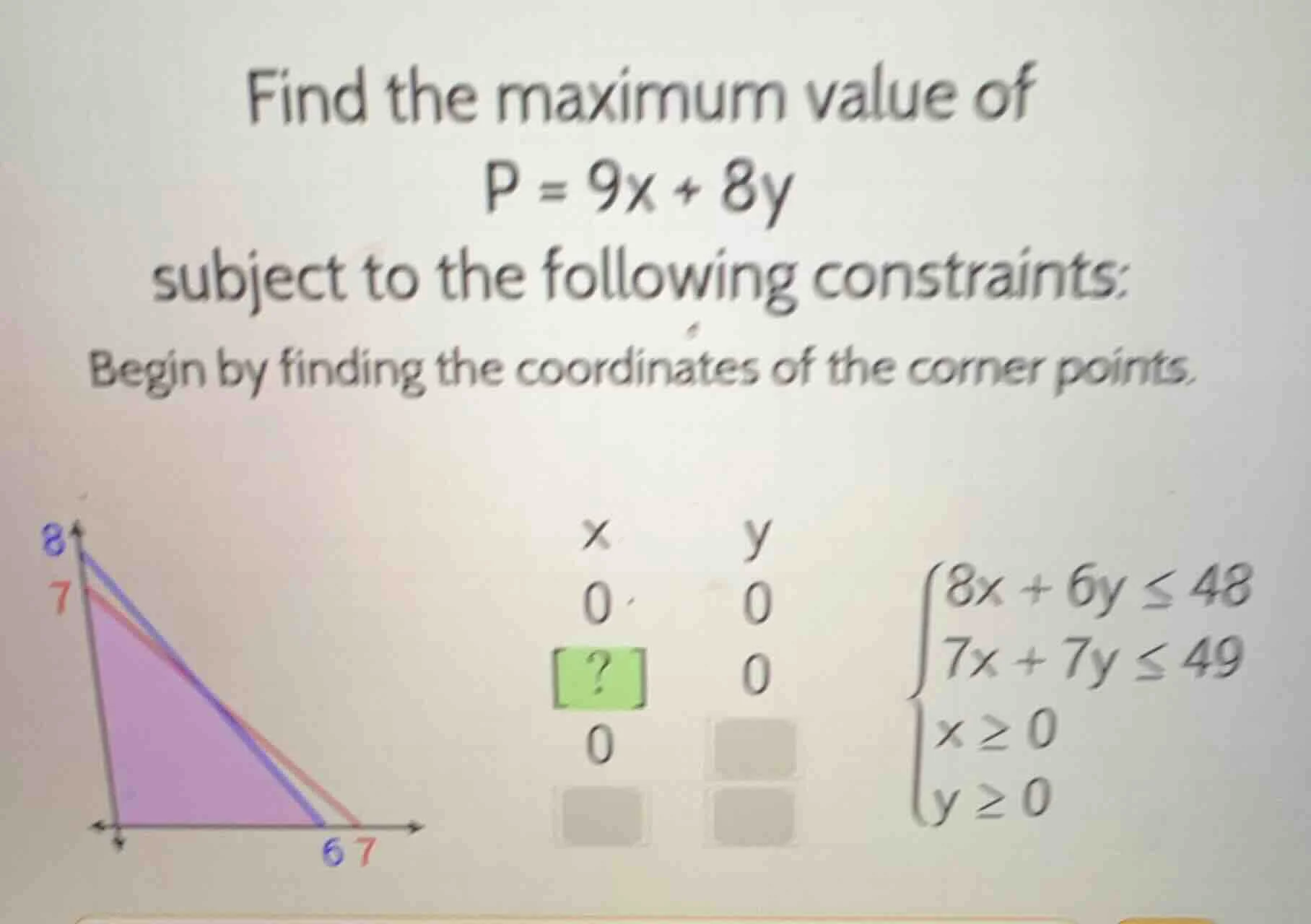
find the maximum value of
p = 9x + 8y
subject to the following constraints:
begin by finding the coordinates of the corner points.
\\(\
\\)
Step1: Find x-intercept of \(8x + 6y \leq 48\) (y=0)
Set \(y = 0\) in \(8x + 6y = 48\), so \(8x = 48\), then \(x=\frac{48}{8}=6\). But wait, also check \(7x + 7y \leq 49\) when \(y = 0\): \(7x=49\Rightarrow x = 7\). But the feasible region is intersection, so for the corner point with \(y = 0\), we take the minimum x from the two constraints? Wait, no, the corner points are where the boundaries intersect or meet axes. Wait, the first corner point with \(y = 0\): let's solve \(8x+6(0)=48\Rightarrow x = 6\), and \(7x+7(0)=49\Rightarrow x = 7\). But the inequality \(8x + 6y \leq 48\) and \(7x + 7y \leq 49\), when \(y = 0\), the more restrictive is \(8x \leq 48\) (x=6) or \(7x \leq 49\) (x=7)? Wait, no, the feasible region is the intersection of all constraints. So \(x \geq 0\), \(y \geq 0\), \(8x + 6y \leq 48\), \(7x + 7y \leq 49\). So when \(y = 0\), \(8x \leq 48\Rightarrow x \leq 6\), and \(7x \leq 49\Rightarrow x \leq 7\). So the intersection is \(x \leq 6\) (since 6 < 7). Wait, but the graph shows x-intercepts at 6 (blue line) and 7 (red line). Wait, maybe the corner points are:
- (0,0)
- Intersection of \(8x + 6y = 48\) and \(x = 0\): \(6y = 48\Rightarrow y = 8\), but check \(7x + 7y = 49\) when \(x=0\): \(7y = 49\Rightarrow y = 7\). So intersection of \(x=0\) with the more restrictive: \(y \leq 7\) (from \(7x + 7y \leq 49\)) and \(y \leq 8\) (from \(8x + 6y \leq 48\)), so \(y = 7\) (0,7).
- Intersection of \(7x + 7y = 49\) (simplify to \(x + y = 7\)) and \(8x + 6y = 48\). Let's solve \(x + y = 7\) (so \(y = 7 - x\)) substitute into \(8x + 6(7 - x)=48\Rightarrow 8x + 42 - 6x = 48\Rightarrow 2x = 6\Rightarrow x = 3\), then \(y = 4\). So (3,4).
- Intersection of \(8x + 6y = 48\) and \(y = 0\): (6,0)
- Intersection of \(7x + 7y = 49\) and \(y = 0\): (7,0) – but wait, is (7,0) in \(8x + 6y \leq 48\)? \(8(7)+0=56>48\), so (7,0) is not in the feasible region. So the corner points are (0,0), (0,7), (3,4), (6,0).
Now, let's list all corner points:
- (0,0): \(P = 9(0) + 8(0) = 0\)
- (0,7): \(P = 9(0) + 8(7) = 56\)
- (3,4): \(P = 9(3) + 8(4) = 27 + 32 = 59\)
- (6,0): \(P = 9(6) + 8(0) = 54\)
Wait, but wait, let's confirm the intersection of \(8x + 6y = 48\) and \(7x + 7y = 49\). Solve \(x + y = 7\) (divided 7x+7y=49 by 7) and \(8x + 6y = 48\). Multiply \(x + y = 7\) by 6: \(6x + 6y = 42\). Subtract from \(8x + 6y = 48\): \(2x = 6\Rightarrow x = 3\), then \(y = 7 - 3 = 4\). Correct.
Now, the corner point with \(y = 0\): when \(y = 0\), the feasible x is from \(8x \leq 48\) (x=6) because \(7x \leq 49\) (x=7) is less restrictive? Wait, no, when \(y = 0\), \(8x + 0 \leq 48\Rightarrow x \leq 6\), and \(7x + 0 \leq 49\Rightarrow x \leq 7\). So the maximum x with \(y = 0\) is 6 (since 6 ≤ 7), so (6,0) is a corner point.
Now, calculate P at each corner:
- (0,0): 0
- (0,7): 56
- (3,4): 27 + 32 = 59
- (6,0): 54
So the maximum P is 59. Wait, but let's check the initial table: the first corner point after (0,0) is (?, 0). Wait, maybe the question first is to find the x-coordinate when y=0. Let's solve for the corner point with y=0: from the constraints, when y=0, the feasible x is the minimum of x from 8x ≤ 48 (x=6) and 7x ≤ 49 (x=7), so x=6? Wait, no, 8x + 6y ≤ 48 when y=0: x ≤ 6; 7x + 7y ≤ 49 when y=0: x ≤ 7. So the intersection is x ≤ 6, so the corner point is (6, 0). So the green box is x=6.
Wait, the problem first asks to find the coordinates of the corner points, starting with (0,0), then (?, 0), then (0,?), then (?,?). So for (?, 0): solve 8x + 6(0) = 48 (since 7x + 7(0)=49 gives x=7, but 8x+6y=48 at y=0 gives x=6, and since 8…

Snap & solve any problem in the app
Get step-by-step solutions on Sovi AI
Photo-based solutions with guided steps
Explore more problems and detailed explanations
The maximum value of \(P\) is \(\boxed{59}\) (and the x-coordinate for \(y=0\) is 6).