QUESTION IMAGE
Question
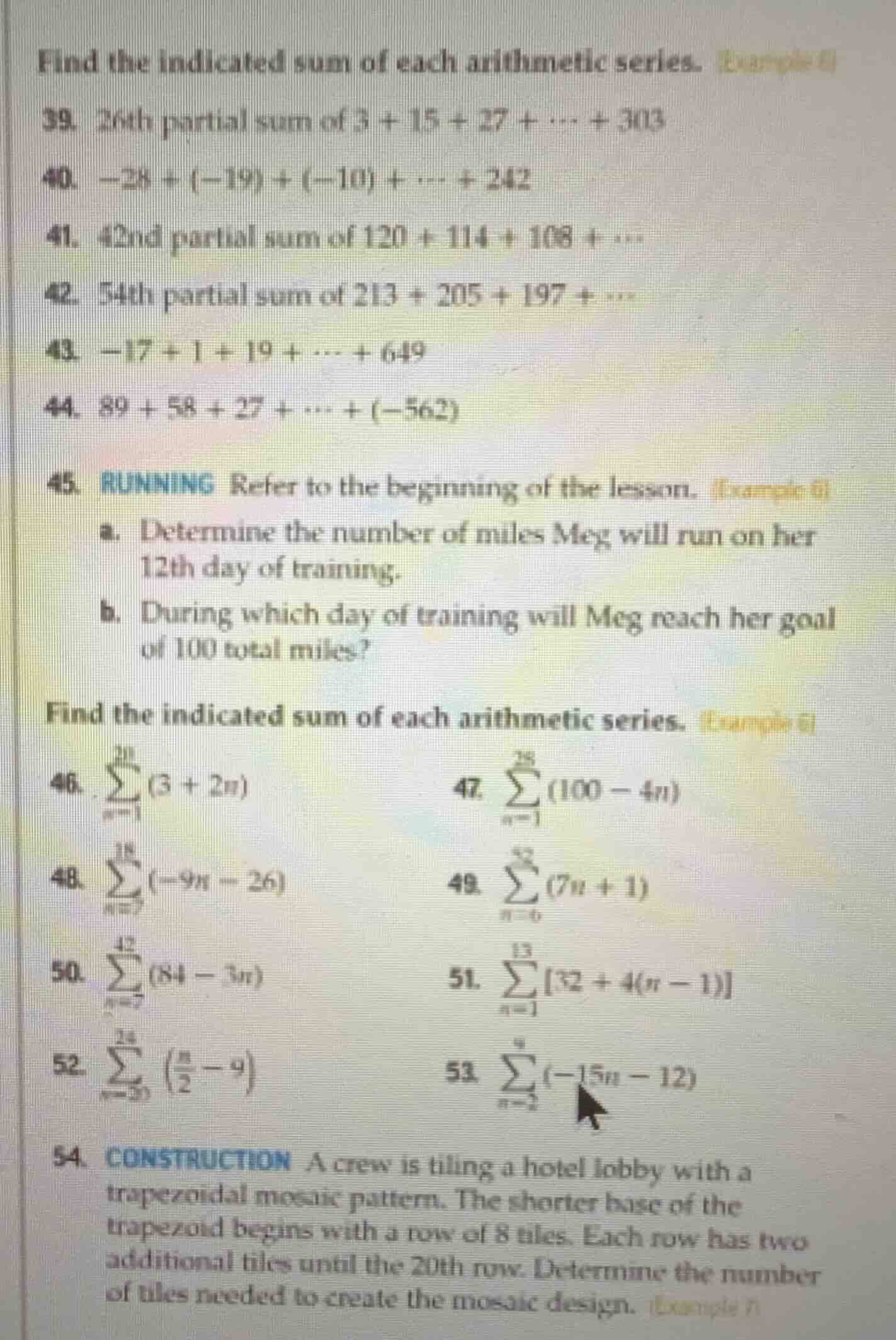
find the indicated sum of each arithmetic series.
- 26th partial sum of \\(3 + 15 + 27 + \dots + 303\\)
- \\(-28 + (-19) + (-10) + \dots + 242\\)
- 42nd partial sum of \\(120 + 114 + 108 + \dots\\)
- 54th partial sum of \\(213 + 205 + 197 + \dots\\)
- \\(-17 + 1 + 19 + \dots + 649\\)
- \\(89 + 58 + 27 + \dots + (-562)\\)
- running refer to the beginning of the lesson.
a. determine the number of miles meg will run on her 12th day of training.
b. during which day of training will meg reach her goal of 100 total miles?
find the indicated sum of each arithmetic series.
- \\(\sum_{n=1}^{20} (3 + 2n)\\)
- \\(\sum_{n=1}^{28} (100 - 4n)\\)
- \\(\sum_{n=1}^{18} (-9n - 26)\\)
- \\(\sum_{n=6}^{32} (7n + 1)\\)
- \\(\sum_{n=1}^{42} (84 - 3n)\\)
- \\(\sum_{n=1}^{13} 32 + 4(n - 1)\\)
- \\(\sum_{n=10}^{24} \left(\frac{n}{2} - 9\
ight)\\)
- \\(\sum_{n=2}^{11} (-15n - 12)\\)
- construction a crew is tiling a hotel lobby with a trapezoidal mosaic pattern. the shorter base of the trapezoid begins with a row of 8 tiles. each row has two additional tiles until the 20th row. determine the number of tiles needed to create the mosaic design.
Find sums for questions 39 to 44
- 39: \(a_1 = 3\), \(d = 12\), \(n = 26\).
$$S_{26} = \frac{26}{2}[2(3) + (26-1)12] = 13[6 + 300] = 3978$$
- 40: \(a_1 = -28\), \(d = 9\), \(a_n = 242\).
$$242 = -28 + (n-1)9 \implies 270 = (n-1)9 \implies n = 31$$
$$S_{31} = \frac{31}{2}(-28 + 242) = \frac{31}{2}(214) = 3317$$
- 41: \(a_1 = 120\), \(d = -6\), \(n = 42\).
$$S_{42} = \frac{42}{2}[2(120) + (42-1)(-6)] = 21[240 - 246] = -126$$
- 42: \(a_1 = 213\), \(d = -8\), \(n = 54\).
$$S_{54} = \frac{54}{2}[2(213) + (54-1)(-8)] = 27[426 - 424] = 54$$
- 43: \(a_1 = -17\), \(d = 18\), \(a_n = 649\).
$$649 = -17 + (n-1)18 \implies 666 = (n-1)18 \implies n = 38$$
$$S_{38} = \frac{38}{2}(-17 + 649) = 19(632) = 12008$$
- 44: \(a_1 = 89\), \(d = -31\), \(a_n = -562\).
$$-562 = 89 + (n-1)(-31) \implies -651 = (n-1)(-31) \implies n = 22$$
$$S_{22} = \frac{22}{2}(89 - 562) = 11(-473) = -5203$$
Solve question 45
- Note: Since the beginning of the lesson is not visible, we solve the remaining explicit math problems 46 to 54.
Find sums for questions 46 to 53
- 46: \(\sum_{n=1}^{20} (3 + 2n)\). \(N = 20\), \(a_1 = 5\), \(a_{20} = 43\).
$$S = \frac{20}{2}(5 + 43) = 480$$
- 47: \(\sum_{n=1}^{28} (100 - 4n)\). \(N = 28\), \(a_1 = 96\), \(a_{28} = -12\).
$$S = \frac{28}{2}(96 - 12) = 14(84) = 1176$$
- 48: \(\sum_{n=1}^{18} (-9n - 26)\). \(N = 18\), \(a_1 = -35\), \(a_{18} = -188\).
$$S = \frac{18}{2}(-35 - 188) = 9(-223) = -2007$$
- 49: \(\sum_{n=6}^{32} (7n + 1)\). \(N = 32 - 6 + 1 = 27\), \(a_6 = 43\), \(a_{32} = 225\).
$$S = \frac{27}{2}(43 + 225) = \frac{27}{2}(268) = 3618$$
- 50: \(\sum_{n=4}^{42} (84 - 3n)\). \(N = 42 - 4 + 1 = 39\), \(a_4 = 72\), \(a_{42} = -42\).
$$S = \frac{39}{2}(72 - 42) = \frac{39}{2}(30) = 585$$
- 51: \(\sum_{n=1}^{13} [32 + 4(n-1)]\). \(N = 13\), \(a_1 = 32\), \(a_{13} = 80\).
$$S = \frac{13}{2}(32 + 80) = \frac{13}{2}(112) = 728$$
- 52: \(\sum_{n=20}^{28} (\frac{n}{2} - 9)\). \(N = 28 - 20 + 1 = 9\), \(a_{20} = 1\), \(a_{28} = 5\).
$$S = \frac{9}{2}(1 + 5) = 27$$
- 53: \(\sum_{n=2}^{9} (-15n - 12)\). \(N = 9 - 2 + 1 = 8\), \(a_2 = -42\), \(a_9 = -147\).
$$S = \frac{8}{2}(-42 - 147) = 4(-189) = -756$$
Solve question 54
- 54: \(a_1 = 8\), \(d = 2\), \(n = 20\).
$$S_{20} = \frac{20}{2}[2(8) + (20-1)2] = 10[16 + 38] = 540$$

Snap & solve any problem in the app
Get step-by-step solutions on Sovi AI
Photo-based solutions with guided steps
Explore more problems and detailed explanations
Question 39
\(3978\)
Question 40
\(3317\)
Question 41
\(-126\)
Question 42
\(54\)
Question 43
\(12008\)
Question 44
\(-5203\)
Question 46
\(480\)
Question 47
\(1176\)
Question 48
\(-2007\)
Question 49
\(3618\)
Question 50
\(585\)
Question 51
\(728\)
Question 52
\(27\)
Question 53
\(-756\)
Question 54
\(540\)