QUESTION IMAGE
Question
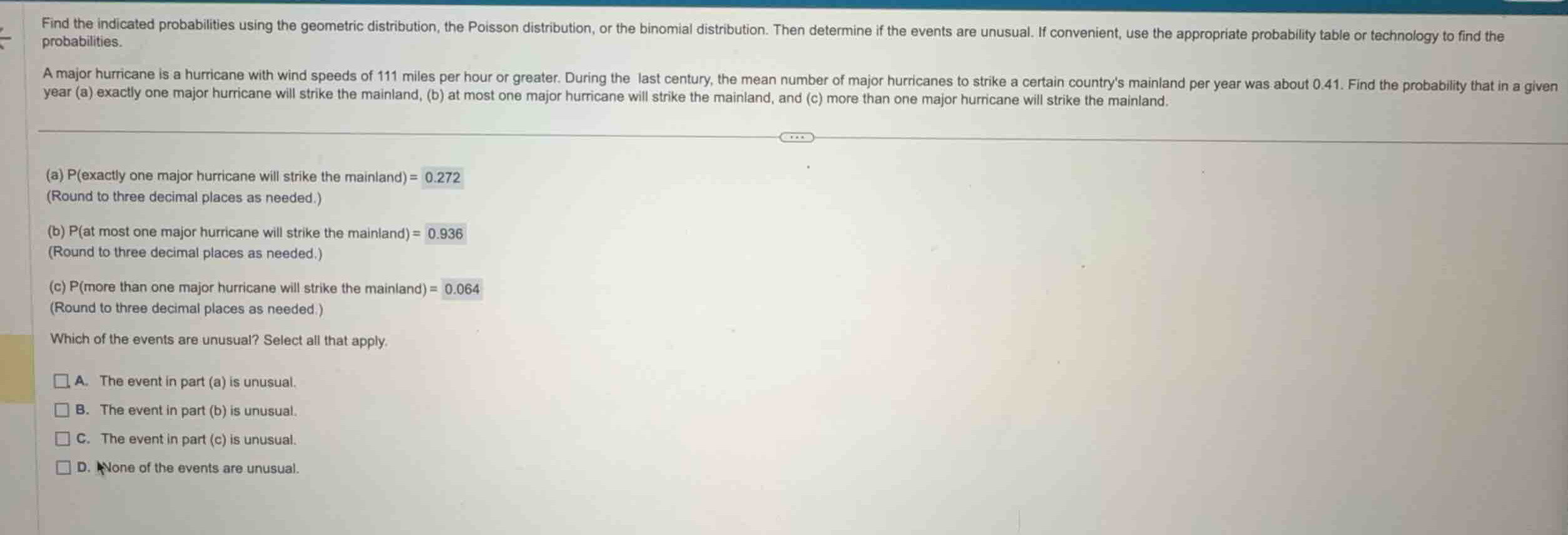
find the indicated probabilities using the geometric distribution, the poisson distribution, or the binomial distribution. then determine if the events are unusual. if convenient, use the appropriate probability table or technology to find the probabilities.
a major hurricane is a hurricane with wind speeds of 111 miles per hour or greater. during the last century, the mean number of major hurricanes to strike a certain countrys mainland per year was about 0.41. find the probability that in a given year (a) exactly one major hurricane will strike the mainland, (b) at most one major hurricane will strike the mainland, and (c) more than one major hurricane will strike the mainland.
(a) p(exactly one major hurricane will strike the mainland) = 0.272
(round to three decimal places as needed.)
(b) p(at most one major hurricane will strike the mainland) = 0.936
(round to three decimal places as needed.)
(c) p(more than one major hurricane will strike the mainland) = 0.064
(round to three decimal places as needed.)
which of the events are unusual? select all that apply.
a. the event in part (a) is unusual.
b. the event in part (b) is unusual.
c. the event in part (c) is unusual.
d. none of the events are unusual.
Identify the threshold for unusual events
An event is typically considered unusual in statistics if its probability is less than or equal to \(0.05\) (or \(5\%\)).
Evaluate the probability of each event
- Part (a): \(P(\text{exactly one}) = 0.272 > 0.05\) (not unusual)
- Part (b): \(P(\text{at most one}) = 0.936 > 0.05\) (not unusual)
- Part (c): \(P(\text{more than one}) = 0.064 > 0.05\) (not unusual)
Determine the correct option
Since all three probabilities are greater than \(0.05\), none of the events are unusual.

Snap & solve any problem in the app
Get step-by-step solutions on Sovi AI
Photo-based solutions with guided steps
Explore more problems and detailed explanations
- A. The event in part (a) is unusual.
- B. The event in part (b) is unusual.
- C. The event in part (c) is unusual.
- D. None of the events are unusual. (Correct answer)