QUESTION IMAGE
Question
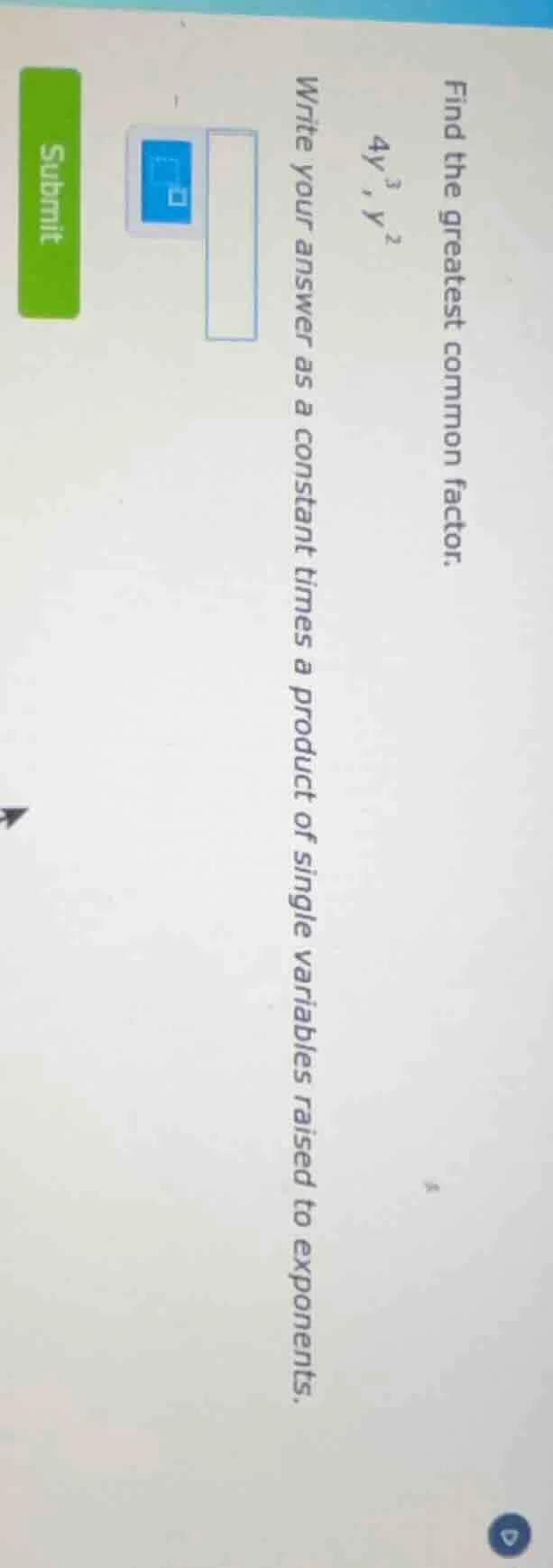
find the greatest common factor.
$4y^{3}$, $y^{2}$
write your answer as a constant times a product of single variables raised to exponents.
Step1: Analyze coefficients
The coefficient of \(4y^3\) is 4, and for \(y^2\) it's 1. The GCF of 4 and 1 is 1.
Step2: Analyze variables
For the variable \(y\), in \(4y^3\) the exponent is 3, in \(y^2\) it's 2. The GCF of exponents 3 and 2 is 2 (since we take the smaller exponent). So the variable part is \(y^2\).
Step3: Combine coefficient and variable
Multiply the GCF of coefficients (1) with the GCF of variables (\(y^2\)). So the GCF is \(1\times y^2 = y^2\). Wait, wait, no, wait. Wait, the first term is \(4y^3\) and the second is \(y^2\). Wait, maybe I made a mistake. Let's redo.
Wait, the two terms are \(4y^3\) and \(y^2\). Let's factor each:
- \(4y^3 = 4\times y\times y\times y\)
- \(y^2 = 1\times y\times y\)
Now, find the common factors. The common numerical factor: the factors of 4 are 1,2,4; factors of 1 are 1. So GCF of 4 and 1 is 1? Wait no, wait, maybe the terms are \(4y^3\) and \(y^2\)? Wait, maybe I misread. Wait, the problem says "Find the greatest common factor. \(4y^3\), \(y^2\)". Wait, no, maybe the first term is \(4y^3\) and the second is \(y^2\)? Wait, no, maybe the first term is \(4y^3\) and the second is \(y^2\)? Wait, let's check again.
Wait, the numerical coefficients: 4 and 1. The GCF of 4 and 1 is 1? No, wait, no. Wait, 4 and 1: the GCF is 1? But 4 and 1 share only 1. But the variable part: \(y^3\) and \(y^2\). The GCF of \(y^3\) (which is \(y\times y\times y\)) and \(y^2\) (which is \(y\times y\)) is \(y^2\) (since we take the lowest power of \(y\) present in both). Then the numerical GCF: 4 and 1. The GCF of 4 and 1 is 1. So the overall GCF is \(1\times y^2 = y^2\)? Wait, but wait, 4y³ and y²: let's see, 4y³ can be written as 4×y×y×y, y² is 1×y×y. The common factors are 1 (from coefficients) and y×y (from variables). So GCF is 1×y² = y². Wait, but wait, is there a numerical factor? Wait, 4 and 1: GCF is 1. So the GCF is y²? Wait, but maybe the first term is 4y³ and the second is y²? Wait, maybe I made a mistake. Wait, no, let's check with another approach. The GCF of two terms \(ax^m\) and \(bx^n\) (where \(a,b\) are coefficients and \(m,n\) are exponents, \(m\geq n\)) is \( \text{GCF}(a,b) \times x^n \). So here, \(a = 4\), \(b = 1\), \(m = 3\), \(n = 2\). GCF(4,1) is 1, so GCF is \(1 \times y^2 = y^2\). Wait, but that seems odd. Wait, maybe the first term is 4y³ and the second is y²? Wait, maybe the problem was written as \(4y^3\) and \(y^2\). So the GCF is \(y^2\)? Wait, but let's check: \(4y^3 \div y^2 = 4y\), and \(y^2 \div y^2 = 1\). So yes, \(y^2\) is a common factor. Is there a greater common factor? Let's see, can we have a numerical factor? The numerical coefficients are 4 and 1. The GCF of 4 and 1 is 1, so we can't have a numerical factor greater than 1. So the GCF is \(y^2\). Wait, but wait, maybe the first term is \(4y^3\) and the second is \(y^2\), so the GCF is \(y^2\). Wait, but let's confirm.
Wait, another way: list the factors of each term.
- Factors of \(4y^3\): 1, 2, 4, y, y², y³, 2y, 2y², 2y³, 4y, 4y², 4y³.
- Factors of \(y^2\): 1, y, y².
The common factors are 1, y, y². The greatest among them is y². So yes, the GCF is y².
Wait, but earlier I thought the numerical GCF was 1, but since the numerical GCF is 1, the overall GCF is 1×y² = y². So that's correct.

Snap & solve any problem in the app
Get step-by-step solutions on Sovi AI
Photo-based solutions with guided steps
Explore more problems and detailed explanations
\(y^2\)