QUESTION IMAGE
Question
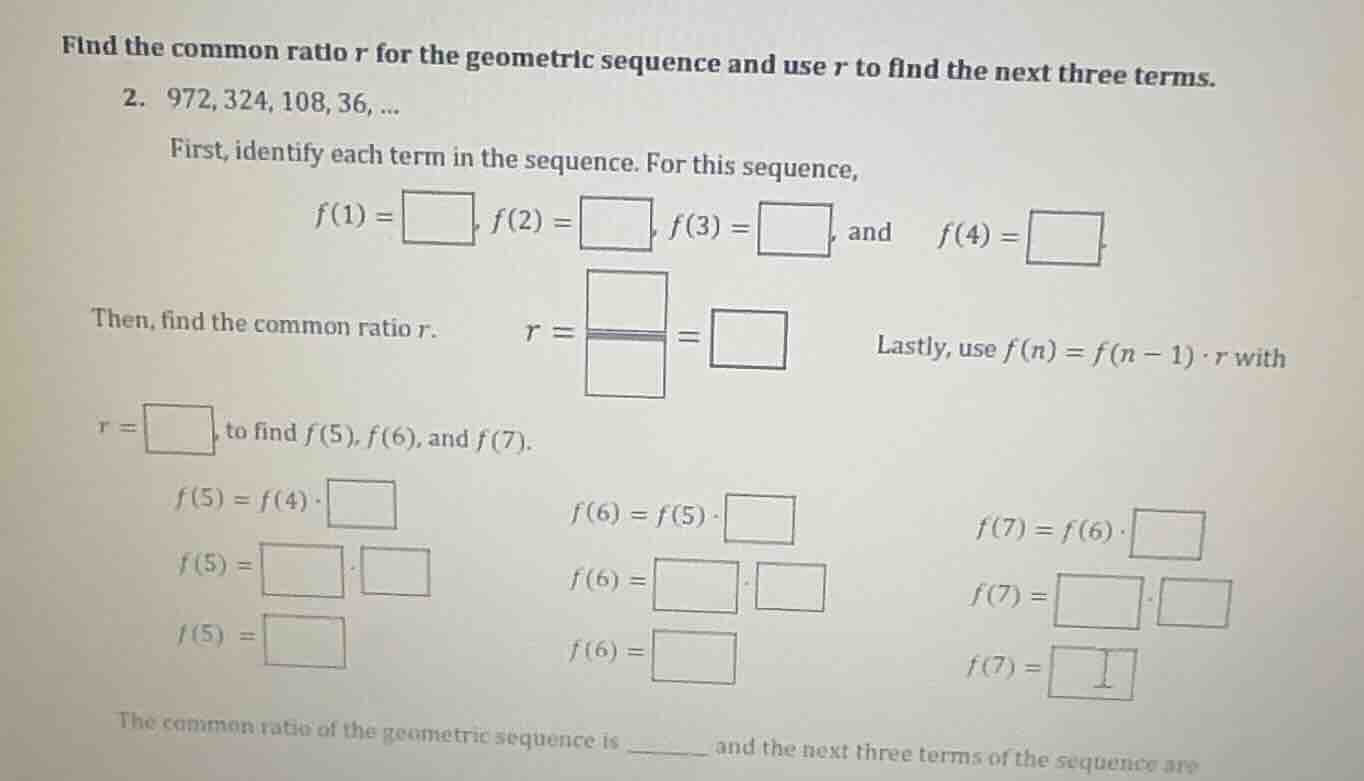
find the common ratio \\(r\\) for the geometric sequence and use \\(r\\) to find the next three terms.
- \\(972, 324, 108, 36, \dots\\)
first, identify each term in the sequence. for this sequence,
\\(f(1) = \square\\), \\(f(2) = \square\\), \\(f(3) = \square\\) and \\(f(4) = \square\\)
then, find the common ratio \\(r\\).
\\(r = \frac{\square}{\square} = \square\\)
lastly, use \\(f(n) = f(n - 1) \cdot r\\) with \\(r = \square\\) to find \\(f(5)\\), \\(f(6)\\), and \\(f(7)\\).
\\(f(5) = f(4) \cdot \square\\)
\\(f(5) = \square \cdot \square\\)
\\(f(5) = \square\\)
\\(f(6) = f(5) \cdot \square\\)
\\(f(6) = \square \cdot \square\\)
\\(f(6) = \square\\)
\\(f(7) = f(6) \cdot \square\\)
\\(f(7) = \square \cdot \square\\)
\\(f(7) = \square\\)
the common ratio of the geometric sequence is \\(\underline{\quad\quad}\\) and the next three terms of the sequence are \\(\underline{\quad\quad}\\)
Identify the terms
We identify the first four terms of the given geometric sequence \(972, 324, 108, 36, \dots\) using Geometric Sequences:
- \(f(1) = 972\)
- \(f(2) = 324\)
- \(f(3) = 108\)
- \(f(4) = 36\)
Find the common ratio
We calculate the Common Ratio \(r\) by dividing consecutive terms:
Calculate the fifth term
Using the recursive formula \(f(n) = f(n-1) \cdot r\) with \(r = \frac{1}{3}\):
- \(f(5) = f(4) \cdot \frac{1}{3}\)
- \(f(5) = 36 \cdot \frac{1}{3}\)
- \(f(5) = 12\)
Calculate the sixth term
Using the recursive formula with \(r = \frac{1}{3}\):
- \(f(6) = f(5) \cdot \frac{1}{3}\)
- \(f(6) = 12 \cdot \frac{1}{3}\)
- \(f(6) = 4\)
Calculate the seventh term
Using the recursive formula with \(r = \frac{1}{3}\):
- \(f(7) = f(6) \cdot \frac{1}{3}\)
- \(f(7) = 4 \cdot \frac{1}{3}\)
- \(f(7) = \frac{4}{3}\)

Snap & solve any problem in the app
Get step-by-step solutions on Sovi AI
Photo-based solutions with guided steps
Explore more problems and detailed explanations
Find the common ratio \(r\) for the geometric sequence and use \(r\) to find the next three terms.
- \(972, 324, 108, 36, \dots\)
First, identify each term in the sequence. For this sequence,
\(f(1) =\) <blank>972</blank>, \(f(2) =\) <blank>324</blank>, \(f(3) =\) <blank>108</blank>, and \(f(4) =\) <blank>36</blank>.
Then, find the common ratio \(r\).
Lastly, use \(f(n) = f(n-1) \cdot r\) with \(r =\) <blank>\(\frac{1}{3}\)</blank> to find \(f(5)\), \(f(6)\), and \(f(7)\).
\(f(5) = f(4) \cdot\) <blank>\(\frac{1}{3}\)</blank>
\(f(5) =\) <blank>36</blank> \(\cdot\) <blank>\(\frac{1}{3}\)</blank>
\(f(5) =\) <blank>12</blank>
\(f(6) = f(5) \cdot\) <blank>\(\frac{1}{3}\)</blank>
\(f(6) =\) <blank>12</blank> \(\cdot\) <blank>\(\frac{1}{3}\)</blank>
\(f(6) =\) <blank>4</blank>
\(f(7) = f(6) \cdot\) <blank>\(\frac{1}{3}\)</blank>
\(f(7) =\) <blank>4</blank> \(\cdot\) <blank>\(\frac{1}{3}\)</blank>
\(f(7) =\) <blank>\(\frac{4}{3}\)</blank>
The common ratio of the geometric sequence is <blank>\(\frac{1}{3}\)</blank> and the next three terms of the sequence are <blank>\(12, 4, \frac{4}{3}\)</blank>.