QUESTION IMAGE
Question
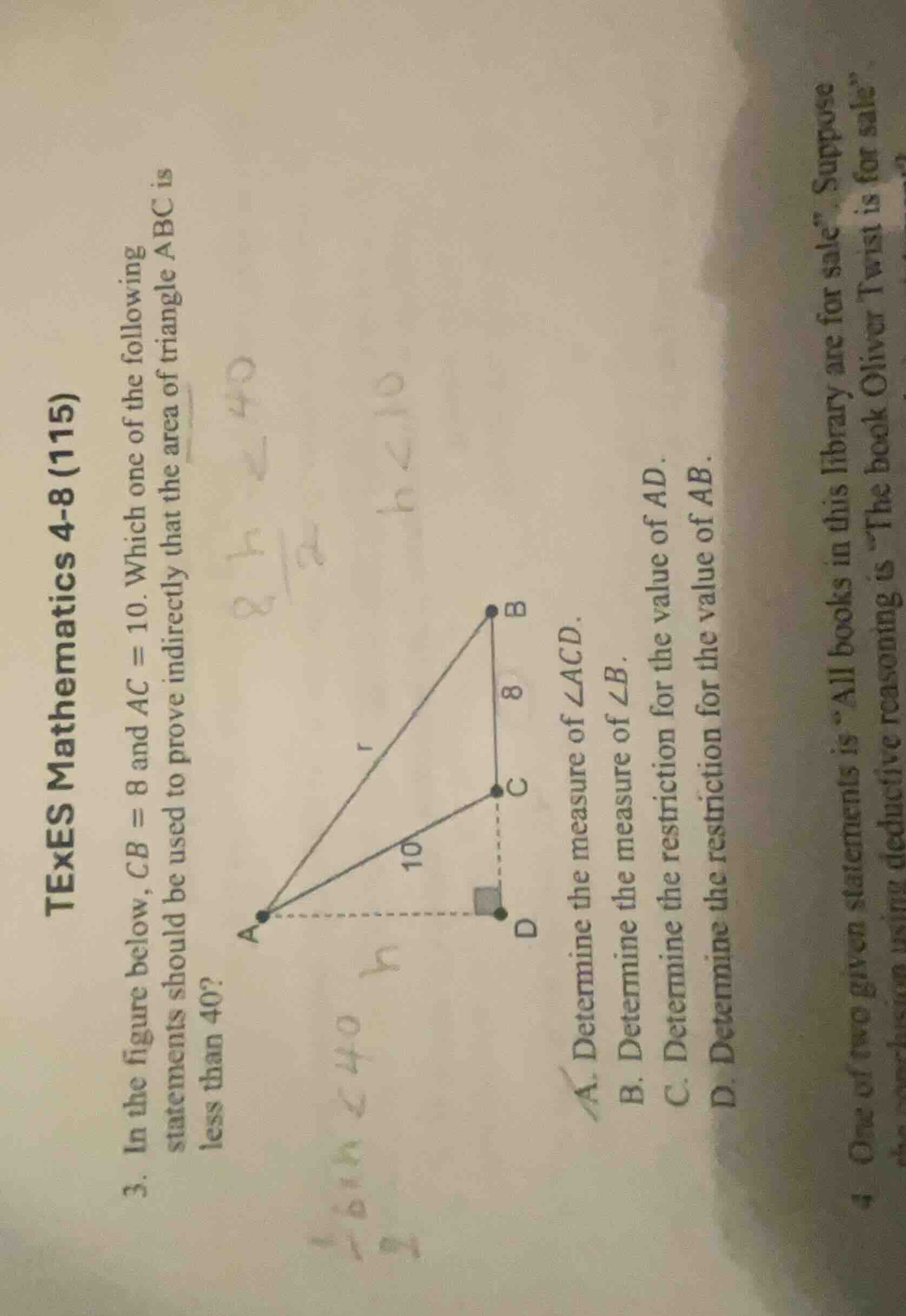
- in the figure below, \\(cb = 8\\) and \\(ac = 10\\). which one of the following statements should be used to prove indirectly that the area of triangle \\(abc\\) is less than 40?
a. determine the measure of \\(\angle acd\\).
b. determine the measure of \\(\angle b\\).
c. determine the restriction for the value of \\(ad\\).
d. determine the restriction for the value of \\(ab\\).
🆕 New Concept Discovered: Proof by Contradiction (Indirect Proof)
Proving a statement by assuming its opposite is true.
Step 1: Understand Indirect Proof
An indirect proof (or proof by contradiction) begins by assuming the negation of the statement we want to prove.
We want to prove:
Therefore, the assumption for an indirect proof must be the negation of this statement:
Step 2: Relate the Assumption to the Triangle's Dimensions
The area of \(\triangle ABC\) with base \(CB = 8\) and altitude \(AD = h\) is given by:
Using our assumption from Step 1:
Since \(AD = h\), this assumption means:
Step 3: Identify the Contradiction
In the right triangle \(\triangle ADC\), the hypotenuse is \(AC = 10\) and one of the legs is \(AD\).
In any right triangle, the length of a leg must be strictly less than the length of the hypotenuse:
This directly contradicts our assumption from Step 2 (\(AD \ge 10\)). Thus, the assumption must be false, proving that the area of \(\triangle ABC\) is indeed less than 40.
The key restriction that leads to this contradiction is the relationship between the leg \(AD\) and the hypotenuse \(AC\). Therefore, determining the restriction for the value of \(AD\) is the statement used to complete the indirect proof.

Snap & solve any problem in the app
Get step-by-step solutions on Sovi AI
Photo-based solutions with guided steps
Explore more problems and detailed explanations
C. Determine the restriction for the value of AD.