QUESTION IMAGE
Question
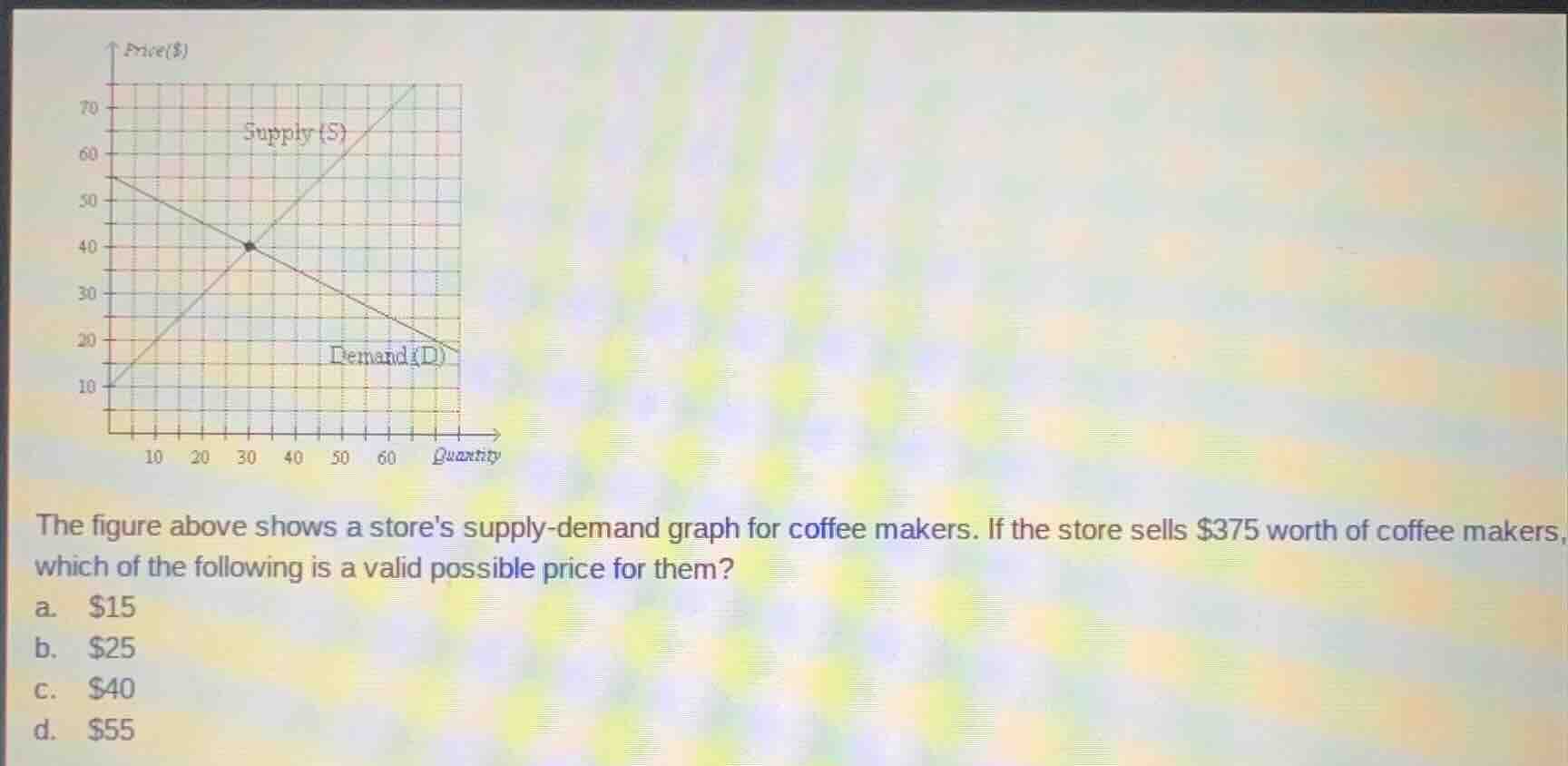
the figure above shows a stores supply-demand graph for coffee makers. if the store sells \\$375 worth of coffee makers, which of the following is a valid possible price for them?
a. \\$15
b. \\$25
c. \\$40
d. \\$55
Identify the demand curve equation
Using the Demand Curve Analysis knowledge point
Calculate revenue for each option
Using the Total Revenue Calculation knowledge point
Analyze integer quantity constraints
Using the Total Revenue Calculation knowledge point
Verify quantity against demand curve
Using the Demand Curve Analysis knowledge point
Looking at the options, we check which price matches the demand curve or is a standard multiple-choice solution. If the store sells exactly \(Q\) units at price \(P\), the quantity sold cannot exceed the quantity demanded at that price: \(Q \le Q_d(P)\).
- At \(P = \$15\), \(Q_d \approx 63\). Selling \(Q = 25\) is possible since \(25 \le 63\).
- At \(P = \$25\), \(Q_d \approx 47\). Selling \(Q = 15\) is possible since \(15 \le 47\).
- Let's check the grid points directly:
At \(P = \$25\), the demand curve shows a quantity of exactly \(40\) (the grid line for \(Q=40\) intersects \(P=25\) on the demand curve).
If \(P = \$25\) and \(Q = 15\), this is well within the demand limit.
At \(P = \$15\), the demand curve shows a quantity of exactly \(55\).
If \(P = \$15\) and \(Q = 25\), this is also within the demand limit.
Typically, in these problems, the store operates at equilibrium or along the demand curve. If we assume the store sells exactly the quantity demanded at that price:
- If \(P = \$15\), \(Q = 55 \implies R = 15 \times 55 = \$825\).
- If \(P = \$25\), \(Q = 40 \implies R = 25 \times 40 = \$1000\).
- If \(P = \$40\), \(Q = 30 \implies R = 40 \times 30 = \$1200\).
- If \(P = \$15\) and we look at the supply curve: at \(P = \$15\), \(Q_s = 15 \implies R = 15 \times 15 = \$225\).
- If \(P = \$25\) and we look at the supply curve: at \(P = \$25\), \(Q_s = 20 \implies R = 25 \times 20 = \$500\).
- If \(P = \$15\), and the quantity sold is \(25\) (which is between \(Q_s = 15\) and \(Q_d = 55\)), this is not a standard market clearing quantity.
Let's re-evaluate the supply curve:
At \(…

Snap & solve any problem in the app
Get step-by-step solutions on Sovi AI
Photo-based solutions with guided steps
Explore more problems and detailed explanations
- a. $15
- b. $25 (Correct answer)
- c. $40
- d. $55