QUESTION IMAGE
Question
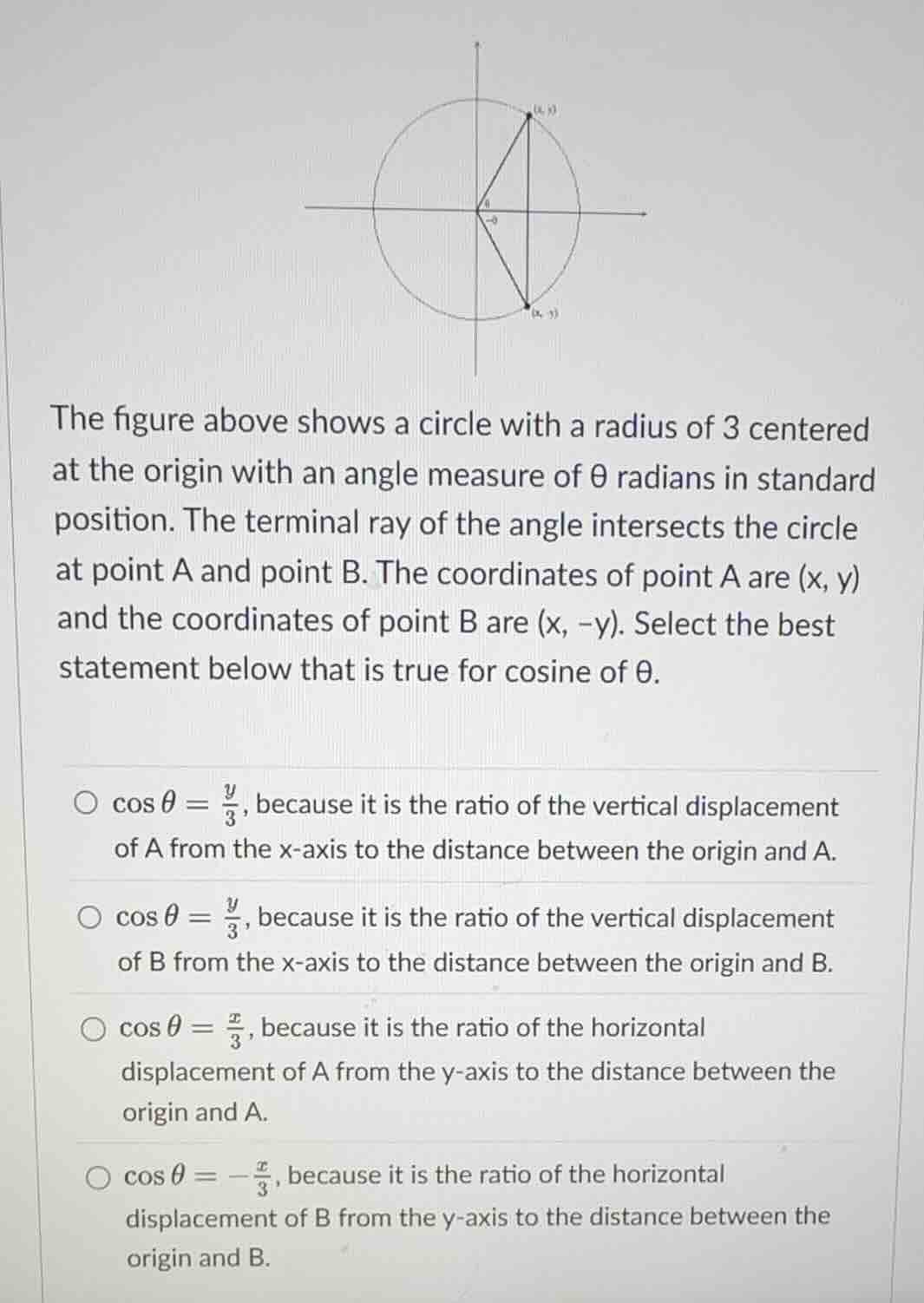
the figure above shows a circle with a radius of 3 centered at the origin with an angle measure of \\(\theta\\) radians in standard position. the terminal ray of the angle intersects the circle at point a and point b. the coordinates of point a are \\((x, y)\\) and the coordinates of point b are \\((x, -y)\\). select the best statement below that is true for cosine of \\(\theta\\).
\\(\bigcirc\\) \\(\cos \theta = \frac{y}{3}\\), because it is the ratio of the vertical displacement of a from the x-axis to the distance between the origin and a.
\\(\bigcirc\\) \\(\cos \theta = \frac{y}{3}\\), because it is the ratio of the vertical displacement of b from the x-axis to the distance between the origin and b.
\\(\bigcirc\\) \\(\cos \theta = \frac{x}{3}\\), because it is the ratio of the horizontal displacement of a from the y-axis to the distance between the origin and a.
\\(\bigcirc\\) \\(\cos \theta = -\frac{x}{3}\\), because it is the ratio of the horizontal displacement of b from the y-axis to the distance between the origin and b.
Identify given values and definitions
We are given a circle centered at the origin with a radius of \(r = 3\).
An angle \(\theta\) in standard position has its terminal ray intersecting the circle at point \(A(x, y)\).
The distance from the origin to point \(A\) is the radius of the circle, which is \(3\).
Apply trigonometric definitions on a circle
For any angle \(\theta\) in standard position whose terminal ray intersects a circle of radius \(r\) at a point \((x, y)\), the cosine function is defined as:
Since the radius of the circle is \(3\), we substitute \(r = 3\):
Interpret the geometric meaning of the coordinates
The coordinate \(x\) represents the horizontal displacement of point \(A\) from the y-axis.
The radius \(3\) represents the distance between the origin and point \(A\).
Therefore, \(\cos\theta = \frac{x}{3}\) because it is the ratio of the horizontal displacement of \(A\) from the y-axis to the distance between the origin and \(A\).
Evaluate the given statements
Let's analyze the options:
- Option 1: \(\cos\theta = \frac{y}{3}\)... (Incorrect, this defines \(\sin\theta\)).
- Option 2: \(\cos\theta = \frac{y}{3}\)... (Incorrect, this relates to the vertical coordinate of \(B\)).
- Option 3: \(\cos\theta = \frac{x}{3}\), because it is the ratio of the horizontal displacement of \(A\) from the y-axis to the distance between the origin and \(A\). (Correct, matches our derivation).
- Option 4: \(\cos\theta = -\frac{x}{3}\)... (Incorrect, the horizontal coordinate of both \(A\) and \(B\) is \(x\), and the ratio is positive \(x/3\)).

Snap & solve any problem in the app
Get step-by-step solutions on Sovi AI
Photo-based solutions with guided steps
Explore more problems and detailed explanations
- \(\cos \theta = \frac{y}{3}\), because it is the ratio of the vertical displacement of A from the x-axis to the distance between the origin and A.
- \(\cos \theta = \frac{y}{3}\), because it is the ratio of the vertical displacement of B from the x-axis to the distance between the origin and B.
- \(\cos \theta = \frac{x}{3}\), because it is the ratio of the horizontal displacement of A from the y-axis to the distance between the origin and A. (Correct answer)
- \(\cos \theta = -\frac{x}{3}\), because it is the ratio of the horizontal displacement of B from the y-axis to the distance between the origin and B.