QUESTION IMAGE
Question
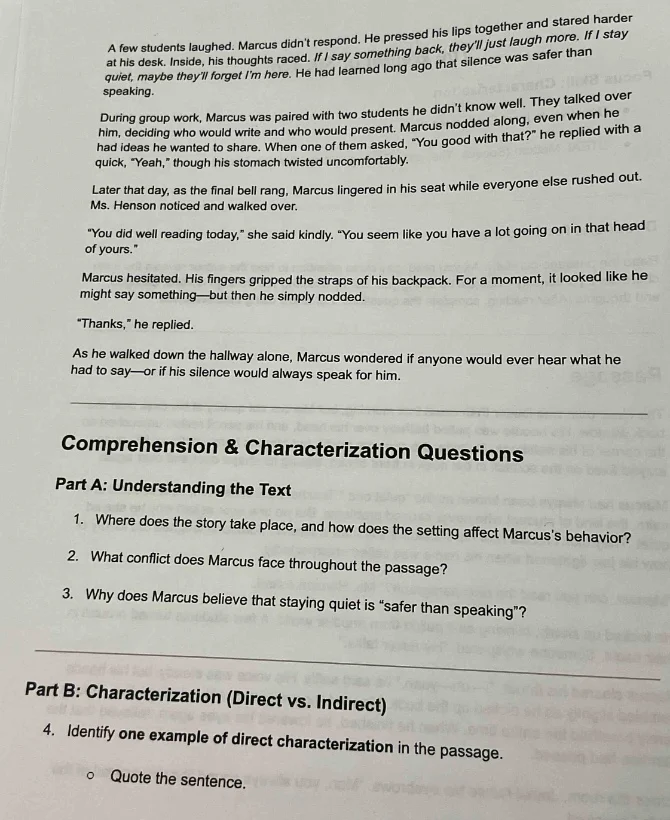
a few students laughed. marcus didnt respond. he pressed his lips together and stared harder at his desk. inside, his thoughts raced. if i say something back, theyll just laugh more. if i stay quiet, maybe theyll forget im here. he had learned long ago that silence was safer than speaking.
during group work, marcus was paired with two students he didnt know well. they talked over him, deciding who would write and who would present. marcus nodded along, even when he had ideas he wanted to share. when one of them asked, \you good with that?\ he replied with a quick, \yeah,\ though his stomach twisted uncomfortably.
later that day, as the final bell rang, marcus lingered in his seat while everyone else rushed out. ms. henson noticed and walked over.
\you did well reading today,\ she said kindly. \you seem like you have a lot going on in that head of yours.\
marcus hesitated. his fingers gripped the straps of his backpack. for a moment, it looked like he might say something—but then he simply nodded.
\thanks,\ he replied.
as he walked down the hallway alone, marcus wondered if anyone would ever hear what he had to say—or if his silence would always speak for him.
comprehension & characterization questions
part a: understanding the text
- where does the story take place, and how does the setting affect marcuss behavior?
- what conflict does marcus face throughout the passage?
- why does marcus believe that staying quiet is \safer than speaking\?
part b: characterization (direct vs. indirect)
- identify one example of direct characterization in the passage.
- quote the sentence.
Part A:
1.
The story takes place in a school (classroom and hallway). The school setting, with peers who laugh at him, makes Marcus feel unsafe to speak, so he stays quiet to avoid more laughter.
Marcus's internal conflict is between wanting to share his ideas and his fear of being laughed at, so he stays silent. Externally, he faces peers who talk over him and mock him, affecting his willingness to speak.
Marcus believes staying quiet is safer because when he might speak, students laugh, and he thinks speaking will make them laugh more, while silence might make them forget him, avoiding ridicule.

Snap & solve any problem in the app
Get step-by-step solutions on Sovi AI
Photo-based solutions with guided steps
Explore more problems and detailed explanations
The story takes place in a school (classroom and hallway). The school setting, where peers laugh at him, makes Marcus stay quiet to avoid more mockery, as he fears speaking will lead to increased laughter.