QUESTION IMAGE
Question
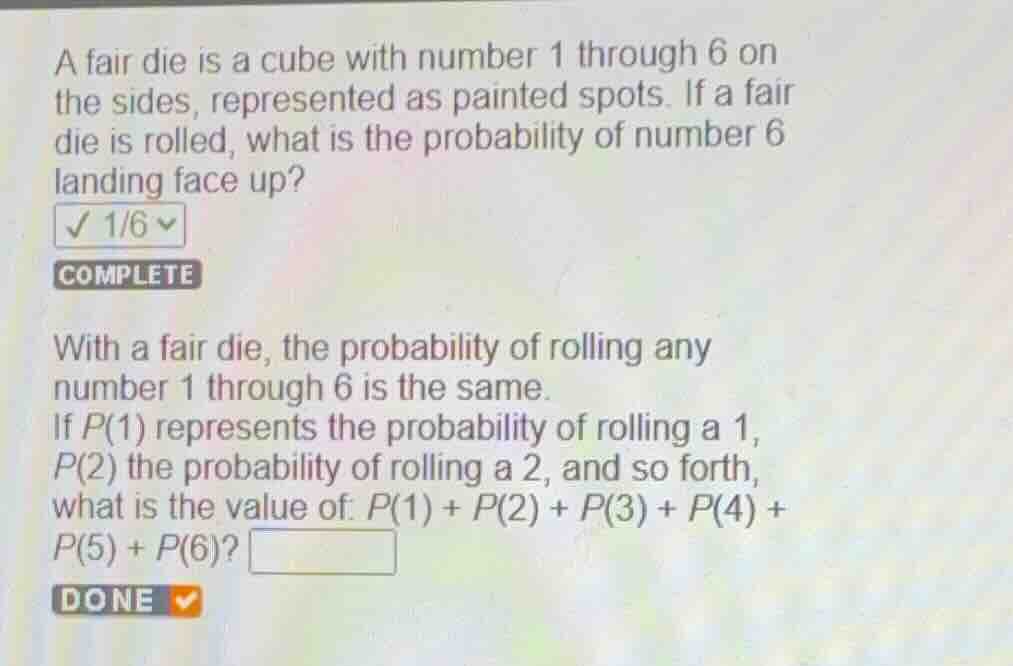
a fair die is a cube with number 1 through 6 on the sides, represented as painted spots. if a fair die is rolled, what is the probability of number 6 landing face up?
with a fair die, the probability of rolling any number 1 through 6 is the same.
if \\(p(1)\\) represents the probability of rolling a 1, \\(p(2)\\) the probability of rolling a 2, and so forth, what is the value of: \\(p(1) + p(2) + p(3) + p(4) + p(5) + p(6)\\)?
Identify the sample space and individual probabilities
The sample space \(S\) for rolling a fair six-sided die is:
Since the die is fair, each outcome is equally likely:
Sum the probabilities of all outcomes
The sum of the probabilities of all mutually exclusive outcomes in a sample space must equal 1:

Snap & solve any problem in the app
Get step-by-step solutions on Sovi AI
Photo-based solutions with guided steps
Explore more problems and detailed explanations
With a fair die, the probability of rolling any number 1 through 6 is the same. If \(P(1)\) represents the probability of rolling a 1, \(P(2)\) the probability of rolling a 2, and so forth, what is the value of: \(P(1) + P(2) + P(3) + P(4) + P(5) + P(6)\)? <blank>1</blank>