QUESTION IMAGE
Question
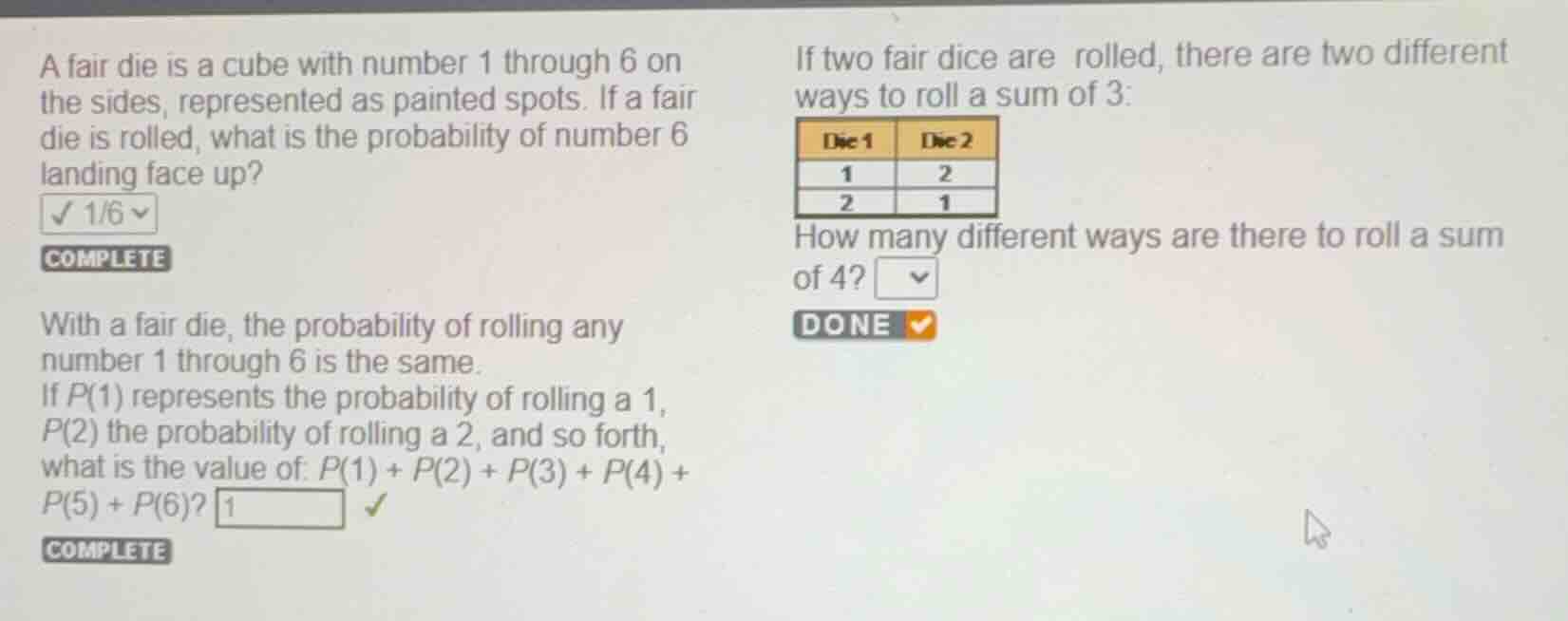
a fair die is a cube with number 1 through 6 on the sides, represented as painted spots. if a fair die is rolled, what is the probability of number 6 landing face up?
with a fair die, the probability of rolling any number 1 through 6 is the same.
if \\(p(1)\\) represents the probability of rolling a 1, \\(p(2)\\) the probability of rolling a 2, and so forth, what is the value of: \\(p(1) + p(2) + p(3) + p(4) + p(5) + p(6)\\)?
if two fair dice are rolled, there are two different ways to roll a sum of 3:
\
how many different ways are there to roll a sum of 4?
Identify the target sum and constraints
Using the Sample Space and Favorable Outcomes knowledge points
We need to find the number of different ways to roll a sum of \(4\) using two fair six-sided dice. Let the outcome of the first die be \(d_1\) and the second die be \(d_2\), where \(d_1, d_2 \in \{1, 2, 3, 4, 5, 6\}\). We seek pairs \((d_1, d_2)\) such that:
List all favorable outcomes
Using the Favorable Outcomes knowledge point
We find all integer pairs \((d_1, d_2)\) within the range \([1, 6]\) that satisfy the equation:
- If \(d_1 = 1\), then \(d_2 = 3\). This gives the pair \((1, 3)\).
- If \(d_1 = 2\), then \(d_2 = 2\). This gives the pair \((2, 2)\).
- If \(d_1 = 3\), then \(d_2 = 1\). This gives the pair \((3, 1)\).
- If \(d_1 \ge 4\), \(d_2\) would have to be \(0\) or negative, which is impossible for standard dice.
Count the total number of ways
Using the Favorable Outcomes knowledge point
Counting the listed pairs:
- \((1, 3)\)
- \((2, 2)\)
- \((3, 1)\)
There are exactly \(3\) different ways.

Snap & solve any problem in the app
Get step-by-step solutions on Sovi AI
Photo-based solutions with guided steps
Explore more problems and detailed explanations
How many different ways are there to roll a sum of 4? <blank>3</blank>