QUESTION IMAGE
Question
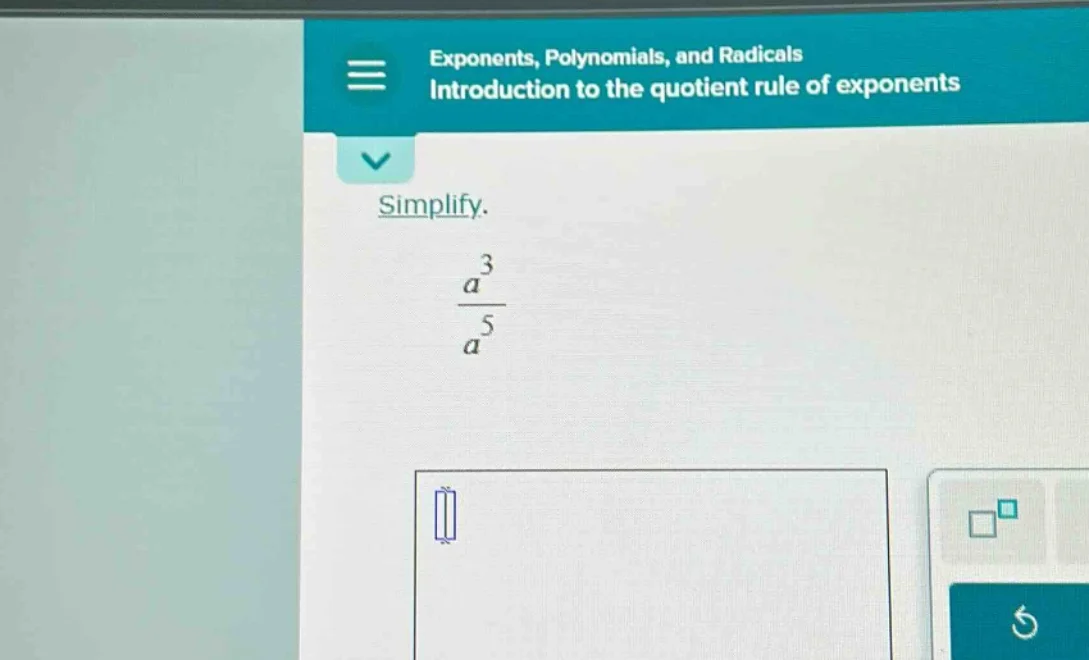
exponents, polynomials, and radicals introduction to the quotient rule of exponents simplify. \\(\frac{a^3}{a^5}\\)
Step1: Recall quotient rule of exponents
The quotient rule of exponents states that for any non - zero number \(a\) and integers \(m\) and \(n\), \(\frac{a^{m}}{a^{n}}=a^{m - n}\). Here, \(m = 3\) and \(n=5\), and the base \(a\) is a variable (we assume \(a
eq0\) since we are dividing by \(a^{5}\)).
Step2: Apply the quotient rule
Substitute \(m = 3\) and \(n = 5\) into the formula \(\frac{a^{m}}{a^{n}}=a^{m - n}\). So we have \(\frac{a^{3}}{a^{5}}=a^{3-5}\).
Step3: Simplify the exponent
Calculate \(3 - 5=- 2\). So \(\frac{a^{3}}{a^{5}}=a^{-2}\). We can also express this using the definition of negative exponents \(a^{-n}=\frac{1}{a^{n}}\) (\(a
eq0\)), so \(a^{-2}=\frac{1}{a^{2}}\).

Snap & solve any problem in the app
Get step-by-step solutions on Sovi AI
Photo-based solutions with guided steps
Explore more problems and detailed explanations
\(\frac{1}{a^{2}}\) (or \(a^{-2}\))