QUESTION IMAGE
Question
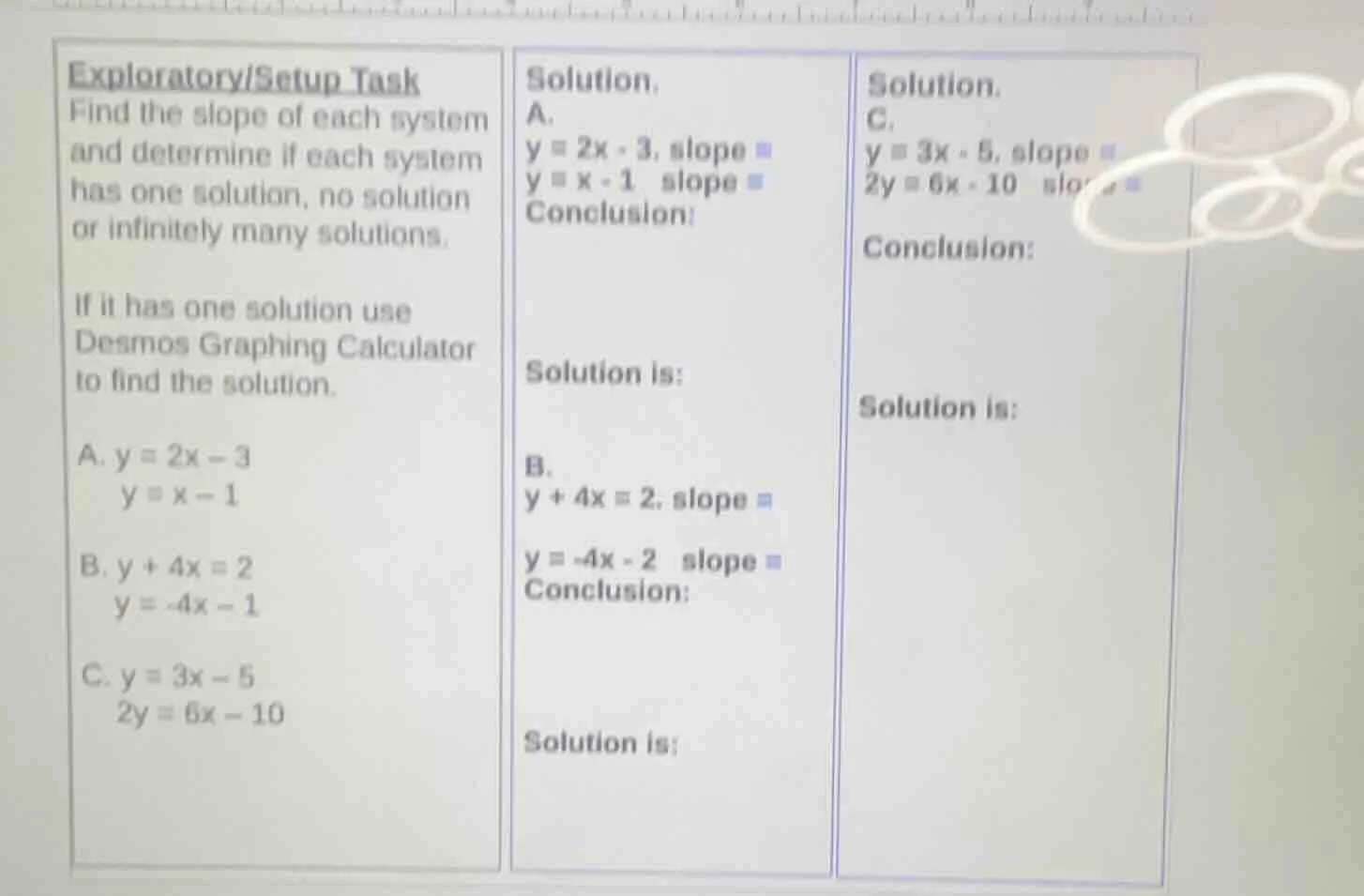
exploratory/setup task
find the slope of each system
and determine if each system
has one solution, no solution
or infinitely many solutions.
if it has one solution use
desmos graphing calculator
to find the solution.
a. ( y = 2x - 3 )
( y = x - 1 )
b. ( y + 4x = 2 )
( y = -4x - 1 )
c. ( y = 3x - 5 )
( 2y = 6x - 10 )
solution.
a.
( y = 2x - 3 ), slope =
( y = x - 1 ) slope =
conclusion:
solution is:
b.
( y + 4x = 2 ), slope =
( y = -4x - 2 ) slope =
conclusion:
solution is:
solution.
c.
( y = 3x - 5 ), slope =
( 2y = 6x - 10 ) slope =
conclusion:
solution is:
Step1: Identify slopes for System A
For $y=2x-3$, slope $m_1=2$. For $y=x-1$, slope $m_2=1$.
Step2: Analyze System A
Since $m_1
eq m_2$, the system has one solution. Set $2x-3=x-1$.
Substitute $x=2$ into $y=x-1$: $y=2-1=1$.
Step3: Identify slopes for System B
Rewrite $y+4x=2$ as $y=-4x+2$, slope $m_1=-4$. For $y=-4x-1$, slope $m_2=-4$.
Step4: Analyze System B
Slopes are equal, y-intercepts ($2
eq -1$) differ: no solution.
Step5: Identify slopes for System C
For $y=3x-5$, slope $m_1=3$. Rewrite $2y=6x-10$ as $y=3x-5$, slope $m_2=3$.
Step6: Analyze System C
Slopes and y-intercepts are identical: infinitely many solutions.

Snap & solve any problem in the app
Get step-by-step solutions on Sovi AI
Photo-based solutions with guided steps
Explore more problems and detailed explanations
System A
Slopes: $2$, $1$
Conclusion: One solution
Solution is: $(2, 1)$
System B
Slopes: $-4$, $-4$
Conclusion: No solution
Solution is: None
System C
Slopes: $3$, $3$
Conclusion: Infinitely many solutions
Solution is: All points on $y=3x-5$