QUESTION IMAGE
Question
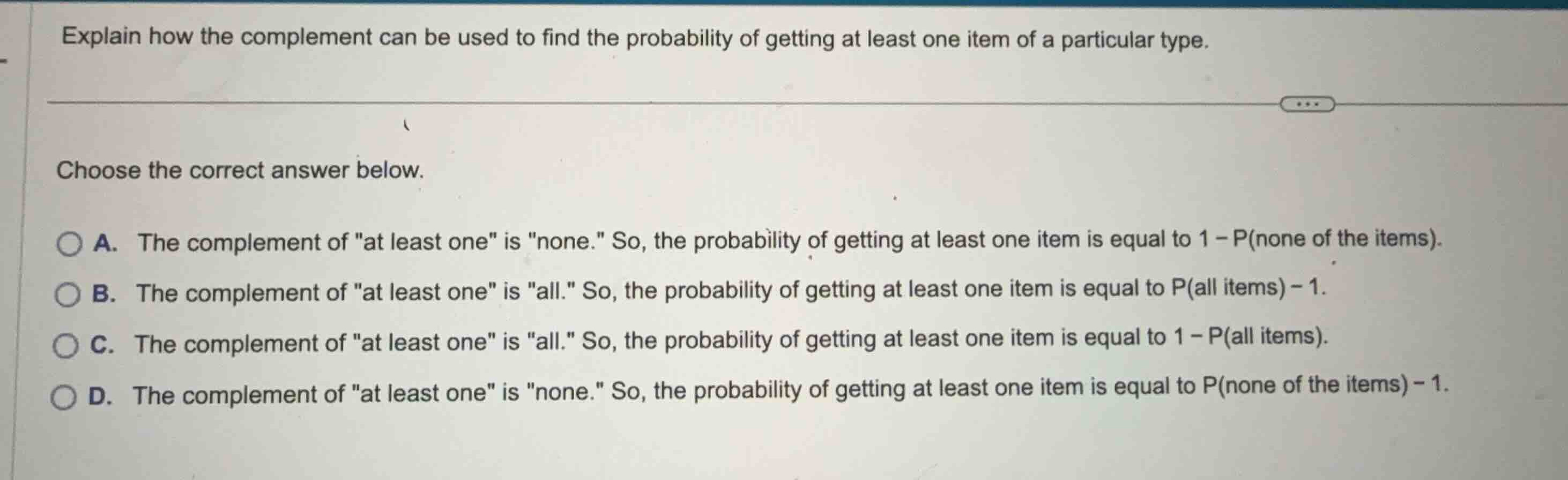
explain how the complement can be used to find the probability of getting at least one item of a particular type.
choose the correct answer below.
a. the complement of \at least one\ is
one.\ so, the probability of getting at least one item is equal to \\(1 - p(\text{none of the items})\\).
b. the complement of \at least one\ is \all.\ so, the probability of getting at least one item is equal to \\(p(\text{all items}) - 1\\).
c. the complement of \at least one\ is \all.\ so, the probability of getting at least one item is equal to \\(1 - p(\text{all items})\\).
d. the complement of \at least one\ is
one.\ so, the probability of getting at least one item is equal to \\(p(\text{none of the items}) - 1\\).
Define the complement of "at least one"
Using the Complementary Events knowledge point
The complement of an event is the set of all outcomes in the sample space that are not in the event. For the event "getting at least one item of a particular type" (which means 1, 2, 3, ..., up to all items), the only outcome not included is getting zero items of that type, which is "none." Thus, the complement of "at least one" is "none."
Apply the complement rule for probability
Using the Complementary Events knowledge point
The sum of the probability of an event and the probability of its complement is always equal to 1:
Rearranging this formula to solve for the target probability yields:
Match with the given options
Using the Complementary Events knowledge point
Comparing our derived statement with the choices:
- Option A states: The complement of "at least one" is "none." So, the probability of getting at least one item is equal to \(1 - P(\text{none of the items})\). This matches our derivation.

Snap & solve any problem in the app
Get step-by-step solutions on Sovi AI
Photo-based solutions with guided steps
Explore more problems and detailed explanations
- A. The complement of "at least one" is "none." So, the probability of getting at least one item is equal to 1 - P(none of the items). (Correct answer)
- B. The complement of "at least one" is "all." So, the probability of getting at least one item is equal to P(all items) - 1.
- C. The complement of "at least one" is "all." So, the probability of getting at least one item is equal to 1 - P(all items).
- D. The complement of "at least one" is "none." So, the probability of getting at least one item is equal to P(none of the items) - 1.