QUESTION IMAGE
Question
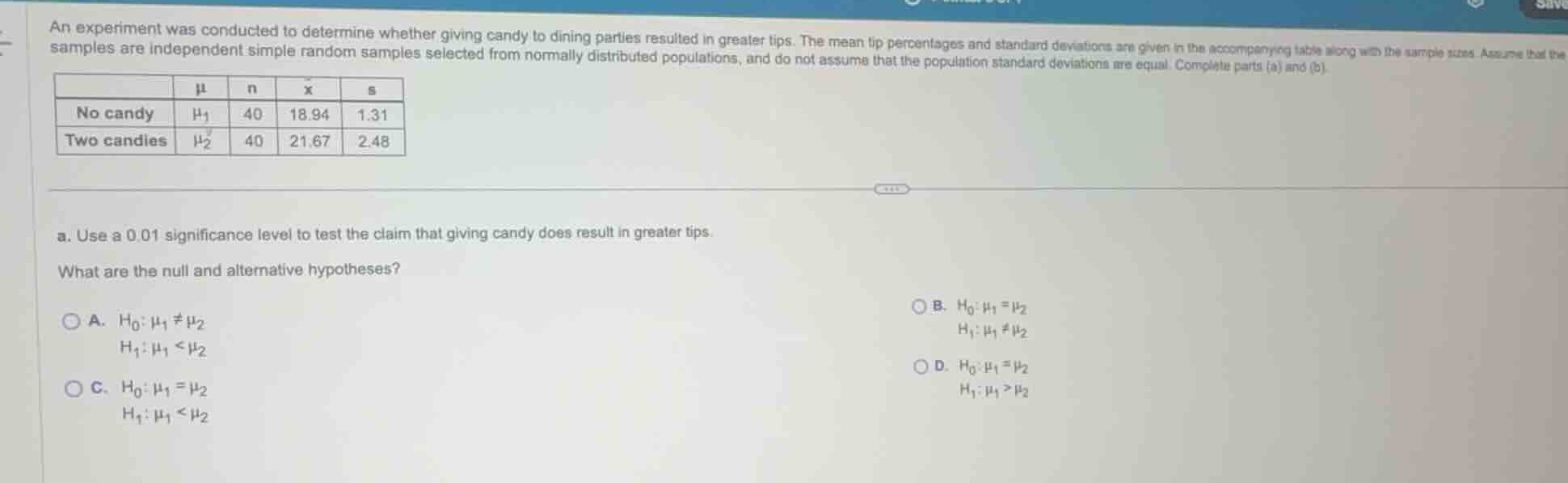
an experiment was conducted to determine whether giving candy to dining parties resulted in greater tips. the mean tip percentages and standard deviations are given in the accompanying table along with the sample sizes. assume that the samples are independent simple random samples selected from normally distributed populations, and do not assume that the population standard deviations are equal. complete parts (a) and (b).
\
a. use a 0.01 significance level to test the claim that giving candy does result in greater tips.
what are the null and alternative hypotheses?
a. \\(h_0: \mu_1 \
eq \mu_2\\)
\\(h_1: \mu_1 < \mu_2\\)
b. \\(h_0: \mu_1 = \mu_2\\)
\\(h_1: \mu_1 \
eq \mu_2\\)
c. \\(h_0: \mu_1 = \mu_2\\)
\\(h_1: \mu_1 < \mu_2\\)
d. \\(h_0: \mu_1 = \mu_2\\)
\\(h_1: \mu_1 > \mu_2\\)
Identify the claim and parameter definitions
Claim: Giving candy results in greater tips.
Let \(\mu_1\) be the mean tip percentage for the "No candy" group.
Let \(\mu_2\) be the mean tip percentage for the "Two candies" group.
The claim that giving candy results in greater tips means the "No candy" mean is less than the "Two candies" mean:
Formulate the null and alternative hypotheses
The null hypothesis \(H_0\) always contains equality:
The alternative hypothesis \(H_1\) represents the claim of a difference in a specific direction:
Match with the given options
Option C states:

Snap & solve any problem in the app
Get step-by-step solutions on Sovi AI
Photo-based solutions with guided steps
Explore more problems and detailed explanations
- A. \(H_0: \mu_1
eq \mu_2\), \(H_1: \mu_1 < \mu_2\)
- B. \(H_0: \mu_1 = \mu_2\), \(H_1: \mu_1
eq \mu_2\)
- C. \(H_0: \mu_1 = \mu_2\), \(H_1: \mu_1 < \mu_2\) (Correct answer)
- D. \(H_0: \mu_1 = \mu_2\), \(H_1: \mu_1 > \mu_2\)