QUESTION IMAGE
Question
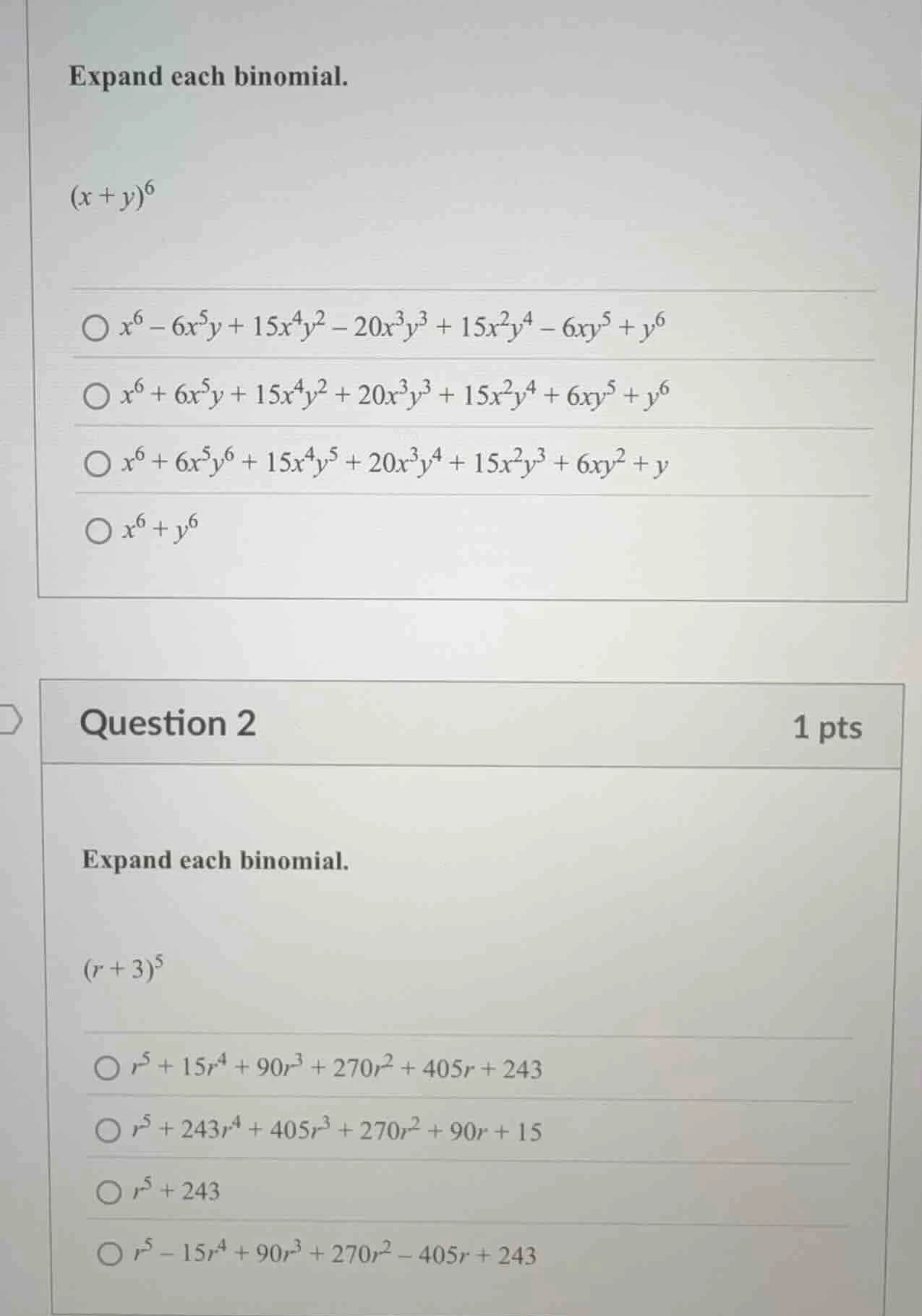
expand each binomial.
$(x + y)^6$
$\bigcirc\\ x^6 - 6x^5y + 15x^4y^2 - 20x^3y^3 + 15x^2y^4 - 6xy^5 + y^6$
$\bigcirc\\ x^6 + 6x^5y + 15x^4y^2 + 20x^3y^3 + 15x^2y^4 + 6xy^5 + y^6$
$\bigcirc\\ x^6 + 6x^5y^6 + 15x^4y^5 + 20x^3y^4 + 15x^2y^3 + 6xy^2 + y$
$\bigcirc\\ x^6 + y^6$
question 2
1 pts
expand each binomial.
$(r + 3)^5$
$\bigcirc\\ r^5 + 15r^4 + 90r^3 + 270r^2 + 405r + 243$
$\bigcirc\\ r^5 + 243r^4 + 405r^3 + 270r^2 + 90r + 15$
$\bigcirc\\ r^5 + 243$
$\bigcirc\\ r^5 - 15r^4 + 90r^3 + 270r^2 - 405r + 243$
Question 1: Expand \((x + y)^6\)
To expand \((x + y)^n\), we use the Binomial Theorem, which states that \((x + y)^n=\sum_{k = 0}^{n}\binom{n}{k}x^{n - k}y^{k}\), where \(\binom{n}{k}=\frac{n!}{k!(n - k)!}\). For \(n = 6\):
Step 1: Calculate binomial coefficients for \(n = 6\)
The binomial coefficients for \(n=6\) are \(\binom{6}{0} = 1\), \(\binom{6}{1}=6\), \(\binom{6}{2}=\frac{6!}{2!4!}=\frac{6\times5}{2\times1}=15\), \(\binom{6}{3}=\frac{6!}{3!3!}=\frac{6\times5\times4}{3\times2\times1}=20\), \(\binom{6}{4}=\binom{6}{2} = 15\), \(\binom{6}{5}=\binom{6}{1}=6\), \(\binom{6}{6}=1\).
Step 2: Apply the Binomial Theorem
Using the formula \((x + y)^6=\binom{6}{0}x^{6}y^{0}+\binom{6}{1}x^{5}y^{1}+\binom{6}{2}x^{4}y^{2}+\binom{6}{3}x^{3}y^{3}+\binom{6}{4}x^{2}y^{4}+\binom{6}{5}x^{1}y^{5}+\binom{6}{6}x^{0}y^{6}\)
Substituting the coefficients:
\(1\times x^{6}y^{0}+6\times x^{5}y^{1}+15\times x^{4}y^{2}+20\times x^{3}y^{3}+15\times x^{2}y^{4}+6\times x^{1}y^{5}+1\times x^{0}y^{6}\)
Simplifying (since \(y^{0}=1\) and \(x^{0}=1\)):
\(x^{6}+6x^{5}y + 15x^{4}y^{2}+20x^{3}y^{3}+15x^{2}y^{4}+6xy^{5}+y^{6}\)
Question 2: Expand \((r + 3)^5\)
Using the Binomial Theorem \((a + b)^n=\sum_{k = 0}^{n}\binom{n}{k}a^{n - k}b^{k}\), where \(a=r\), \(b = 3\), and \(n = 5\).
Step 1: Calculate binomial coefficients for \(n = 5\)
The binomial coefficients for \(n = 5\) are \(\binom{5}{0}=1\), \(\binom{5}{1}=5\), \(\binom{5}{2}=\frac{5!}{2!3!}=10\), \(\binom{5}{3}=\binom{5}{2}=10\), \(\binom{5}{4}=\binom{5}{1}=5\), \(\binom{5}{5}=1\)
Step 2: Apply the Binomial Theorem
\((r+3)^{5}=\binom{5}{0}r^{5}3^{0}+\binom{5}{1}r^{4}3^{1}+\binom{5}{2}r^{3}3^{2}+\binom{5}{3}r^{2}3^{3}+\binom{5}{4}r^{1}3^{4}+\binom{5}{5}r^{0}3^{5}\)
Substitute the coefficients and calculate the powers of 3:
- \(\binom{5}{0}r^{5}3^{0}=1\times r^{5}\times1=r^{5}\)
- \(\binom{5}{1}r^{4}3^{1}=5\times r^{4}\times3 = 15r^{4}\)
- \(\binom{5}{2}r^{3}3^{2}=10\times r^{3}\times9=90r^{3}\)
- \(\binom{5}{3}r^{2}3^{3}=10\times r^{2}\times27 = 270r^{2}\)
- \(\binom{5}{4}r^{1}3^{4}=5\times r\times81=405r\)
- \(\binom{5}{5}r^{0}3^{5}=1\times1\times243 = 243\)
Combine these terms: \(r^{5}+15r^{4}+90r^{3}+270r^{2}+405r + 243\)

Snap & solve any problem in the app
Get step-by-step solutions on Sovi AI
Photo-based solutions with guided steps
Explore more problems and detailed explanations
Question 1:
B. \(x^{6}+6x^{5}y + 15x^{4}y^{2}+20x^{3}y^{3}+15x^{2}y^{4}+6xy^{5}+y^{6}\)
Question 2:
A. \(r^{5}+15r^{4}+90r^{3}+270r^{2}+405r + 243\)