QUESTION IMAGE
Question
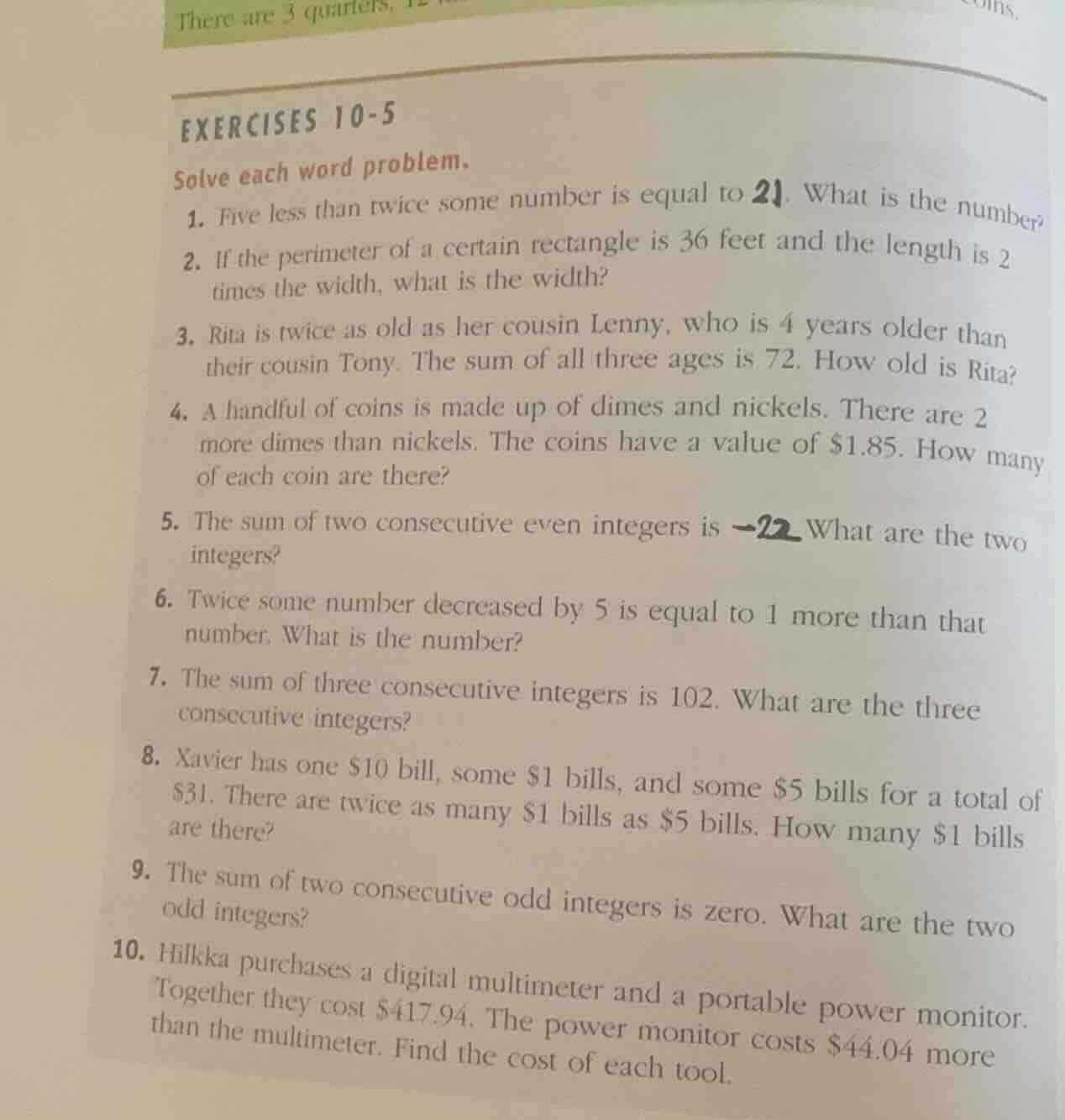
exercises 10-5
solve each word problem.
- five less than twice some number is equal to 21. what is the number?
- if the perimeter of a certain rectangle is 36 feet and the length is 2 times the width, what is the width?
- rita is twice as old as her cousin lenny, who is 4 years older than their cousin tony. the sum of all three ages is 72. how old is rita?
- a handful of coins is made up of dimes and nickels. there are 2 more dimes than nickels. the coins have a value of $1.85. how many of each coin are there?
- the sum of two consecutive even integers is -22. what are the two integers?
- twice some number decreased by 5 is equal to 1 more than that number. what is the number?
- the sum of three consecutive integers is 102. what are the three consecutive integers?
- xavier has one $10 bill, some $1 bills, and some $5 bills for a total of $31. there are twice as many $1 bills as $5 bills. how many $1 bills are there?
- the sum of two consecutive odd integers is zero. what are the two odd integers?
- hilkka purchases a digital multimeter and a portable power monitor. together they cost $417.94. the power monitor costs $44.04 more than the multimeter. find the cost of each tool.
Translate and model each word problem
Using the Translating Word Problems and Algebraic Modeling knowledge points
- Question 1: Let the number be \(x\). "Five less than twice some number is equal to 21" translates to:
- Question 2: Let the width be \(w\) feet. The length is \(2w\). The perimeter is \(2(\text{length} + \text{width}) = 36\):
- Question 3: Let Tony's age be \(t\). Lenny is \(t + 4\). Rita is \(2(t + 4)\). The sum of their ages is 72:
- Question 4: Let the number of nickels be \(n\). The number of dimes is \(n + 2\). The total value in cents is 185:
- Question 5: Let the first even integer be \(x\). The next consecutive even integer is \(x + 2\). Their sum is \(-22\):
- Question 6: Let the number be \(x\). "Twice some number decreased by 5 is equal to 1 more than that number" translates to:
- Question 7: Let the three consecutive integers be \(n\), \(n+1\), and \(n+2\). Their sum is 102:
- Question 8: Let the number of \(\$5\) bills be \(f\). The number of \(\$1\) bills is \(2f\). The total value of these bills is \(\$31 - \$10 = \$21\):
- Question 9: Let the first odd integer be \(x\). The next consecutive odd integer is \(x + 2\). Their sum is 0:
- Question 10: Let the cost of the multimeter be \(m\) dollars. The power monitor costs \(m + 44.04\). Together they cost \(417.94\):
Solve the linear equations
Using the Linear Equations Solving knowledge point
- Question 1:
- Question 2:
- Question 3:
Rita's age is \(2(t + 4) = 2(19) = 38\).
- Question 4:
Nickels: 11, Dimes: \(11 + 2 = 13\).
- Question 5:
The integers are \(-12\) and \(-10\).
- Question 6:
- Question 7:
The integers are 33, 34, and 35.
- Question 8:
The number of \(\$1\) bills is \(2f = 2(3) = 6\).
- Question 9:
The integers are \(-1\) and \(1\).
- Question 10:
Multimeter: \(\$186.95\), Power monitor: \(186.95 + 44.04 = \$230.99\).

Snap & solve any problem in the app
Get step-by-step solutions on Sovi AI
Photo-based solutions with guided steps
Explore more problems and detailed explanations
Question 1
The number is 13.
Question 2
The width is 6 feet.
Question 3
Rita is 38 years old.
Question 4
There are 11 nickels and 13 dimes.
Question 5
The two integers are \(-12\) and \(-10\).
Question 6
The number is 6.
Question 7
The three consecutive integers are 33, 34, and 35.
Question 8
There are 6 \(\$1\) bills.
Question 9
The two consecutive odd integers are \(-1\) and 1.
Question 10
The multimeter costs \(\$186.95\) and the power monitor costs \(\$230.99\).