QUESTION IMAGE
Question
excerpt from \song of myself\
walt whitman
section 3
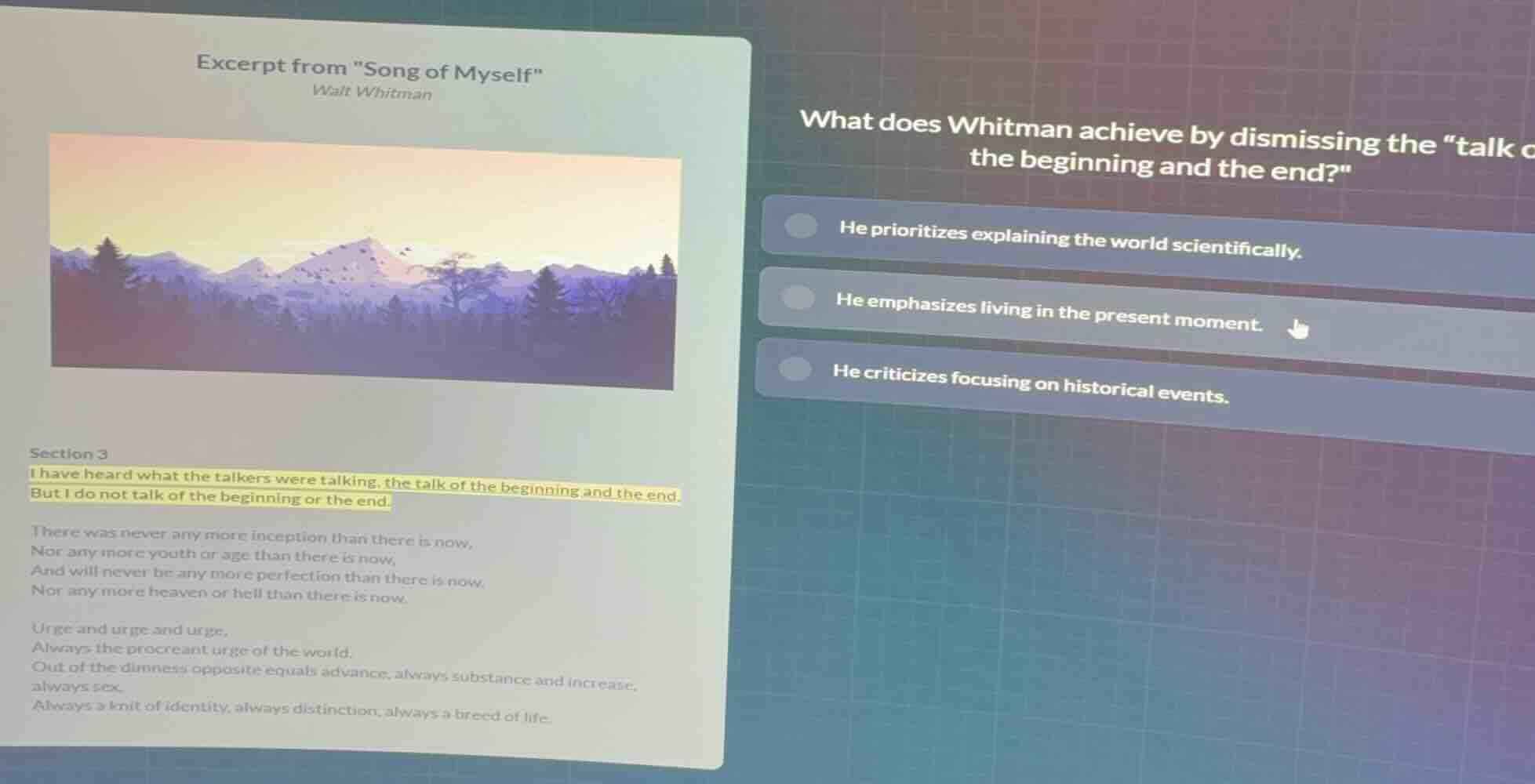
i have heard what the talkers were talking, the talk of the beginning and the end,
but i do not talk of the beginning or the end.
there was never any more inception than there is now,
nor any more youth or age than there is now,
and will never be any more perfection than there is now,
nor any more heaven or hell than there is now.
urge and urge and urge,
always the procreant urge of the world.
out of the dimness opposite equals advance, always substance and increase, always sex,
always a knit of identity, always distinction, always a breed of life.
what does whitman achieve by dismissing the \talk of the beginning and the end?\
- he prioritizes explaining the world scientifically.
- he emphasizes living in the present moment.
- he criticizes focusing on historical events.
Analyze the highlighted text
The excerpt from Section 3 of Walt Whitman's "Song of Myself" begins with:
"I have heard what the talkers were talking, the talk of the beginning and the end,
But I do not talk of the beginning or the end."
This shows Whitman consciously dismissing discussions about the past ("the beginning") and the future ("the end").
Connect to Whitman's themes
Using the Whitman Poetic Themes knowledge point, we analyze the lines that immediately follow this dismissal:
"There was never any more inception than there is now,
Nor any more youth or age than there is now,
And will never be any more perfection than there is now,
Nor any more heaven or hell than there is now."
The repetition of "than there is now" strongly emphasizes that the present moment contains all the inception, youth, age, perfection, heaven, and hell that ever was or will be.
Evaluate the options
- Option 1: "He prioritizes explaining the world scientifically." This is incorrect because Whitman's focus here is philosophical and experiential, not scientific.
- Option 2: "He emphasizes living in the present moment." This is correct. By rejecting talk of the beginning and the end, he redirects focus entirely to the absolute value of "now."
- Option 3: "He criticizes focusing on historical events." While he dismisses "the beginning," his primary goal is not a specific critique of historical study, but rather a celebration of the present.
Formulate the final conclusion
Whitman dismisses the "talk of the beginning and the end" to emphasize the supreme importance of the present moment ("now").

Snap & solve any problem in the app
Get step-by-step solutions on Sovi AI
Photo-based solutions with guided steps
Explore more problems and detailed explanations
- He prioritizes explaining the world scientifically.
- He emphasizes living in the present moment. (Correct answer)
- He criticizes focusing on historical events.