QUESTION IMAGE
Question
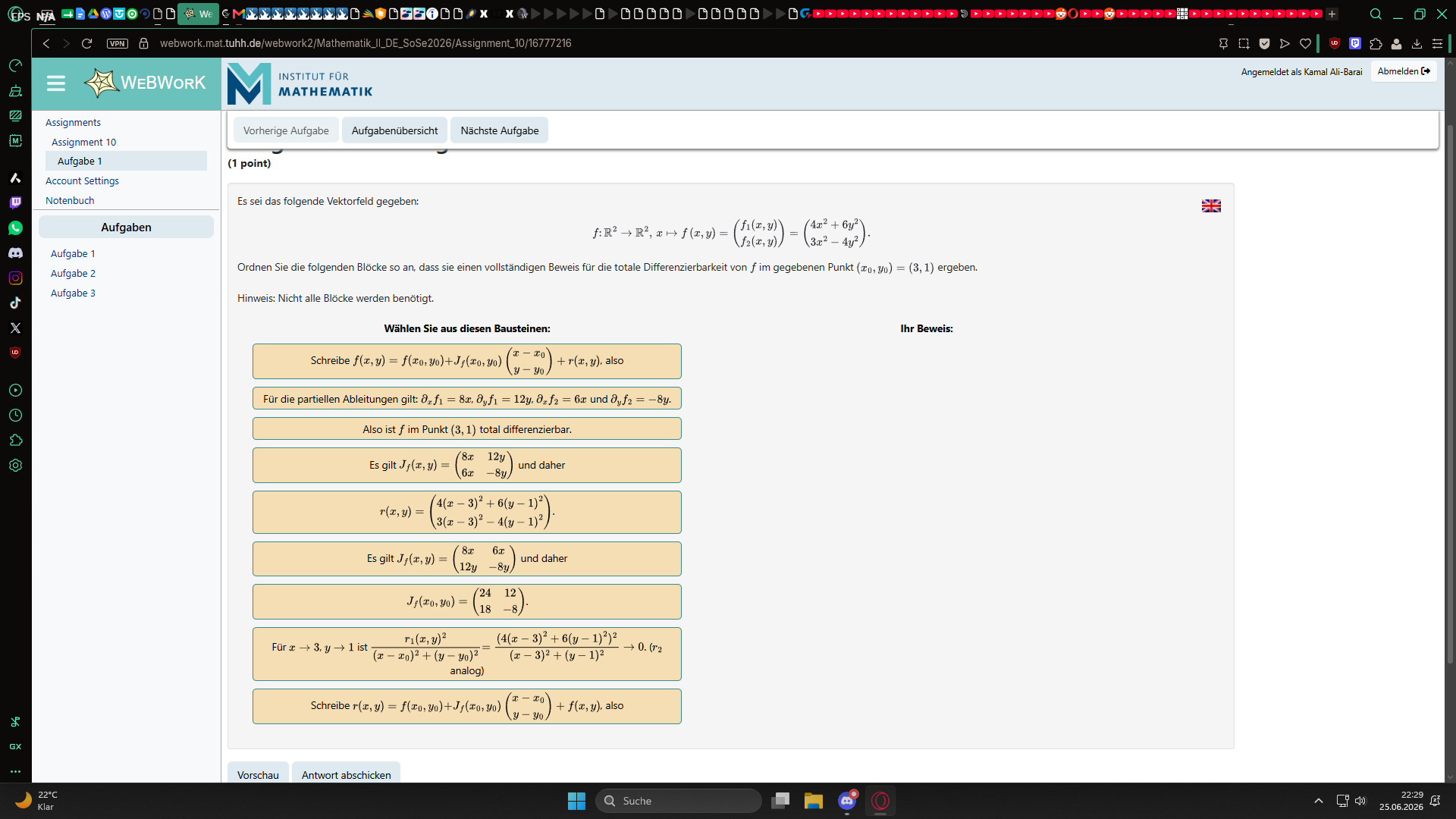
es sei das folgende vektorfeld gegeben:
\\ f: \mathbb{r}^2 \to \mathbb{r}^2, \\ x \mapsto f(x,y) = \
= \
. \\
ordnen sie die folgenden blöcke so an, dass sie einen vollständigen beweis für die totale differenzierbarkeit von \\( f \\) im gegebenen punkt \\( (x_0, y_0) = (3, 1) \\) ergeben.
hinweis: nicht alle blöcke werden benötigt.
wählen sie aus diesen bausteinen:
- schreibe \\( f(x,y) = f(x_0, y_0) + j_f(x_0, y_0) \
+ r(x,y) \\), also
- für die partiellen ableitungen gilt: \\( \partial_x f_1 = 8x \\), \\( \partial_y f_1 = 12y \\), \\( \partial_x f_2 = 6x \\) und \\( \partial_y f_2 = -8y \\).
- also ist \\( f \\) im punkt \\( (3, 1) \\) total differenzierbar.
- es gilt \\( j_f(x,y) = \
\\) und daher
- \\( r(x,y) = \
\\)
- es gilt \\( j_f(x,y) = \
\\) und daher
- \\( j_f(x_0, y_0) = \
\\)
- für \\( x \to 3, y \to 1 \\) ist \\( \frac{r_1(x,y)^2}{(x-x_0)^2 + (y-y_0)^2} = \frac{(4(x-3)^2 + 6(y-1)^2)^2}{(x-3)^2 + (y-1)^2} \to 0 \\). (\\( r_2 \\) analog)
- schreibe \\( r(x,y) = f(x,y) + j_f(x_0, y_0) \
+ f(x,y) \\), also
🆕 New Concept Discovered: Total Differentiability of Vector Fields
Showing a function is differentiable using its Jacobian matrix.
Step 1: Calculate Partial Derivatives
To prove total differentiability, we first compute the partial derivatives of the component functions \( f_1(x, y) = 4x^2 + 6y^2 \) and \( f_2(x, y) = 3x^2 - 4y^2 \):
This corresponds to the block:
- "Für die partiellen Ableitungen gilt: \(\partial_x f_1 = 8x\), \(\partial_y f_1 = 12y\), \(\partial_x f_2 = 6x\) und \(\partial_y f_2 = -8y\)."
---
Step 2: Construct the Jacobian Matrix
The Jacobian matrix \( J_f(x, y) \) is structured with the partial derivatives of \( f_1 \) in the first row and \( f_2 \) in the second row:
This corresponds to the block:
- **"Es gilt \( J_f(x, y) =
\) und daher"**
---
Step 3: Evaluate the Jacobian at the Given Point
We evaluate the Jacobian matrix at the point \((x_0, y_0) = (3, 1)\):
This corresponds to the block:
- **"\( J_f(x_0, y_0) =
\)."**
---
Step 4: Define the Linear Approximation and Remainder Term
By definition, a function is totally differentiable at \((x_0, y_0)\) if we can write it as a linear approximation plus a remainder term \( r(x, y) \) that vanishes faster than the distance to the point:
This corresponds to the block:
- **"Schreibe \( f(x, y) = f(x_0, y_0) + J_f(x_0, y_0)
+ r(x, y) \), also"**
---
Step 5: Express the Remainder Term Explicitly
By substituting the functions and their linear approximations, we find the components of the remainder vector \( r(x, y) =
\):
This corresponds to the block:
- **"\( r(x, y) =
\)."**
---
Step 6: Analyze the Limit of the Remainder Term
For total differentiability, the remainder term divided by the Euclidean distance must approach \( 0 \) as \((x, y) \to (3, 1)\):
Note that the block in the exercise uses the squared distance in the denominator, which also correctly shows that the ratio goes to \( 0 \):
This corresponds to the block:
- "Für \( x \to 3, y \to 1 \) ist \( \frac{r_1(x, y)^2}{(x - x_0)^2 + (y - y_0)^2} = \frac{(4(x - 3)^2 + 6(y - 1)^2)^2}{(x - 3)^2 + (y - 1)^2} \to 0 \). (\( r_2 \) analog)"
---
Step 7: Conclude Total Differentiability
Since the limit condition holds, the function is totally differentiable at the given point.
This corresponds to the block:
- "Also ist \( f \) im Punkt \( (3, 1) \) total differenzierbar."
---

Snap & solve any problem in the app
Get step-by-step solutions on Sovi AI
Photo-based solutions with guided steps
Explore more problems and detailed explanations
Arrange the blocks in the following order to complete the proof:
- Für die partiellen Ableitungen gilt: \(\partial_x f_1 = 8x\), \(\partial_y f_1 = 12y\), \(\partial_x f_2 = 6x\) und \(\partial_y f_2 = -8y\).
- **Es gilt \( J_f(x, y) =
\) und daher**
- **\( J_f(x_0, y_0) =
\).**
- **Schreibe \( f(x, y) = f(x_0, y_0) + J_f(x_0, y_0)
+ r(x, y) \), also**
- **\( r(x, y) =
\).**
- Für \( x \to 3, y \to 1 \) ist \( \frac{r_1(x, y)^2}{(x - x_0)^2 + (y - y_0)^2} = \frac{(4(x - 3)^2 + 6(y - 1)^2)^2}{(x - 3)^2 + (y - 1)^2} \to 0 \). (\( r_2 \) analog)
- Also ist \( f \) im Punkt \( (3, 1) \) total differenzierbar.