QUESTION IMAGE
Question
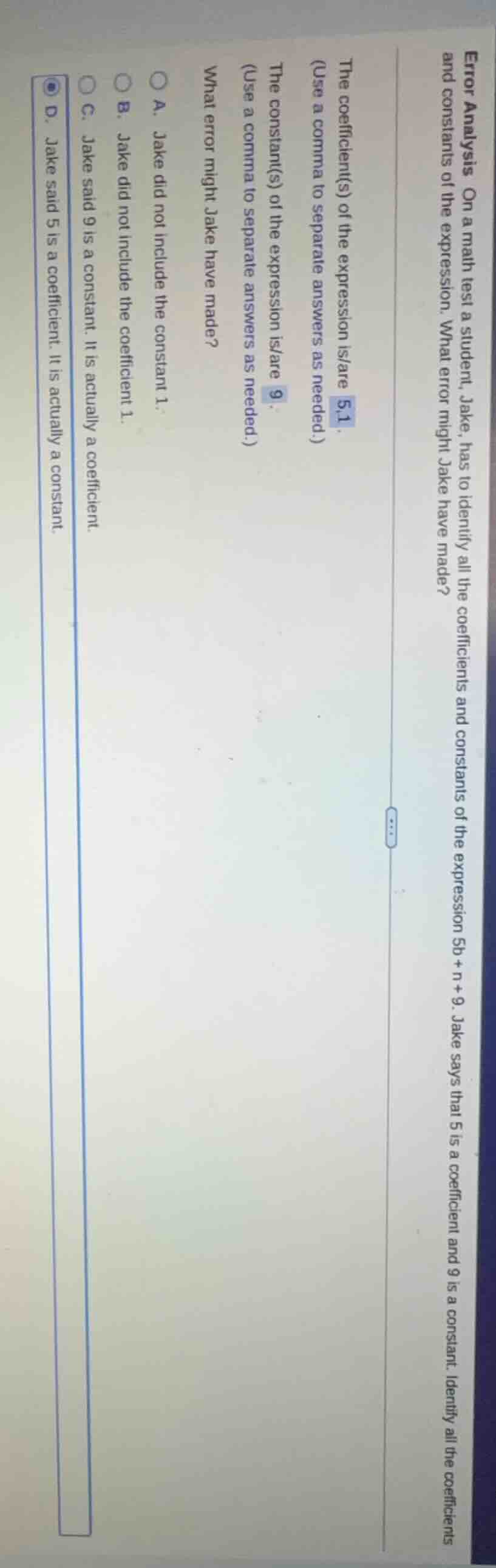
error analysis on a math test a student, jake, has to identify all the coefficients and constants of the expression 5b + n + 9. jake says that 5 is a coefficient and 9 is a constant. identify all the coefficients and constants of the expression. what error might jake have made? the coefficient(s) of the expression is/are 5,1. (use a comma to separate answers as needed.) the constant(s) of the expression is/are 9. (use a comma to separate answers as needed.) what error might jake have made? a. jake did not include the constant 1. b. jake did not include the coefficient 1. c. jake said 9 is a constant. it is actually a coefficient. d. jake said 5 is a coefficient. it is actually a constant.
Step1: Analyze the expression \(5b + n + 9\)
- A coefficient is a number multiplied by a variable. In \(5b\), the coefficient of \(b\) is \(5\). In \(n\), the term can be written as \(1n\), so the coefficient of \(n\) is \(1\).
- A constant is a term without a variable, so \(9\) is a constant.
Step2: Evaluate Jake's answers
- Jake said coefficients are \(5,1\) (wait, no, the first part says he said coefficients are \(5,1\)? Wait, no, the problem says "Jake says that 5 is a coefficient and 9 is a constant". Wait, the first blue box says "The coefficient(s) of the expression is/are 5,1" (maybe Jake's answer for coefficients) and "The constant(s) of the expression is/are 9". But when checking the error:
- For the term \(n\), the coefficient is \(1\) (since \(n = 1\times n\)). Jake's coefficient list: if he only included \(5\) (and maybe thought \(1\) is not a coefficient), or for the constant, no, the constant is \(9\) (correct). Wait, the options:
- Option B: "Jake did not include the coefficient 1." Because in the term \(n\), the coefficient is \(1\) (since \(n = 1n\)), so if Jake's coefficients are \(5\) (and maybe he missed \(1\)), that's the error. Let's check the options:
- Option A: "Jake did not include the constant 1." But \(1\) is a coefficient, not a constant. So A is wrong.
- Option B: "Jake did not include the coefficient 1." Since \(n\) has coefficient \(1\), if Jake didn't include \(1\) as a coefficient, that's the error.
- Option C: "Jake said 9 is a constant. It is actually a coefficient." But \(9\) is a constant (no variable), so C is wrong.
- Option D: "Jake said 5 is a coefficient. It is actually a constant." But \(5\) is a coefficient (of \(b\) in \(5b\)), so D is wrong.

Snap & solve any problem in the app
Get step-by-step solutions on Sovi AI
Photo-based solutions with guided steps
Explore more problems and detailed explanations
B. Jake did not include the coefficient 1.