Sovi.AI - AI Math Tutor

Scan to solve math questions

QUESTION IMAGE

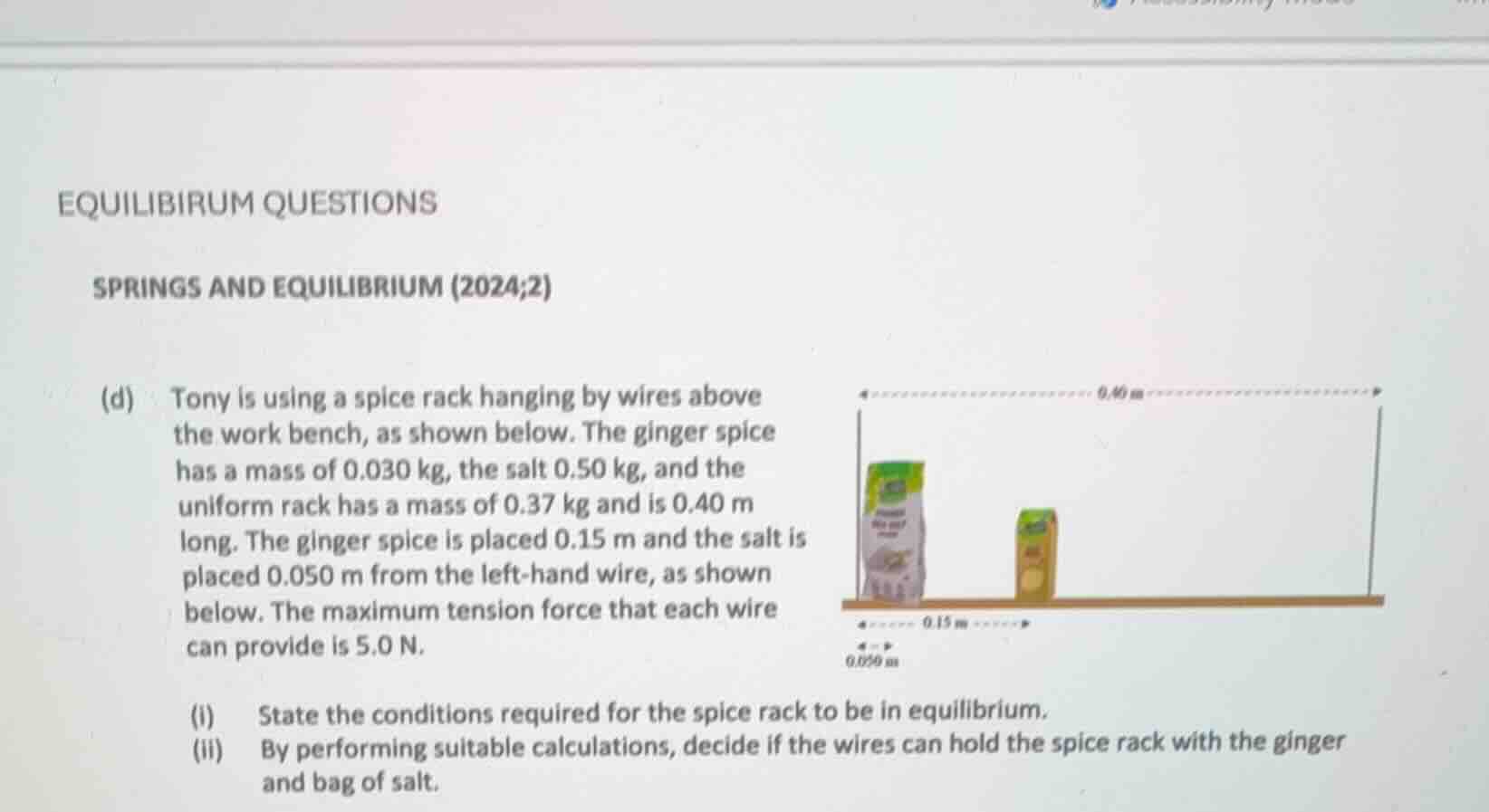
equilibirum questions springs and equilibrium (2024;2) (d) tony is usin…
26,079 Learners found this answer helpful

Question

equilibirum questions

springs and equilibrium (2024;2)

(d) tony is using a spice rack hanging by wires above the work bench, as shown below. the ginger spice has a mass of 0.030 kg, the salt 0.50 kg, and the uniform rack has a mass of 0.37 kg and is 0.40 m long. the ginger spice is placed 0.15 m and the salt is placed 0.050 m from the left-hand wire, as shown below. the maximum tension force that each wire can provide is 5.0 n.

(i) state the conditions required for the spice rack to be in equilibrium.
(ii) by performing suitable calculations, decide if the wires can hold the spice rack with the ginger and bag of salt.

Explanation:

Response

<pre_analysis>
{
"quality": "clear",
"question_count": 2,
"skills_matched": [
"step_cot",
"explain_then_answer",
"tutor"
],
"needs_drawing": false,
"concepts_used": [],
"new_concepts": [
"Rotational Equilibrium",
"Translational Equilibrium",
"Torque Balance"
],
"current_concepts": [
"Rotational Equilibrium",
"Translational Equilibrium",
"Torque Balance",
"Static Equilibrium"
]
}
</pre_analysis>

<reasoning>

State the conditions for equilibrium

For an object to be in static equilibrium, two conditions must be met:

  1. The net external force acting on the system must be zero (translational equilibrium):

\[ \sum \vec{F} = 0 \]

  1. The net external torque acting on the system about any pivot point must be zero (rotational equilibrium):

\[ \sum \vec{\tau} = 0 \]

Define the system parameters

Let the left-hand wire be at position \(x = 0\ \text{m}\) and the right-hand wire be at \(x = 0.40\ \text{m}\).

  • Length of the rack, \(L = 0.40\ \text{m}\)
  • Mass of the uniform rack, \(m_{\text{rack}} = 0.37\ \text{kg}\), acting at its center of mass \(x_{\text{rack}} = 0.20\ \text{m}\)
  • Mass of salt, \(m_{\text{salt}} = 0.50\ \text{kg}\), at \(x_{\text{salt}} = 0.050\ \text{m}\)
  • Mass of ginger, \(m_{\text{ginger}} = 0.030\ \text{kg}\), at \(x_{\text{ginger}} = 0.15\ \text{m}\)
  • Acceleration due to gravity, \(g = 9.8\ \text{m/s}^2\) (or \(9.81\ \text{m/s}^2\))

Let us calculate the gravitational forces (weights):

  • \(F_{g,\text{rack}} = 0.37 \times 9.8 = 3.626\ \text{N}\)
  • \(F_{g,\text{salt}} = 0.50 \times 9.8 = 4.90\ \text{N}\)
  • \(F_{g,\text{ginger}} = 0.030 \times 9.8 = 0.294\ \text{N}\)

Calculate the tension in the right-hand wire

Take the pivot point at the left-hand wire (\(x = 0\)). The sum of torques about this pivot must equal zero:
\[ \sum \tau_{\text{left}} = 0 \]
\[ (T_{\text{right}} \times L) - (F_{g,\text{salt}} \times x_{\text{salt}}) - (F_{g,\text{ginger}} \times x_{\text{ginger}}) - (F_{g,\text{rack}} \times x_{\text{rack}}) = 0 \]
\[ T_{\text{right}} \times 0.40 = (4.90 \times 0.050) + (0.294 \times 0.15) + (3.626 \times 0.20) \]
\[ T_{\text{right}} \times 0.40 = 0.245 + 0.0441 + 0.7252 = 1.0143\ \text{N}\cdot\text{m} \]
\[ T_{\text{right}} = \frac{1.0143}{0.40} \approx 2.54\ \text{N} \]

Calculate the tension in the left-hand wire

Using translational equilibrium, the sum of upward forces must equal the sum of downward forces:
\[ T_{\text{left}} + T_{\text{right}} = F_{g,\text{salt}} + F_{g,\text{ginger}} + F_{g,\text{rack}} \]
\[ T_{\text{left}} + 2.54 = 4.90 + 0.294 + 3.626 = 8.82\ \text{N} \]
\[ T_{\text{left}} = 8.82 - 2.54 = 6.28\ \text{N} \]

Compare calculated tensions with the maximum limit

The maximum tension force that each wire can support is \(5.0\ \text{N}\).

  • Calculated tension in the right wire: \(T_{\text{right}} \approx 2.54\ \text{N}\) (which is less than \(5.0\ \text{N}\))
  • Calculated tension in the left wire: \(T_{\text{left}} \approx 6.28\ \text{N}\) (which is greater than \(5.0\ \text{N}\))

Since the tension in the left-hand wire exceeds the maximum limit of \(5.0\ \text{N}\), the wires cannot hold the spice rack.
</reasoning>

<answer>

Question (i)

The two conditions required for the spice rack to be in equilibrium are:

  1. Translational Equilibrium: The vector sum of all external forces acting on the rack must be zero (\(\sum \vec{F} = 0\)).
  2. Rotational Equilibrium: The vector sum of all external torques acting on the rack about any pivot point must be zero (\(\sum \vec{\tau} = 0\)).

Question (ii)

No, the wires…

Answer:

<pre_analysis>
{
"quality": "clear",
"question_count": 2,
"skills_matched": [
"step_cot",
"explain_then_answer",
"tutor"
],
"needs_drawing": false,
"concepts_used": [],
"new_concepts": [
"Rotational Equilibrium",
"Translational Equilibrium",
"Torque Balance"
],
"current_concepts": [
"Rotational Equilibrium",
"Translational Equilibrium",
"Torque Balance",
"Static Equilibrium"
]
}
</pre_analysis>

<reasoning>

State the conditions for equilibrium

For an object to be in static equilibrium, two conditions must be met:

  1. The net external force acting on the system must be zero (translational equilibrium):

\[ \sum \vec{F} = 0 \]

  1. The net external torque acting on the system about any pivot point must be zero (rotational equilibrium):

\[ \sum \vec{\tau} = 0 \]

Define the system parameters

Let the left-hand wire be at position \(x = 0\ \text{m}\) and the right-hand wire be at \(x = 0.40\ \text{m}\).

  • Length of the rack, \(L = 0.40\ \text{m}\)
  • Mass of the uniform rack, \(m_{\text{rack}} = 0.37\ \text{kg}\), acting at its center of mass \(x_{\text{rack}} = 0.20\ \text{m}\)
  • Mass of salt, \(m_{\text{salt}} = 0.50\ \text{kg}\), at \(x_{\text{salt}} = 0.050\ \text{m}\)
  • Mass of ginger, \(m_{\text{ginger}} = 0.030\ \text{kg}\), at \(x_{\text{ginger}} = 0.15\ \text{m}\)
  • Acceleration due to gravity, \(g = 9.8\ \text{m/s}^2\) (or \(9.81\ \text{m/s}^2\))

Let us calculate the gravitational forces (weights):

  • \(F_{g,\text{rack}} = 0.37 \times 9.8 = 3.626\ \text{N}\)
  • \(F_{g,\text{salt}} = 0.50 \times 9.8 = 4.90\ \text{N}\)
  • \(F_{g,\text{ginger}} = 0.030 \times 9.8 = 0.294\ \text{N}\)

Calculate the tension in the right-hand wire

Take the pivot point at the left-hand wire (\(x = 0\)). The sum of torques about this pivot must equal zero:
\[ \sum \tau_{\text{left}} = 0 \]
\[ (T_{\text{right}} \times L) - (F_{g,\text{salt}} \times x_{\text{salt}}) - (F_{g,\text{ginger}} \times x_{\text{ginger}}) - (F_{g,\text{rack}} \times x_{\text{rack}}) = 0 \]
\[ T_{\text{right}} \times 0.40 = (4.90 \times 0.050) + (0.294 \times 0.15) + (3.626 \times 0.20) \]
\[ T_{\text{right}} \times 0.40 = 0.245 + 0.0441 + 0.7252 = 1.0143\ \text{N}\cdot\text{m} \]
\[ T_{\text{right}} = \frac{1.0143}{0.40} \approx 2.54\ \text{N} \]

Calculate the tension in the left-hand wire

Using translational equilibrium, the sum of upward forces must equal the sum of downward forces:
\[ T_{\text{left}} + T_{\text{right}} = F_{g,\text{salt}} + F_{g,\text{ginger}} + F_{g,\text{rack}} \]
\[ T_{\text{left}} + 2.54 = 4.90 + 0.294 + 3.626 = 8.82\ \text{N} \]
\[ T_{\text{left}} = 8.82 - 2.54 = 6.28\ \text{N} \]

Compare calculated tensions with the maximum limit

The maximum tension force that each wire can support is \(5.0\ \text{N}\).

  • Calculated tension in the right wire: \(T_{\text{right}} \approx 2.54\ \text{N}\) (which is less than \(5.0\ \text{N}\))
  • Calculated tension in the left wire: \(T_{\text{left}} \approx 6.28\ \text{N}\) (which is greater than \(5.0\ \text{N}\))

Since the tension in the left-hand wire exceeds the maximum limit of \(5.0\ \text{N}\), the wires cannot hold the spice rack.
</reasoning>

<answer>

Question (i)

The two conditions required for the spice rack to be in equilibrium are:

  1. Translational Equilibrium: The vector sum of all external forces acting on the rack must be zero (\(\sum \vec{F} = 0\)).
  2. Rotational Equilibrium: The vector sum of all external torques acting on the rack about any pivot point must be zero (\(\sum \vec{\tau} = 0\)).

Question (ii)

No, the wires cannot hold the spice rack.

By calculating the tension in each wire:

  • The tension in the right-hand wire is approximately \(2.54\ \text{N}\).
  • The tension in the left-hand wire is approximately \(6.28\ \text{N}\).

Since the tension in the left-hand wire (\(6.28\ \text{N}\)) exceeds the maximum allowable tension of \(5.0\ \text{N}\), the left wire will break.
</answer>

<post_analysis>
{
"subject": "Natural Science",
"question_type": "Multi-part",
"knowledge_point": [
"Natural Science",
"Physics",
"Static Equilibrium"
]
}
</post_analysis>