QUESTION IMAGE
Question
english ii
summer assignment
day 4
passage 1: writing task
directions: after reading \everyday use\ respond to the following prompt.
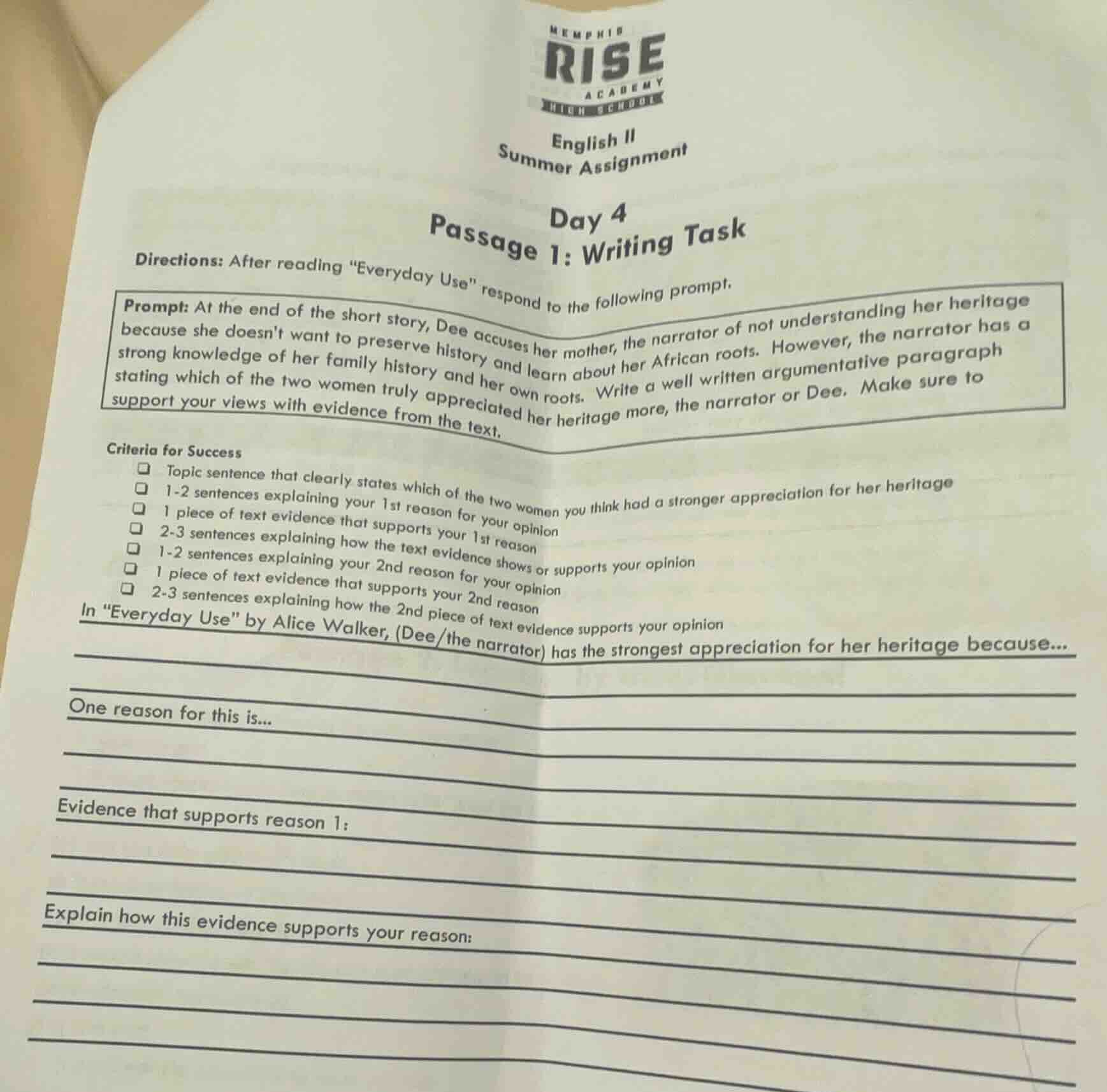
prompt: at the end of the short story, dee accuses her mother, the narrator of not understanding her heritage because she doesnt want to preserve history and learn about her african roots. however, the narrator has a strong knowledge of her family history and her own roots. write a well written argumentative paragraph stating which of the two women truly appreciated her heritage more, the narrator or dee. make sure to support your views with evidence from the text.
criteria for success
- topic sentence that clearly states which of the two women you think had a stronger appreciation for her heritage
- 1-2 sentences explaining your 1st reason for your opinion
- 1 piece of text evidence that supports your 1st reason
- 2-3 sentences explaining how the text evidence shows or supports your opinion
- 1-2 sentences explaining your 2nd reason for your opinion
- 1 piece of text evidence that supports your 2nd reason
- 2-3 sentences explaining how the 2nd piece of text evidence supports your opinion
in \everyday use\ by alice walker, (dee/the narrator) has the strongest appreciation for her heritage because...
one reason for this is...
evidence that supports reason 1:
explain how this evidence supports your reason:
Analyze the prompt and criteria
The prompt asks us to write an argumentative paragraph about Alice Walker's short story "Everyday Use." We must argue whether Dee or the narrator (Mama) truly appreciates her heritage more, using textual evidence.
We will argue that the narrator (Mama) has a stronger appreciation for her heritage because she values the lived history, practical use, and emotional connections of family items, whereas Dee views heritage as an aesthetic, static museum display.
We will structure the response to match the "Criteria for Success" and fill-in-the-blank sentence starters shown on the worksheet:
- Topic Sentence: State that the narrator has the strongest appreciation.
- Reason 1: Explain that the narrator values the functional, lived history of family heirlooms.
- Evidence 1: Reference Mama's decision to let Maggie use the quilts.
- Explanation 1: Explain how this shows true appreciation of heritage through daily connection.
Draft the topic sentence
Using the starter: "In 'Everyday Use' by Alice Walker, the narrator has the strongest appreciation for her heritage because..."
Draft: "In 'Everyday Use' by Alice Walker, the narrator has the strongest appreciation for her heritage because she understands that true heritage is lived and kept alive through daily use, rather than preserved as a static display."
Draft the first reason
Using the starter: "One reason for this is..."
Draft: "One reason for this is that the narrator values the deep, personal memories and ancestral connections embedded in everyday family items."
Select and integrate evidence
Using the starter: "Evidence that supports reason 1:"
Draft: "Evidence that supports reason 1: When discussing the hand-stitched quilts, the narrator insists on giving them to Maggie, who will 'use them' and 'hang them on the bed,' rather than keeping them locked away."
Draft the explanation
Using the starter: "Explain how this evidence supports your reason:"
Draft: "Explain how this evidence supports your reason: This evidence shows that the narrator views heritage as an active, continuous bond shared among family members. By letting Maggie use the quilts, she ensures that the love and labor of their ancestors remain a functional part of their daily lives, unlike Dee, who only wants to hang them on a wall as decorative art."

Snap & solve any problem in the app
Get step-by-step solutions on Sovi AI
Photo-based solutions with guided steps
Explore more problems and detailed explanations
In "Everyday Use" by Alice Walker, the narrator has the strongest appreciation for her heritage because <blank>she understands that true heritage is lived and kept alive through daily use, rather than preserved as a static, aesthetic display.</blank>
One reason for this is... <blank>that the narrator values the deep, personal memories and ancestral connections embedded in everyday family items.</blank>
Evidence that supports reason 1: <blank>When discussing the hand-stitched quilts, the narrator insists on giving them to Maggie, who will "use them" and "hang them on the bed," rather than keeping them locked away.</blank>
Explain how this evidence supports your reason: <blank>This evidence shows that the narrator views heritage as an active, continuous bond shared among family members. By letting Maggie use the quilts, she ensures that the love and labor of their ancestors remain a functional part of their daily lives, unlike Dee, who only wants to hang them on a wall as decorative art.</blank>