Sovi.AI - AI Math Tutor

Scan to solve math questions

QUESTION IMAGE

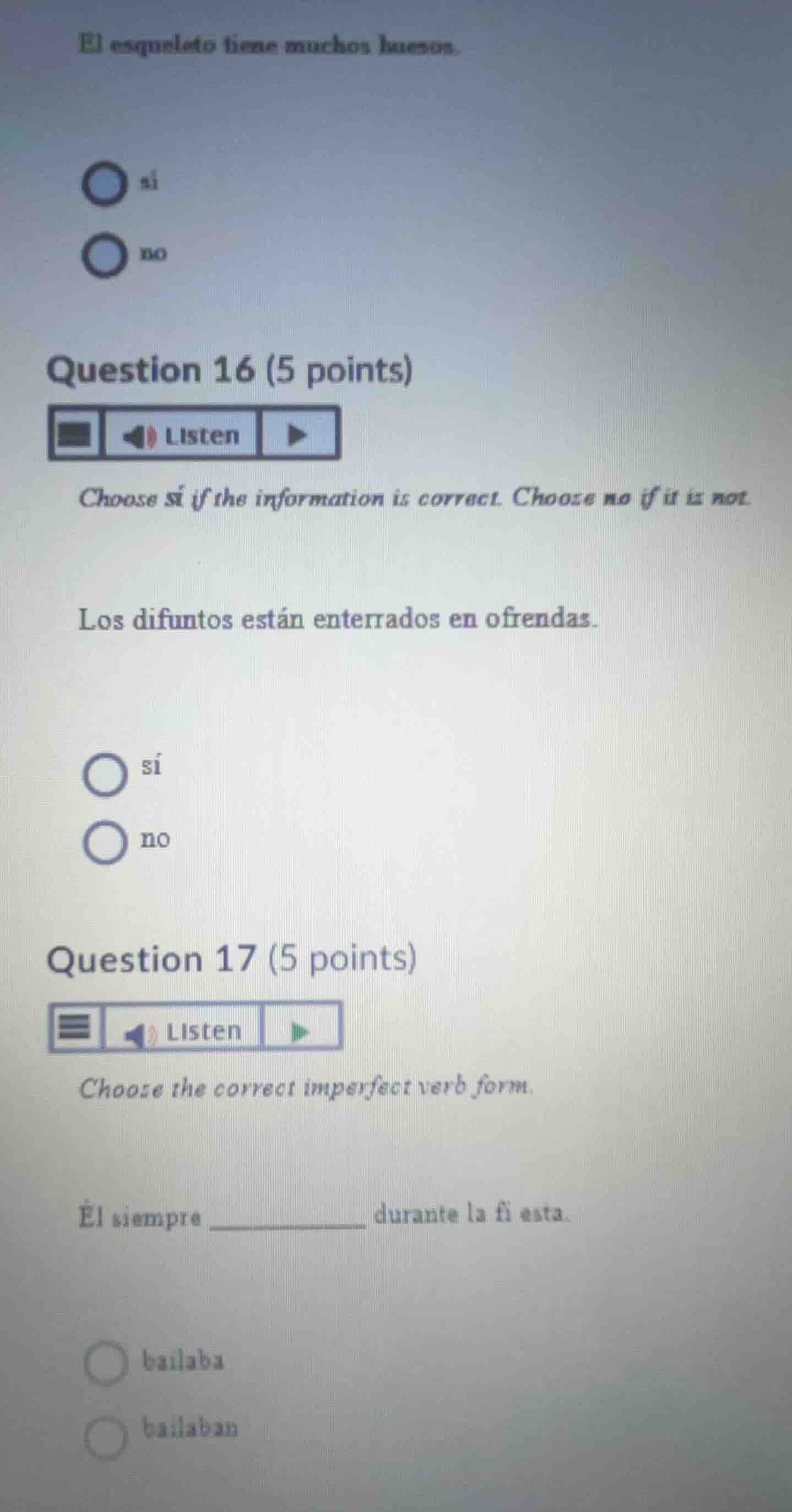
el esqueleto tiene muchos huesos. sí no question 16 (5 points) choose s…

Question

el esqueleto tiene muchos huesos.


no

question 16 (5 points)
choose sí if the information is correct. choose no if it is not.

los difuntos están enterrados en ofrendas.


no

question 17 (5 points)
choose the correct imperfect verb form.

él siempre ________ durante la fiesta.

bailaba
bailaban

Explanation:

Response

<pre_analysis>
{
"quality": "clear",
"question_count": 3,
"skills_matched": [
"direct_cot",
"multiple_choice_formatter",
"explain_then_answer",
"quick"
],
"needs_drawing": false,
"concepts_used": [
"Spanish Vocabulary",
"Spanish Body Parts",
"Day of the Dead Vocabulary",
"Spanish Imperfect Tense",
"Imperfect Conjugation"
],
"new_concepts": [],
"current_concepts": [
"Spanish Vocabulary",
"Spanish Body Parts",
"Day of the Dead Vocabulary",
"Spanish Imperfect Tense",
"Imperfect Conjugation"
]
}
</pre_analysis>

<reasoning>

Analyze the first statement

The statement is "El esqueleto tiene muchos huesos" (The skeleton has many bones). This is a true statement.

Analyze Question 16

The statement is "Los difuntos están enterrados en ofrendas" (The deceased are buried in altars/offerings). Deceased people are buried in cemeteries (cementerios), not inside the decorative altars (ofrendas) built for Day of the Dead. Therefore, this statement is false.

Analyze Question 17

The sentence is "Él siempre ________ durante la fiesta" (He always used to dance during the party). The subject is "Él" (third-person singular). The imperfect conjugation of "bailar" for "él" is "bailaba".
</reasoning>

<answer>

Question 15

<mcq-correct>(A) sí</mcq-correct>
<mcq-option>(B) no</mcq-option>

Question 16

<mcq-option>(A) sí</mcq-option>
<mcq-correct>(B) no</mcq-correct>

Question 17

<mcq-correct>(A) bailaba</mcq-correct>
<mcq-option>(B) bailaban</mcq-option>
</answer>

<post_analysis>
{
"subject": "Others",
"question_type": "Multiple Choice",
"knowledge_point": [
"Others",
"Spanish",
"Spanish Grammar and Vocabulary"
]
}
</post_analysis>

Answer:

<pre_analysis>
{
"quality": "clear",
"question_count": 3,
"skills_matched": [
"direct_cot",
"multiple_choice_formatter",
"explain_then_answer",
"quick"
],
"needs_drawing": false,
"concepts_used": [
"Spanish Vocabulary",
"Spanish Body Parts",
"Day of the Dead Vocabulary",
"Spanish Imperfect Tense",
"Imperfect Conjugation"
],
"new_concepts": [],
"current_concepts": [
"Spanish Vocabulary",
"Spanish Body Parts",
"Day of the Dead Vocabulary",
"Spanish Imperfect Tense",
"Imperfect Conjugation"
]
}
</pre_analysis>

<reasoning>

Analyze the first statement

The statement is "El esqueleto tiene muchos huesos" (The skeleton has many bones). This is a true statement.

Analyze Question 16

The statement is "Los difuntos están enterrados en ofrendas" (The deceased are buried in altars/offerings). Deceased people are buried in cemeteries (cementerios), not inside the decorative altars (ofrendas) built for Day of the Dead. Therefore, this statement is false.

Analyze Question 17

The sentence is "Él siempre ________ durante la fiesta" (He always used to dance during the party). The subject is "Él" (third-person singular). The imperfect conjugation of "bailar" for "él" is "bailaba".
</reasoning>

<answer>

Question 15

<mcq-correct>(A) sí</mcq-correct>
<mcq-option>(B) no</mcq-option>

Question 16

<mcq-option>(A) sí</mcq-option>
<mcq-correct>(B) no</mcq-correct>

Question 17

<mcq-correct>(A) bailaba</mcq-correct>
<mcq-option>(B) bailaban</mcq-option>
</answer>

<post_analysis>
{
"subject": "Others",
"question_type": "Multiple Choice",
"knowledge_point": [
"Others",
"Spanish",
"Spanish Grammar and Vocabulary"
]
}
</post_analysis>