QUESTION IMAGE
Question
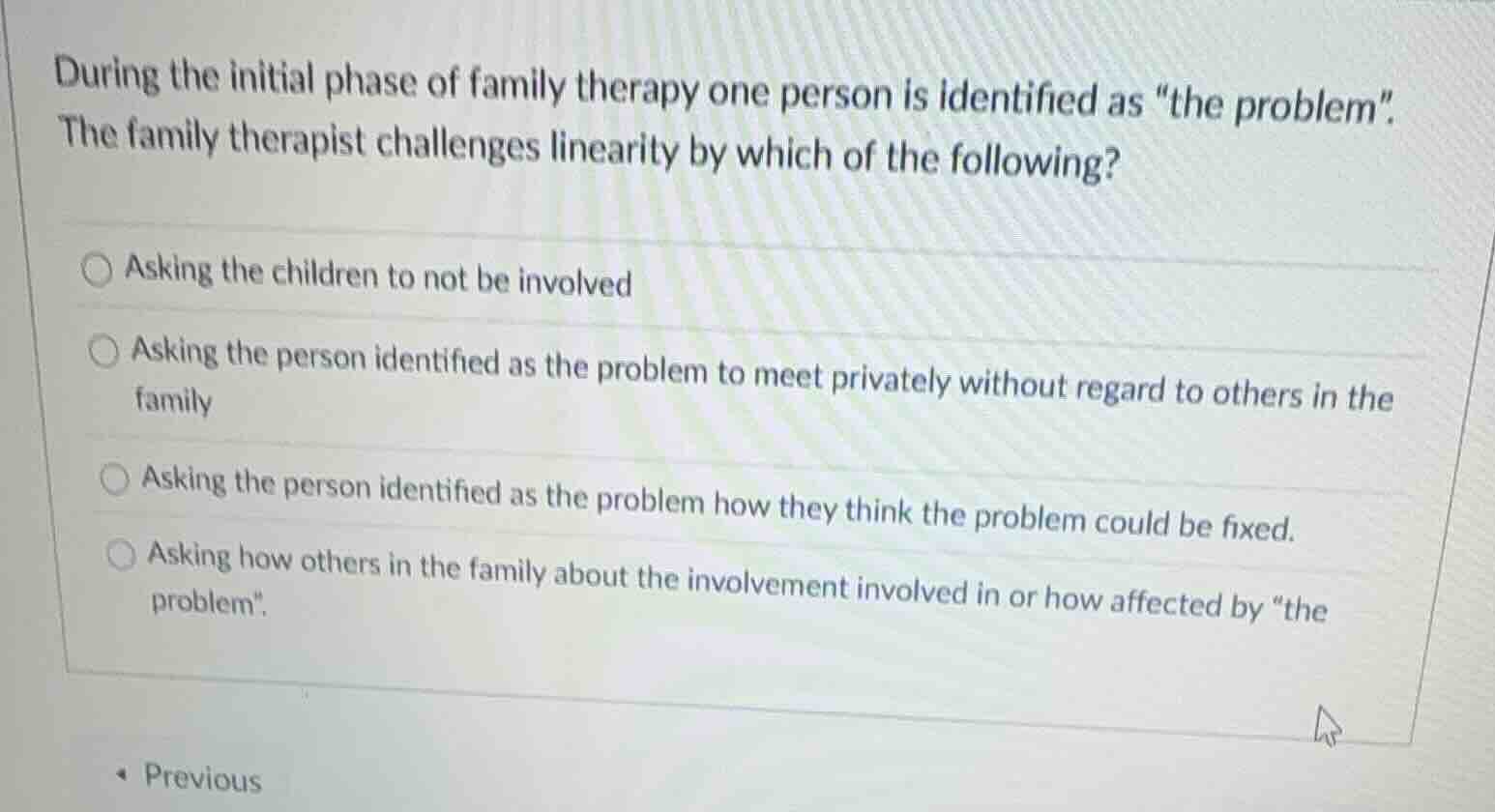
during the initial phase of family therapy one person is identified as \the problem\. the family therapist challenges linearity by which of the following?
asking the children to not be involved
asking the person identified as the problem to meet privately without regard to others in the family
asking the person identified as the problem how they think the problem could be fixed.
asking how others in the family about the involvement involved in or how affected by \the problem\.
🆕 New Concept Discovered: Circular Causality vs. Linear Causality
Shifting focus from one "cause" to family interactions.
Step 1: Understand "Linearity" in Family Therapy
In family systems theory, "linearity" (or linear causality) is the idea that one event directly causes another in a straight line. In a family setting, this looks like blaming a single person—often called the "identified patient" or "the problem"—as the sole cause of the family's distress (e.g., "If only this person behaved, our family would be fine").
To challenge this linear view, a therapist must introduce "circular causality," which shows that everyone's behaviors are interconnected and influence one another in a continuous loop.
Step 2: Evaluate the Options
- Option 1: Asking the children to not be involved
This isolates family members rather than exploring how they interact, which does not challenge linear thinking.
- Option 2: Asking the person identified as the problem to meet privately without regard to others in the family
This reinforces the linear idea that the problem resides solely within that individual, rather than within the family system.
- Option 3: Asking the person identified as the problem how they think the problem could be fixed
While this engages the individual, it still keeps the focus entirely on them as the source and solution of the issue, maintaining a linear perspective.
- Option 4: Asking how others in the family about the involvement involved in or how affected by "the problem"
(Note: Despite the slight typographical errors in the question text, this option asks about the involvement and impact on other family members).
By asking how other family members are involved in or affected by the issue, the therapist shifts the focus from a single individual to the wider family system. This highlights the interconnected relationships and feedback loops, directly challenging the linear assumption that only one person is responsible.

Snap & solve any problem in the app
Get step-by-step solutions on Sovi AI
Photo-based solutions with guided steps
Explore more problems and detailed explanations
Asking how others in the family about the involvement involved in or how affected by "the problem".