QUESTION IMAGE
Question
drills
arithmetic sequences & series
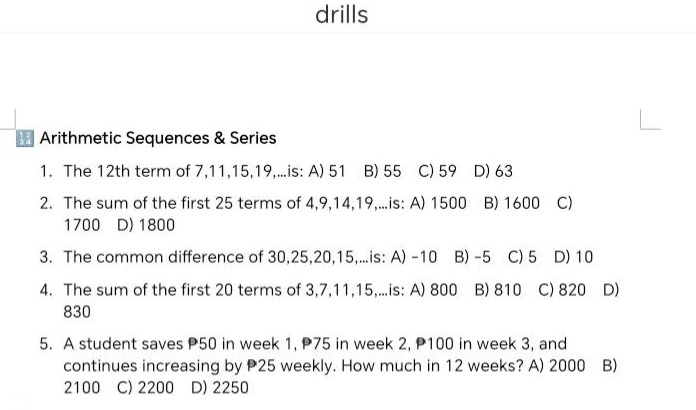
- the 12th term of \\(7,11,15,19,\dots\\) is: a) 51 b) 55 c) 59 d) 63
- the sum of the first 25 terms of \\(4,9,14,19,\dots\\) is: a) 1500 b) 1600 c) 1700 d) 1800
- the common difference of \\(30,25,20,15,\dots\\) is: a) -10 b) -5 c) 5 d) 10
- the sum of the first 20 terms of \\(3,7,11,15,\dots\\) is: a) 800 b) 810 c) 820 d) 830
- a student saves \\(\text{p}50\\) in week 1, \\(\text{p}75\\) in week 2, \\(\text{p}100\\) in week 3, and continues increasing by \\(\text{p}25\\) weekly. how much in 12 weeks? a) 2000 b) 2100 c) 2200 d) 2250
🆕 New Concept Discovered: Arithmetic Sequences and Series
Finding terms and sums of sequences with a constant difference
---
Step 1: Solve Question 1
To find the \(n\)-th term of an arithmetic sequence, we use the formula:
where \(a_1\) is the first term, \(d\) is the common difference, and \(n\) is the term number.
- Sequence: \(7, 11, 15, 19, \dots\)
- First term (\(a_1\)): \(7\)
- Common difference (\(d\)): \(11 - 7 = 4\)
- Term to find (\(n\)): \(12\)
Substitute the values into the formula:
This matches option A.
---
Step 2: Solve Question 2
To find the sum of the first \(n\) terms of an arithmetic sequence, we use the sum formula:
- Sequence: \(4, 9, 14, 19, \dots\)
- First term (\(a_1\)): \(4\)
- Common difference (\(d\)): \(9 - 4 = 5\)
- Number of terms (\(n\)): \(25\)
Substitute the values into the formula:
This matches option B.
---
Step 3: Solve Question 3
The common difference (\(d\)) is found by subtracting any term from the term that immediately follows it:
- Sequence: \(30, 25, 20, 15, \dots\)
- Calculation:
This matches option B.
---
Step 4: Solve Question 4
We use the sum formula again:
- Sequence: \(3, 7, 11, 15, \dots\)
- First term (\(a_1\)): \(3\)
- Common difference (\(d\)): \(7 - 3 = 4\)
- Number of terms (\(n\)): \(20\)
Substitute the values:
This matches option C.
---
Step 5: Solve Question 5
We need to find the total amount saved over \(12\) weeks. This is the sum of an arithmetic series where each week's savings is a term.
- Savings sequence: \(50, 75, 100, \dots\)
- First term (\(a_1\)): \(50\)
- Common difference (\(d\)): \(25\)
- Number of terms (\(n\)): \(12\)
Substitute the values into the sum formula:
This matches option D.
---

Snap & solve any problem in the app
Get step-by-step solutions on Sovi AI
Photo-based solutions with guided steps
Explore more problems and detailed explanations
- A) 51
- B) 1600
- B) -5
- C) 820
- D) 2250