QUESTION IMAGE
Question
b) draw \\(2\boldsymbol{u} - \frac{1}{3}\boldsymbol{v}\\). (4 points)
c) draw \\(\boldsymbol{u} + \boldsymbol{v} + \boldsymbol{w}\\). (4 points)
Identify vector components from the grids
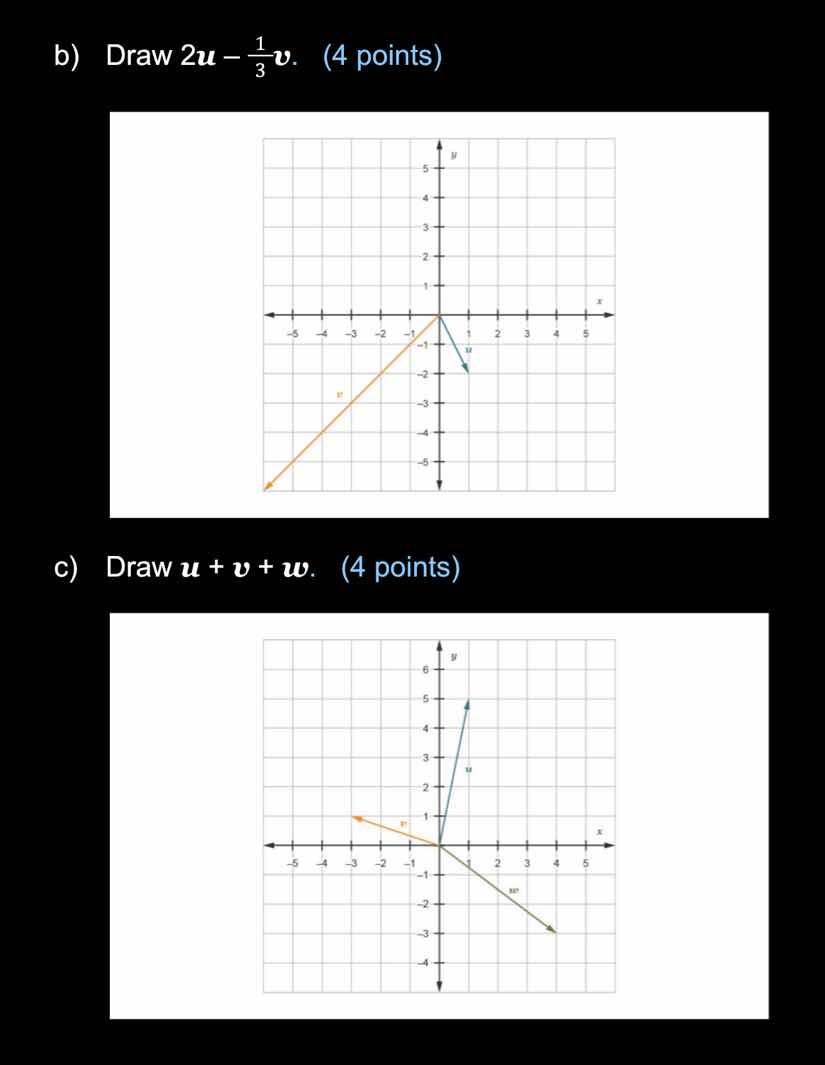
Identify components of each vector.
For part b):
Vector \(\vec{u}\) starts at \((0,0)\) and ends at \((1,-2)\). Thus, \(\vec{u} = \langle 1, -2
angle\).
Vector \(\vec{v}\) starts at \((0,0)\) and ends at \((-6,-6)\). Thus, \(\vec{v} = \langle -6, -6
angle\).
For part c):
Vector \(\vec{u}\) starts at \((0,0)\) and ends at \((1,5)\). Thus, \(\vec{u} = \langle 1, 5
angle\).
Vector \(\vec{v}\) starts at \((0,0)\) and ends at \((-3,1)\). Thus, \(\vec{v} = \langle -3, 1
angle\).
Vector \(\vec{w}\) starts at \((0,0)\) and ends at \((4,-3)\). Thus, \(\vec{w} = \langle 4, -3
angle\).
Calculate the linear combination for part b)
Using Scalar Multiplication and Vector Addition:
Combine these components:
The resulting vector starts at \((0,0)\) and ends at \((4,-2)\).
Calculate the linear combination for part c)
Using Vector Addition for three Geometric Vectors:
Sum the horizontal components:
Sum the vertical components:
The resulting vector starts at \((0,0)\) and ends at \((2,3)\).

Snap & solve any problem in the app
Get step-by-step solutions on Sovi AI
Photo-based solutions with guided steps
Explore more problems and detailed explanations
Question b)
The vector \(2\vec{u} - \frac{1}{3}\vec{v}\) is represented by an arrow starting at the origin \((0,0)\) and ending at the coordinate point \((4, -2)\).
Question c)
The vector \(\vec{u} + \vec{v} + \vec{w}\) is represented by an arrow starting at the origin \((0,0)\) and ending at the coordinate point \((2, 3)\).