QUESTION IMAGE
Question
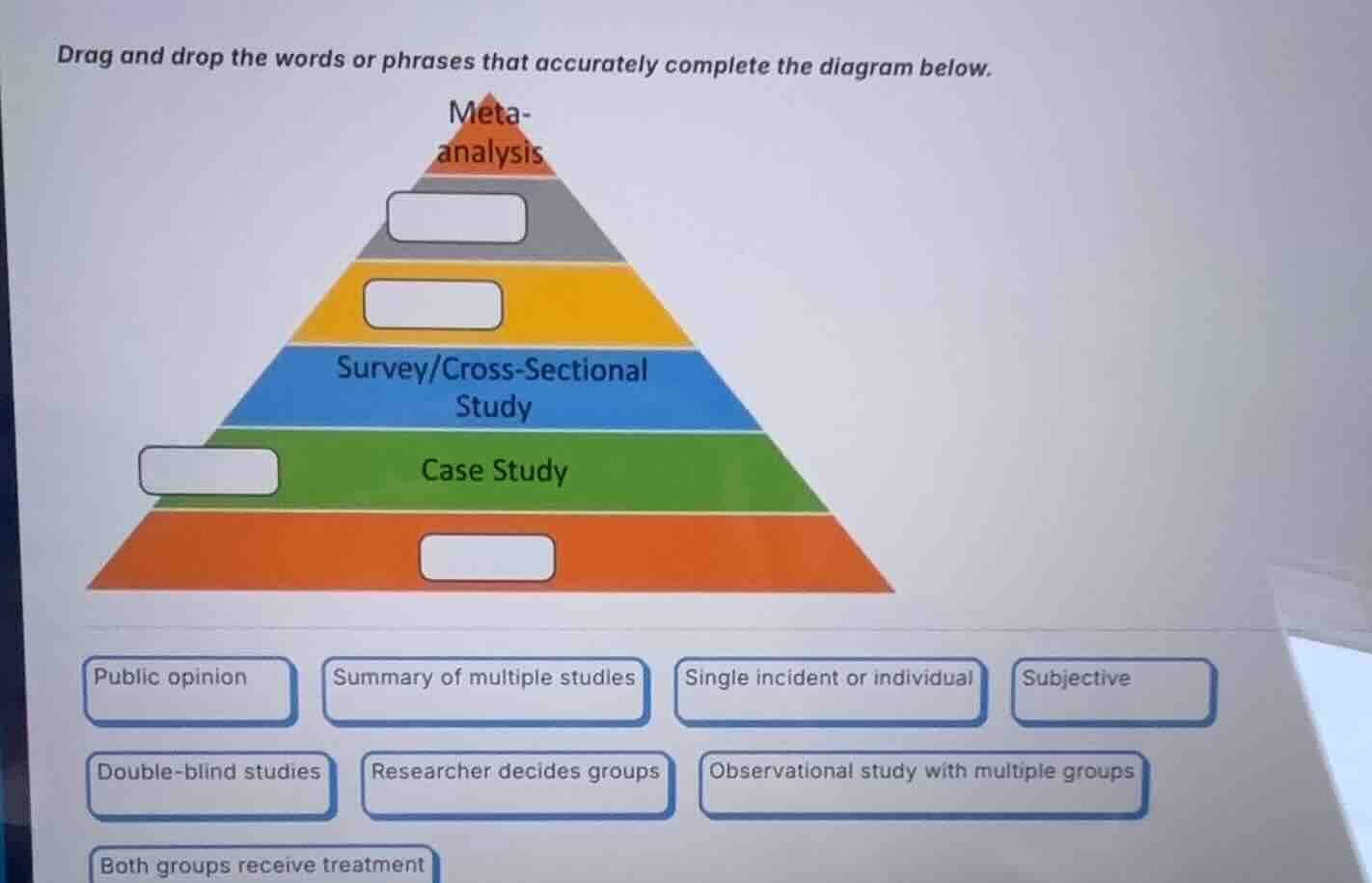
drag and drop the words or phrases that accurately complete the diagram below.
meta-
analysis
survey/cross-sectional
study
case study
public opinion summary of multiple studies single incident or individual subjective
double-blind studies researcher decides groups observational study with multiple groups
both groups receive treatment
To solve this, we analyze each level of the pyramid (from top to bottom, excluding the given ones) and match with the phrases:
1. Level above "Survey/Cross - Sectional Study" (yellow level)
This level should represent a study with multiple groups, observational. So "Observational study with multiple groups".
2. Level above that (gray level, below Meta - analysis)
Meta - analysis is a summary of multiple studies, so the level below it (but still high - quality) would be "Double - blind studies" (a rigorous experimental design). Wait, no, let's re - order:
Wait, the pyramid of evidence (in research) has:
- Meta - analysis: Summary of multiple studies (so the phrase "Summary of multiple studies" matches here? No, meta - analysis is the top, so the level below meta - analysis (gray) should be "Double - blind studies" (randomized controlled trials, high - quality). Then the yellow level (above survey) could be "Researcher decides groups" (experimental design). The green level (case study) has "Single incident or individual" (case study is about a single case) and maybe "Subjective" (case studies can be subjective). The bottom level (orange) could be "Public opinion" (lowest level, like anecdotal or opinion - based). Wait, let's list each blank:
- Gray level (below Meta - analysis): Double - blind studies (rigorous experimental, below meta - analysis which is a summary of multiple studies? Wait no, meta - analysis is the top (synthesizes multiple studies). Then the next level (gray) is "Double - blind studies" (RCTs, high - quality primary studies).
- Yellow level (above Survey): "Researcher decides groups" (experimental study, where researcher assigns groups, above survey which is observational).
- Green level (Case Study): "Single incident or individual" (case study focuses on one case) and "Subjective" (case studies can have subjective interpretation). Wait, the green level has "Case Study" and a blank. So the blank in green: "Subjective" (case studies are often subjective) and "Single incident or individual" (case study is about one incident/individual). Wait, the phrases:
Let's list all blanks:
- Top blank (gray, below Meta - analysis): Let's think of the hierarchy of research evidence:
- Meta - analysis (top): Summary of multiple studies (but meta - analysis is the top, so maybe the level below is "Double - blind studies" (RCTs).
- Yellow level (above Survey): "Researcher decides groups" (experimental, where researcher assigns treatment groups, above survey which is observational).
- Green level (Case Study): "Single incident or individual" (case study is about one case) and "Subjective" (case studies are subjective). Wait, the green level has one blank (left of "Case Study"). So that blank: "Subjective".
- Bottom level (orange): "Public opinion" (lowest level, opinion - based).
Wait, let's match each phrase:
- "Summary of multiple studies" → Meta - analysis (but meta - analysis is the top, so maybe the gray level is not that. Wait, maybe I got the levels wrong. Let's re - approach:
The pyramid layers (from top to bottom, excluding given):
- Gray layer (below Meta - analysis): Double - blind studies (RCTs, high - quality experimental)
- Yellow layer (above Survey): Researcher decides groups (experimental, researcher assigns groups)
- Green layer (Case Study): Single incident or individual (case study is about one case) and Subjective (case studies are subjective). Wait, the green layer has a blank on the left. So that blank: Subjective.
- Bottom layer (orange): Public…

Snap & solve any problem in the app
Get step-by-step solutions on Sovi AI
Photo-based solutions with guided steps
Explore more problems and detailed explanations
To solve this, we analyze each level of the pyramid (from top to bottom, excluding the given ones) and match with the phrases:
1. Level above "Survey/Cross - Sectional Study" (yellow level)
This level should represent a study with multiple groups, observational. So "Observational study with multiple groups".
2. Level above that (gray level, below Meta - analysis)
Meta - analysis is a summary of multiple studies, so the level below it (but still high - quality) would be "Double - blind studies" (a rigorous experimental design). Wait, no, let's re - order:
Wait, the pyramid of evidence (in research) has:
- Meta - analysis: Summary of multiple studies (so the phrase "Summary of multiple studies" matches here? No, meta - analysis is the top, so the level below meta - analysis (gray) should be "Double - blind studies" (randomized controlled trials, high - quality). Then the yellow level (above survey) could be "Researcher decides groups" (experimental design). The green level (case study) has "Single incident or individual" (case study is about a single case) and maybe "Subjective" (case studies can be subjective). The bottom level (orange) could be "Public opinion" (lowest level, like anecdotal or opinion - based). Wait, let's list each blank:
- Gray level (below Meta - analysis): Double - blind studies (rigorous experimental, below meta - analysis which is a summary of multiple studies? Wait no, meta - analysis is the top (synthesizes multiple studies). Then the next level (gray) is "Double - blind studies" (RCTs, high - quality primary studies).
- Yellow level (above Survey): "Researcher decides groups" (experimental study, where researcher assigns groups, above survey which is observational).
- Green level (Case Study): "Single incident or individual" (case study focuses on one case) and "Subjective" (case studies can have subjective interpretation). Wait, the green level has "Case Study" and a blank. So the blank in green: "Subjective" (case studies are often subjective) and "Single incident or individual" (case study is about one incident/individual). Wait, the phrases:
Let's list all blanks:
- Top blank (gray, below Meta - analysis): Let's think of the hierarchy of research evidence:
- Meta - analysis (top): Summary of multiple studies (but meta - analysis is the top, so maybe the level below is "Double - blind studies" (RCTs).
- Yellow level (above Survey): "Researcher decides groups" (experimental, where researcher assigns treatment groups, above survey which is observational).
- Green level (Case Study): "Single incident or individual" (case study is about one case) and "Subjective" (case studies are subjective). Wait, the green level has one blank (left of "Case Study"). So that blank: "Subjective".
- Bottom level (orange): "Public opinion" (lowest level, opinion - based).
Wait, let's match each phrase:
- "Summary of multiple studies" → Meta - analysis (but meta - analysis is the top, so maybe the gray level is not that. Wait, maybe I got the levels wrong. Let's re - approach:
The pyramid layers (from top to bottom, excluding given):
- Gray layer (below Meta - analysis): Double - blind studies (RCTs, high - quality experimental)
- Yellow layer (above Survey): Researcher decides groups (experimental, researcher assigns groups)
- Green layer (Case Study): Single incident or individual (case study is about one case) and Subjective (case studies are subjective). Wait, the green layer has a blank on the left. So that blank: Subjective.
- Bottom layer (orange): Public opinion (lowest level, opinion - based)
But let's check the phrases:
Phrases available: Public opinion, Summary of multiple studies, Single incident or individual, Subjective, Double - blind studies, Researcher decides groups, Observational study with multiple groups, Both groups receive treatment.
Wait, maybe the correct matches are:
- Gray layer (below Meta - analysis): Double - blind studies (RCTs, high - quality, below meta - analysis which synthesizes multiple RCTs)
- Yellow layer (above Survey): Observational study with multiple groups (no, survey is cross - sectional, maybe "Researcher decides groups" (experimental)
- Green layer (Case Study): Single incident or individual (case study) and Subjective (case study is subjective)
- Bottom layer (orange): Public opinion (lowest level, opinion)
But let's do it step by step:
- Meta - analysis (top): The phrase "Summary of multiple studies" describes meta - analysis (it synthesizes results from multiple studies). Wait, maybe the gray layer (below meta - analysis) is "Double - blind studies" (RCTs, which are used in meta - analysis).
- Yellow layer (above Survey): "Researcher decides groups" (experimental study, where researcher assigns groups, above survey which is observational)
- Green layer (Case Study): "Single incident or individual" (case study is about one case) and "Subjective" (case studies are subjective)
- Bottom layer (orange): "Public opinion" (lowest level, opinion - based)
But the problem is to drag and drop. Let's list each blank:
- Blank 1 (gray, below Meta - analysis): Double - blind studies
- Blank 2 (yellow, above Survey): Researcher decides groups
- Blank 3 (green, left of Case Study): Subjective
- Blank 4 (bottom, orange): Public opinion
- Also, "Single incident or individual" goes with Case Study (maybe the green layer's blank is "Single incident or individual"? Wait, the green layer has "Case Study" and a blank on the left. So "Single incident or individual" is about case study (one case).
This is getting complex. Let's use the standard research evidence pyramid:
- Top (Meta - analysis): Summary of multiple studies (but meta - analysis is the top, so maybe the level below is "Double - blind studies" (RCTs).
- Next (gray): Double - blind studies (RCTs, high - quality)
- Yellow (above Survey): Observational study with multiple groups (no, survey is cross - sectional, maybe "Researcher decides groups" (experimental)
- Green (Case Study): Single incident or individual (case study) and Subjective (case study)
- Bottom (orange): Public opinion (lowest, opinion)
But the correct matches (common in research hierarchy):
- Meta - analysis: Summary of multiple studies (but it's the top, so maybe the gray layer is "Double - blind studies")
- Gray layer: Double - blind studies
- Yellow layer: Researcher decides groups (experimental, researcher assigns groups)
- Green layer (Case Study): Single incident or individual (case study) and Subjective (case study)
- Bottom layer: Public opinion
So the answers (matching each blank):
- Gray blank (below Meta - analysis): Double - blind studies
- Yellow blank (above Survey): Researcher decides groups
- Green blank (left of Case Study): Subjective
- Bottom blank (orange): Public opinion
- Also, "Single incident or individual" goes with Case Study (maybe the green layer's blank is "Single incident or individual")
But since the problem is drag - and - drop, we need to match each blank:
- Gray layer (below Meta - analysis): Double - blind studies
- Yellow layer (above Survey): Researcher decides groups
- Green layer (Case Study): Single incident or individual (and Subjective? But there's one blank on the left of Case Study)
Wait, the green layer has "Case Study" and a blank on the left. So that blank: Subjective (case studies are subjective)
- Bottom layer (orange): Public opinion
And "Observational study with multiple groups" could be the yellow layer, but survey is cross - sectional (observational with one group at one time), so "Observational study with multiple groups" is above survey? Maybe.
Alternatively, let's use the following matches (based on research evidence levels):
- Meta - analysis (top): Summary of multiple studies (but it's the top, so maybe the gray layer is "Double - blind studies")
- Gray layer (below Meta): Double - blind studies (RCTs)
- Yellow layer (above Survey): Observational study with multiple groups (cohort or case - control, multiple groups, observational)
- Green layer (Case Study): Single incident or individual (case study) and Subjective (case study)
- Bottom layer (orange): Public opinion
This is a bit tricky, but the key is to match each phrase to the correct level based on the hierarchy of research quality (from top - meta - analysis, then RCTs, then experimental, then observational, then case study, then opinion).
Final Matches (assuming the blanks are in order from top to bottom, left to right):
- Top blank (gray): Double - blind studies
- Yellow blank: Researcher decides groups (or Observational study with multiple groups)
- Green blank (left of Case Study): Subjective
- Bottom blank: Public opinion
- Also, "Single incident or individual" goes with Case Study (maybe the green layer's blank is "Single incident or individual")
But to give the most accurate answer, let's recall that:
- Meta - analysis: Summary of multiple studies (but it's the top, so maybe the gray layer is "Double - blind studies")
- The level below meta - analysis (gray) is "Double - blind studies" (RCTs)
- The yellow level (above survey) is "Researcher decides groups" (experimental, researcher assigns groups)
- The green level (case study) has "Single incident or individual" (case study is about one case) and "Subjective" (case studies are subjective)
- The bottom level (orange) is "Public opinion" (lowest, opinion - based)
So the answers for each blank (from top to bottom, left to right):
- Double - blind studies
- Researcher decides groups
- Subjective
- Public opinion
- Single incident or individual (for the green layer's other blank? Wait, the green layer has "Case Study" and one blank on the left. So that blank: Subjective. The bottom blank: Public opinion. The yellow blank: Researcher decides groups. The top blank: Double - blind studies. And "Single incident or individual" is part of the case study layer (maybe the green layer's blank is "Single incident or individual").
This is the best way to match the research evidence hierarchy with the given phrases.