QUESTION IMAGE
Question
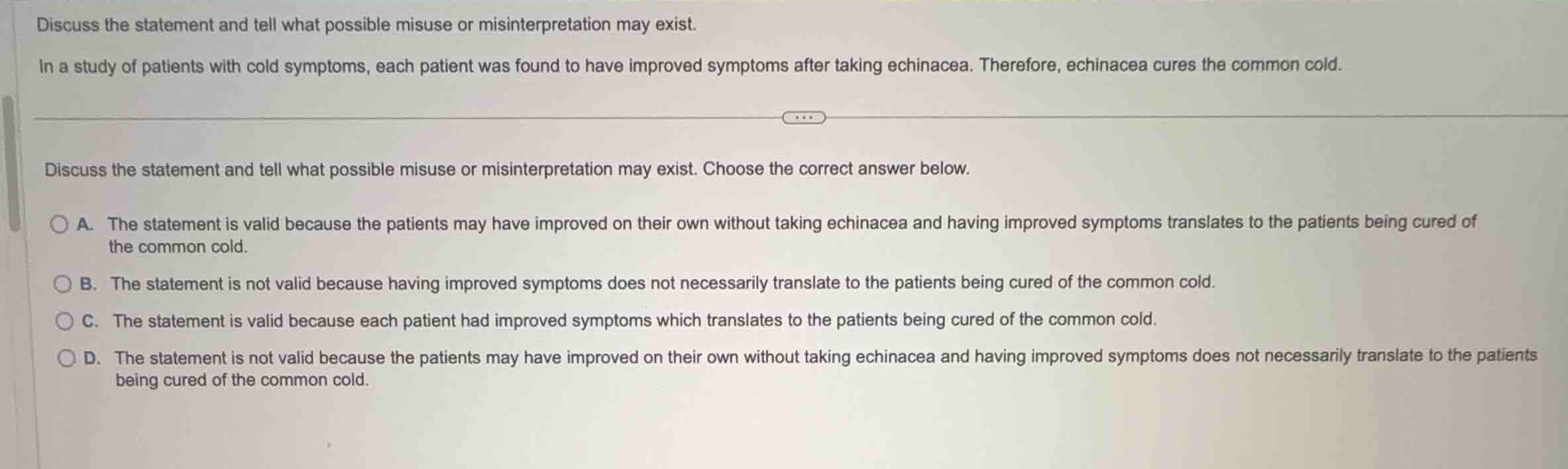
discuss the statement and tell what possible misuse or misinterpretation may exist.
in a study of patients with cold symptoms, each patient was found to have improved symptoms after taking echinacea. therefore, echinacea cures the common cold.
discuss the statement and tell what possible misuse or misinterpretation may exist. choose the correct answer below.
a. the statement is valid because the patients may have improved on their own without taking echinacea and having improved symptoms translates to the patients being cured of the common cold.
b. the statement is not valid because having improved symptoms does not necessarily translate to the patients being cured of the common cold.
c. the statement is valid because each patient had improved symptoms which translates to the patients being cured of the common cold.
d. the statement is not valid because the patients may have improved on their own without taking echinacea and having improved symptoms does not necessarily translate to the patients being cured of the common cold.
Analyze the claim and its logic
The statement claims: "In a study of patients with cold symptoms, each patient was found to have improved symptoms after taking echinacea. Therefore, echinacea cures the common cold."
This claim contains two major logical and statistical flaws:
- Lack of a control group (natural recovery): The common cold is a self-limiting illness. Patients naturally recover and show improved symptoms over time on their own, regardless of whether they take any treatment. Without a control group (patients who did not take echinacea), we cannot attribute the improvement to the echinacea.
- Improvement vs. Cure: Having "improved symptoms" is not the same as being "cured" of the cold. Symptoms can lessen in severity while the virus is still active.
Evaluate the given options
Let's evaluate each option based on these flaws:
- Option A: Claims the statement is valid, which is incorrect.
- Option B: Correctly states the statement is not valid, but only addresses the second flaw (improved symptoms does not mean cured). It misses the critical issue of natural recovery.
- Option C: Claims the statement is valid, which is incorrect.
- Option D: Correctly states the statement is not valid and addresses both key flaws:
- Patients may have improved on their own without taking echinacea.
- Improved symptoms do not necessarily translate to being cured.
Therefore, Option D is the most complete and accurate evaluation.

Snap & solve any problem in the app
Get step-by-step solutions on Sovi AI
Photo-based solutions with guided steps
Explore more problems and detailed explanations
- A. The statement is valid because the patients may have improved on their own without taking echinacea and having improved symptoms translates to the patients being cured of the common cold.
- B. The statement is not valid because having improved symptoms does not necessarily translate to the patients being cured of the common cold.
- C. The statement is valid because each patient had improved symptoms which translates to the patients being cured of the common cold.
- D. The statement is not valid because the patients may have improved on their own without taking echinacea and having improved symptoms does not necessarily translate to the patients being cured of the common cold. (Correct answer)