QUESTION IMAGE
Question
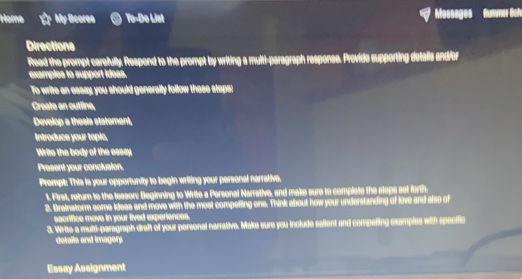
directions
read the prompt carefully. respond to the prompt by writing a multi-paragraph response. provide supporting details and/or examples to support ideas.
to write an essay you should generally follow these steps:
create an outline.
develop a thesis statement.
introduce your topic.
write the body of the essay.
present your conclusion.
prompt: this is your opportunity to begin writing your personal narrative.
- first, return to the lesson: beginning to write a personal narrative, and make sure to complete the steps set forth.
- brainstorm some ideas and move with the most compelling one. think about how your understanding of love and also of sacrifice move in your lived experiences.
- write a multi-paragraph draft of your personal narrative. make sure you include salient and compelling examples with specific details and imagery.
essay assignment
🆕 New Concept Discovered: Personal Narrative Writing
Sharing a true story from your life to reveal a deeper truth.
Step 1: Deconstruct the Prompt
To write a successful personal narrative, we need to break down the prompt's core requirements:
- Topic: A personal story about how your understanding of love and sacrifice has played out in your lived experiences.
- Format: A multi-paragraph essay (typically an introduction, body paragraphs, and a conclusion).
- Key Elements: Specific details, sensory imagery, and a clear narrative arc (beginning, middle, and end).
Step 2: Brainstorming a Narrative Arc
A powerful way to show "love and sacrifice" is through a small, everyday moment rather than a massive, dramatic event.
- The Idea: Helping a family member (like a younger sibling or grandparent) when you had other plans, realizing that putting someone else's needs first is where love and sacrifice meet.
- The Conflict: You have a personal goal or event you really want to attend (e.g., a long-awaited weekend plan with friends), but a family situation arises where you must step in to help.
- The Resolution: Through the act of helping, you experience a quiet moment of connection that changes your perspective on what it means to care for someone.
Step 3: Drafting the Narrative
Let's write a multi-paragraph personal narrative based on this theme, focusing on vivid imagery and emotional reflection.
---

Snap & solve any problem in the app
Get step-by-step solutions on Sovi AI
Photo-based solutions with guided steps
Explore more problems and detailed explanations
Title: The Quiet Weight of Sunday Afternoons
The golden afternoon light filtered through the dusty blinds of our living room, casting long, striped shadows across the carpet. It was a Saturday I had spent weeks planning. My friends were already at the lake, their excited text messages buzzing against my thigh like a persistent insect. I was supposed to be with them, diving into the cool water and escaping the summer heat. Instead, I sat on the floor, surrounded by plastic therapy blocks, looking at my seven-year-old brother, Leo.
Leo has severe developmental delays, and Saturdays are usually his hardest days when his routine is disrupted. That morning, our mother had woken up with a debilitating migraine, leaving her unable to stand. My father was away on a work shift. The choice hadn't been forced on me with words, but rather by the quiet reality of our household. I had to stay. In that moment, watching my friends' Snapchat stories, the word "sacrifice" felt heavy, bitter, and deeply unfair. I felt a knot of resentment tightening in my chest as I closed my phone and slid it into my pocket.
"Stack, Leo," I said, trying to keep my voice gentle despite the frustration bubbling underneath. He looked at me, his wide brown eyes searching my face for a frustration I was trying desperately to hide. He reached out a chubby hand, carefully balancing a blue block on top of a yellow one. When the tower didn't collapse, a brilliant, toothy grin spread across his face, and he let out a joyful, flapping squeal. Looking at his pure excitement, the knot in my chest began to loosen. He didn't know about the lake, or my friends, or the plans I had missed. He only knew that I was there, sitting on the floor with him.
As the hours passed, we built towers, read the same picture book four times, and made a messy lunch of peanut butter sandwiches. I watched him navigate his world with a mixture of vulnerability and determination. It occurred to me then that love isn't just a warm feeling we have when things are easy and convenient. Love is an active choice. It is the willingness to trade our own comfort, our own time, and our own desires to ensure the well-being of someone else. My sacrifice that afternoon wasn't a grand, heroic gesture; it was simply choosing to be fully present in a quiet living room when I wanted to be somewhere else.
By the time my mother emerged from her room, pale but recovered, the sun was dipping below the horizon. Leo was fast asleep on the couch, his head resting against my arm. When I finally pulled my phone out to check the missed messages from the lake, the urge to reply had faded. The day hadn't gone the way I wanted, but as I looked down at my sleeping brother, I realized I wouldn't trade the quiet connection we shared for any afternoon at the lake. I had learned that sacrifice doesn't diminish us; instead, it expands our capacity to love.