QUESTION IMAGE
Question
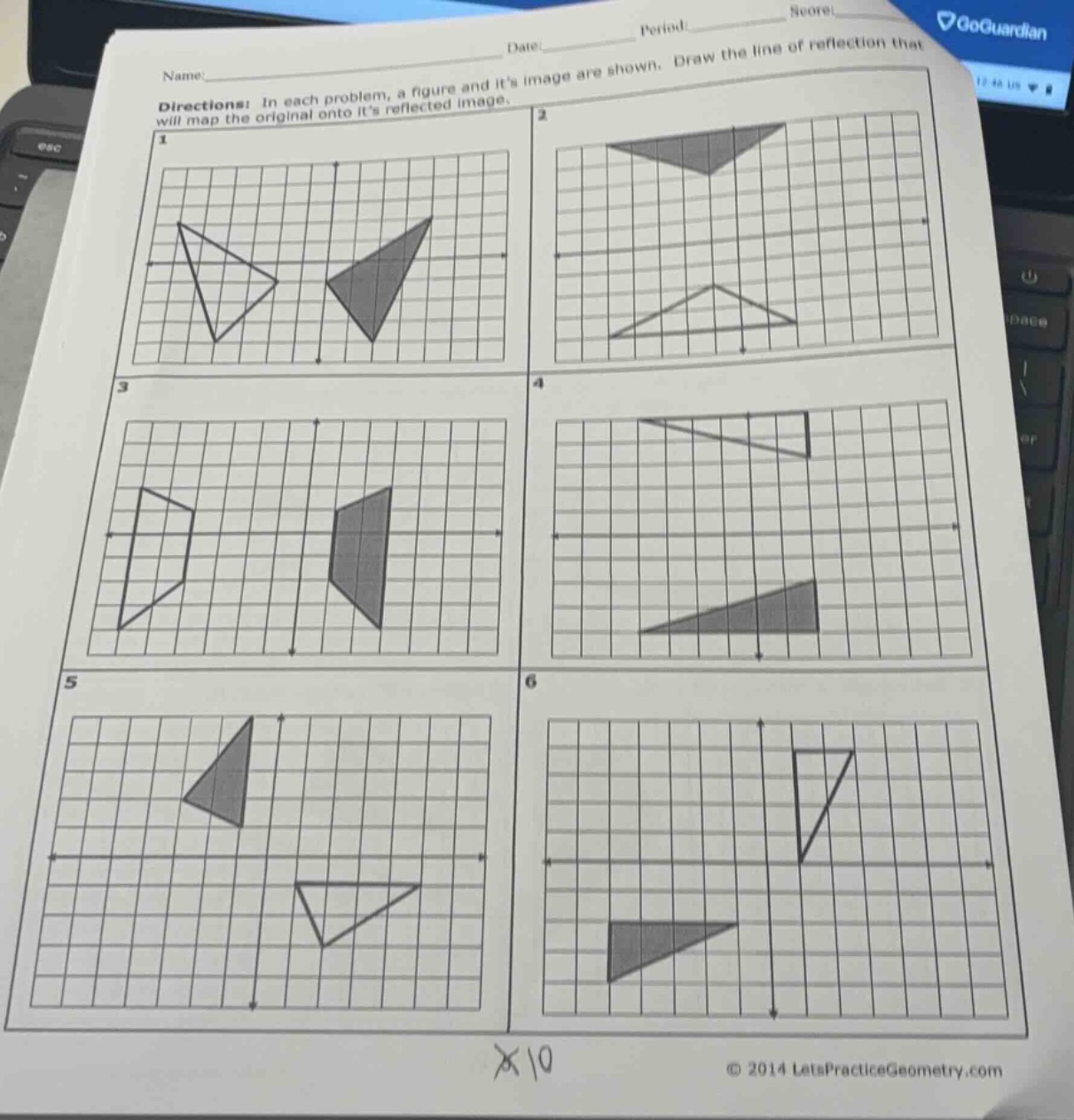
directions: in each problem, a figure and its image are shown. draw the line of reflection that will map the original onto its reflected image.
Identify corresponding vertices
To find the line of reflection for each problem, we identify corresponding vertices of the original figure and its reflected image. Let the origin \((0,0)\) be the intersection of the bold axes.
- Problem 1:
- Left triangle vertices: \((-5, 3)\), \((-2, 1)\), \((-4, -2)\)
- Right triangle vertices: \((5, 3)\), \((2, 1)\), \((4, -2)\)
- The \(y\)-coordinates are identical, while the \(x\)-coordinates are negated.
- Problem 2:
- Top triangle vertices: \((-3, 5)\), \((2, 5)\), \((1, 3)\)
- Bottom triangle vertices: \((-3, -3)\), \((2, -3)\), \((1, -1)\)
- The \(x\)-coordinates are identical. The \(y\)-coordinates reflect across a horizontal line.
- Problem 3:
- Left trapezoid vertices: \((-5, 2)\), \((-4, 2)\), \((-4, -2)\), \((-5, -4)\)
- Right trapezoid vertices: \((3, 2)\), \((2, 2)\), \((2, -2)\), \((3, -4)\)
- The \(y\)-coordinates are identical. The \(x\)-coordinates reflect across a vertical line.
- Problem 4:
- Top triangle vertices: \((-2, 5)\), \((4, 4)\), \((4, 5)\)
- Bottom triangle vertices: \((-2, -3)\), \((4, -2)\), \((4, -3)\)
- The \(x\)-coordinates are identical. The \(y\)-coordinates reflect across a horizontal line.
- Problem 5:
- Top-left triangle vertices: \((-2, 5)\), \((-1, 2)\), \((-3, 3)\)
- Bottom-right triangle vertices: \((5, -2)\), \((2, -1)\), \((3, -3)\)
- The coordinates swap positions: \((x, y)
ightarrow (y, x)\).
- Problem 6:
- Top-right triangle vertices: \((2, 0)\), \((2, 4)\), \((4, 4)\)
- Bottom-left triangle vertices: \((-2, -4)\), \((-2, -2)\), \((-4, -2)\)
- The coordinates swap positions with negation: \((x, y)
ightarrow (-y, -x)\).
Calculate the midpoint equations
The line of reflection is the perpendicular bisector of the segments connecting corresponding vertices.
- Problem 1:
- Midpoint of \((-5, 3)\) and \((5, 3)\) is \((0, 3)\).
- Midpoint of \((-2, 1)\) and \((2, 1)\) is \((0, 1)\).
- The line is vertical: \(x = 0\) (the \(y\)-axis).
- Problem 2:
- Midpoint of \((-3, 5)\) and \((-3, -3)\) is \((-3, 1)\).
- Midpoint of \((1, 3)\) and \((1, -1)\) is \((1, 1)\).
- The line is horizontal: \(y = 1\).
- Problem 3:
- Midpoint of \((-5, 2)\) and \((3, 2)\) is \((-1, 2)\).
- Midpoint of \((-4, -2)\) and \((2, -2)\) is \((-1, -2)\).
- The line is vertical: \(x = -1\).
- Problem 4:
- Midpoint of \((-2, 5)\) and \((-2, -3)\) is \((-2, 1)\).
- Midpoint of \((4, 4)\) and \((4, -2)\) is \((4, 1)\).
- The line is horizontal: \(y = 1\).
- Problem 5:
- Midpoint of \((-2, 5)\) and \((5, -2)\) is \((1.5, 1.5)\).
- Midpoint of \((-1, 2)\) and \((2, -1)\) is \((0.5, 0.5)\).
- Since \(y = x\) for these midpoints, the line of reflection is \(y = x\).
- Problem 6:
- Midpoint of \((2, 0)\) and \((-2, -4)\) is \((0, -2)\).
- Midpoint of \((4, 4)\) and \((-4, -2)\) is \((0, 1)\).
- Let's re-verify the vertices for Problem 6:
- Top-right triangle: \((2, 0)\), \((2, 4)\), \((4, 4)\)
- Bottom-left triangle: \((-4, -2)\), \((-2, -2)\), \((-2, -4)\)
- Corresponding pairs:
- \…

Snap & solve any problem in the app
Get step-by-step solutions on Sovi AI
Photo-based solutions with guided steps
Explore more problems and detailed explanations
| No. | Answer |
|---|---|
| 2 | \(y = 1\) |
| 3 | \(x = -1\) |
| 4 | \(y = 1\) |
| 5 | \(y = x\) |
| 6 | \(y = -x\) |