QUESTION IMAGE
Question
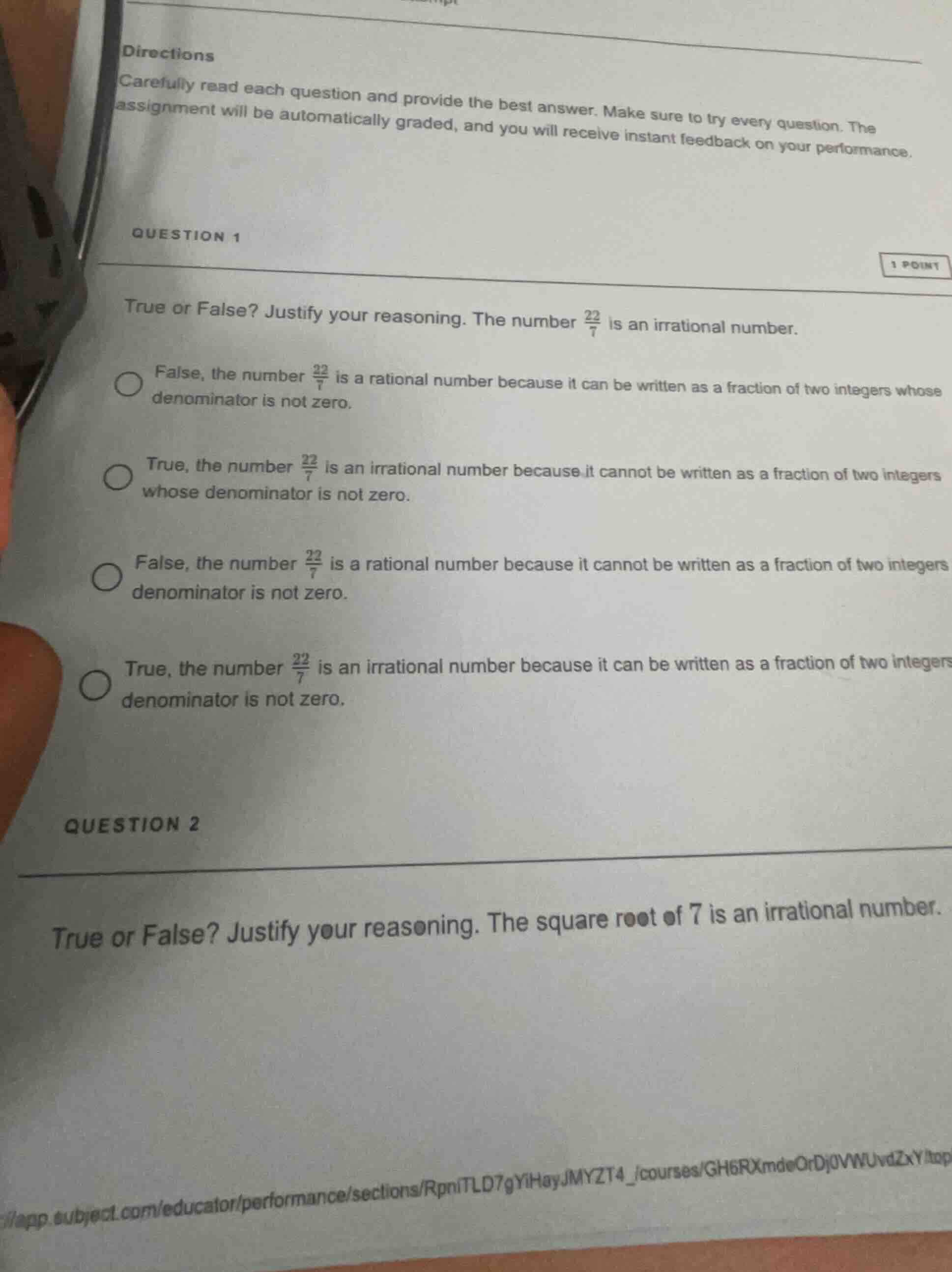
directions
carefully read each question and provide the best answer. make sure to try every question. the assignment will be automatically graded, and you will receive instant feedback on your performance.
question 1
true or false? justify your reasoning. the number \\(\frac{22}{7}\\) is an irrational number.
false, the number \\(\frac{22}{7}\\) is a rational number because it can be written as a fraction of two integers whose denominator is not zero.
true, the number \\(\frac{22}{7}\\) is an irrational number because it cannot be written as a fraction of two integers whose denominator is not zero.
false, the number \\(\frac{22}{7}\\) is a rational number because it cannot be written as a fraction of two integers whose denominator is not zero.
true, the number \\(\frac{22}{7}\\) is an irrational number because it can be written as a fraction of two integers whose denominator is not zero.
question 2
true or false? justify your reasoning. the square root of 7 is an irrational number.
Analyze Question 1
The first question asks whether the number \(\frac{22}{7}\) is irrational and requests a justification.
A rational number is defined as any number that can be expressed as the quotient or fraction \(\frac{p}{q}\) of two integers, a numerator \(p\) and a non-zero denominator \(q\).
Since \(22\) and \(7\) are both integers and \(7
eq 0\), the number \(\frac{22}{7}\) is a rational number.
Therefore, the statement "The number \(\frac{22}{7}\) is an irrational number" is False.
The correct justification is: "False, the number \(\frac{22}{7}\) is a rational number because it can be written as a fraction of two integers whose denominator is not zero."
Analyze Question 2
The second question asks whether the square root of \(7\) (\(\sqrt{7}\)) is an irrational number.
An irrational number is a real number that cannot be expressed as a ratio of two integers.
Since \(7\) is a prime number and not a perfect square, its square root \(\sqrt{7}\) cannot be simplified to an integer or a ratio of two integers.
Its decimal representation is non-terminating and non-repeating.
Therefore, the statement "The square root of \(7\) is an irrational number" is True.
The justification is that \(\sqrt{7}\) cannot be expressed as a fraction of two integers.

Snap & solve any problem in the app
Get step-by-step solutions on Sovi AI
Photo-based solutions with guided steps
Explore more problems and detailed explanations
Question 1
- (A) False, the number \(\frac{22}{7}\) is a rational number because it can be written as a fraction of two integers whose denominator is not zero. (Correct answer)
- (B) True, the number \(\frac{22}{7}\) is an irrational number because it cannot be written as a fraction of two integers whose denominator is not zero.
- (C) False, the number \(\frac{22}{7}\) is a rational number because it cannot be written as a fraction of two integers denominator is not zero.
- (D) True, the number \(\frac{22}{7}\) is an irrational number because it can be written as a fraction of two integers denominator is not zero.
Question 2
True, the square root of \(7\) (\(\sqrt{7}\)) is an irrational number because it cannot be expressed as a fraction of two integers (its decimal form is non-terminating and non-repeating).