QUESTION IMAGE
Question
determining the number of possible triangles
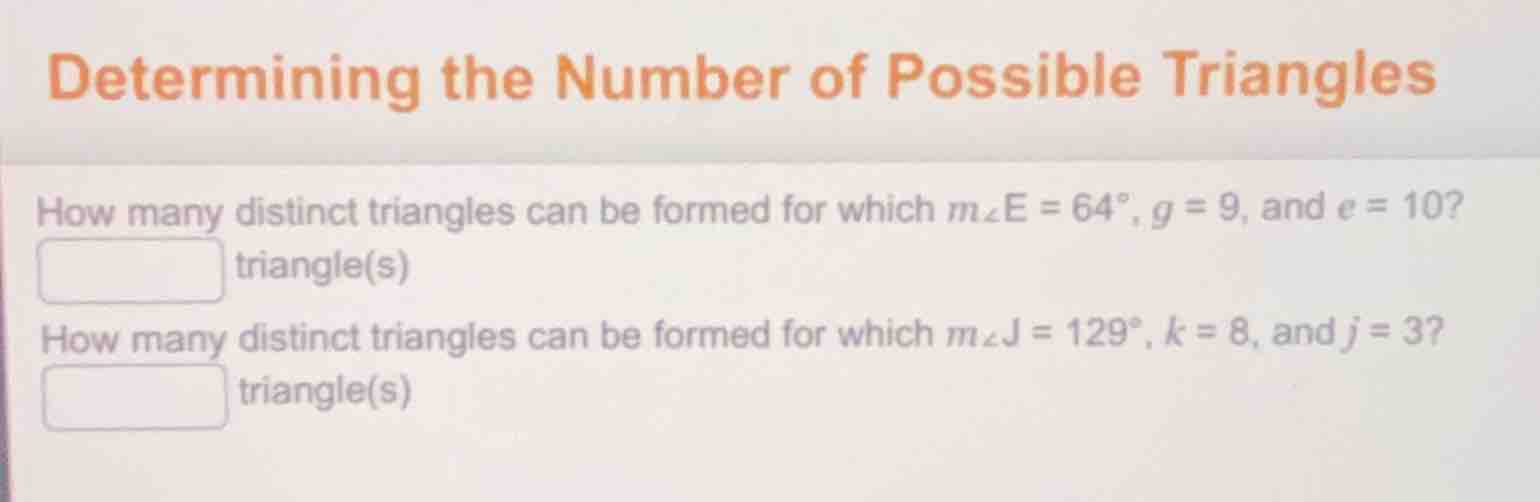
how many distinct triangles can be formed for which (m\angle e = 64^{\circ}), (g = 9), and (e = 10)?
triangle(s)
how many distinct triangles can be formed for which (m\angle j = 129^{\circ}), (k = 8), and (j = 3)?
triangle(s)
🆕 New Concept Discovered: The Ambiguous Case (SSA) of the Law of Sines
When we know two sides and a non-included angle, there might be 0, 1, or 2 possible triangles.
Step 1: Analyze the first scenario
We are given:
- Angle \( E = 64^\circ \) (an acute angle)
- Side adjacent to the angle, \( g = 9 \)
- Side opposite to the angle, \( e = 10 \)
Since the opposite side \( e \) is greater than the adjacent side \( g \) (\( 10 > 9 \)), the opposite side is long enough to reach the base in exactly one way.
Therefore, there is exactly 1 distinct triangle.
Step 2: Analyze the second scenario
We are given:
- Angle \( J = 129^\circ \) (an obtuse angle)
- Side adjacent to the angle, \( k = 8 \)
- Side opposite to the angle, \( j = 3 \)
For an obtuse angle, the side opposite the obtuse angle must be the longest side of the triangle. This means we must have \( j > k \).
Since \( j = 3 \) and \( k = 8 \), we have \( 3 < 8 \), which is impossible for a valid triangle.
Therefore, there are 0 distinct triangles.

Snap & solve any problem in the app
Get step-by-step solutions on Sovi AI
Photo-based solutions with guided steps
Explore more problems and detailed explanations
First box: 1
Second box: 0