QUESTION IMAGE
Question
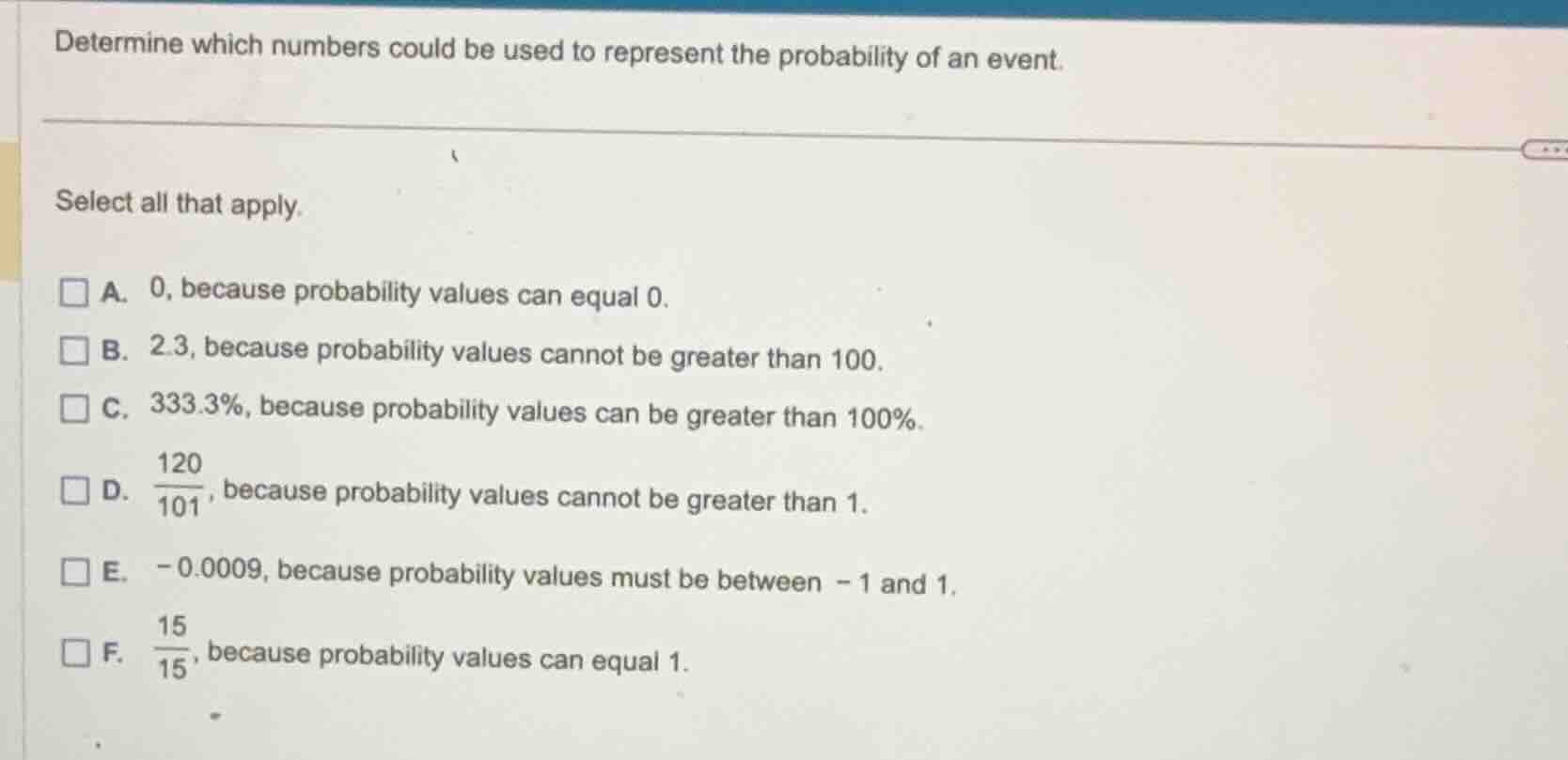
determine which numbers could be used to represent the probability of an event.
select all that apply.
a. 0, because probability values can equal 0.
b. 2.3, because probability values cannot be greater than 100.
c. 333.3%, because probability values can be greater than 100%.
d. \\(\frac{120}{101}\\), because probability values cannot be greater than 1.
e. -0.0009, because probability values must be between -1 and 1.
f. \\(\frac{15}{15}\\), because probability values can equal 1.
State the fundamental rule of probability
The probability of any event \(E\), denoted by \(P(E)\), must be a real number between \(0\) and \(1\), inclusive. Mathematically, this is expressed as:
An event with a probability of \(0\) is impossible, and an event with a probability of \(1\) is certain to occur.
Evaluate options A, B, and C
- Option A: The value is \(0\). Since \(0 \le 0 \le 1\), this is a valid probability. The reason given is correct: probability values can equal \(0\).
- Option B: The value is \(2.3\). Since \(2.3 > 1\), it cannot represent a probability.
- Option C: The value is \(333.3\%\), which is equivalent to \(3.333\). Since \(3.333 > 1\), it cannot represent a probability.
Evaluate options D, E, and F
- Option D: The value is \(\frac{120}{101}\). Since \(\frac{120}{101} > 1\), it cannot represent a probability.
- Option E: The value is \(-0.0009\). Since \(-0.0009 < 0\), it cannot represent a probability.
- Option F: The value is \(\frac{15}{15}\), which simplifies exactly to \(1\). Since \(0 \le 1 \le 1\), this is a valid probability. The reason given is correct: probability values can equal \(1\).
Identify the correct choices
Based on the evaluations, only options A and F represent valid probabilities with correct reasoning.

Snap & solve any problem in the app
Get step-by-step solutions on Sovi AI
Photo-based solutions with guided steps
Explore more problems and detailed explanations
- A. 0, because probability values can equal 0. (Correct answer)
- B. 2.3, because probability values cannot be greater than 100.
- C. 333.3%, because probability values can be greater than 100%.
- D. \(\frac{120}{101}\), because probability values cannot be greater than 1.
- E. -0.0009, because probability values must be between -1 and 1.
- F. \(\frac{15}{15}\), because probability values can equal 1. (Correct answer)