QUESTION IMAGE
Question
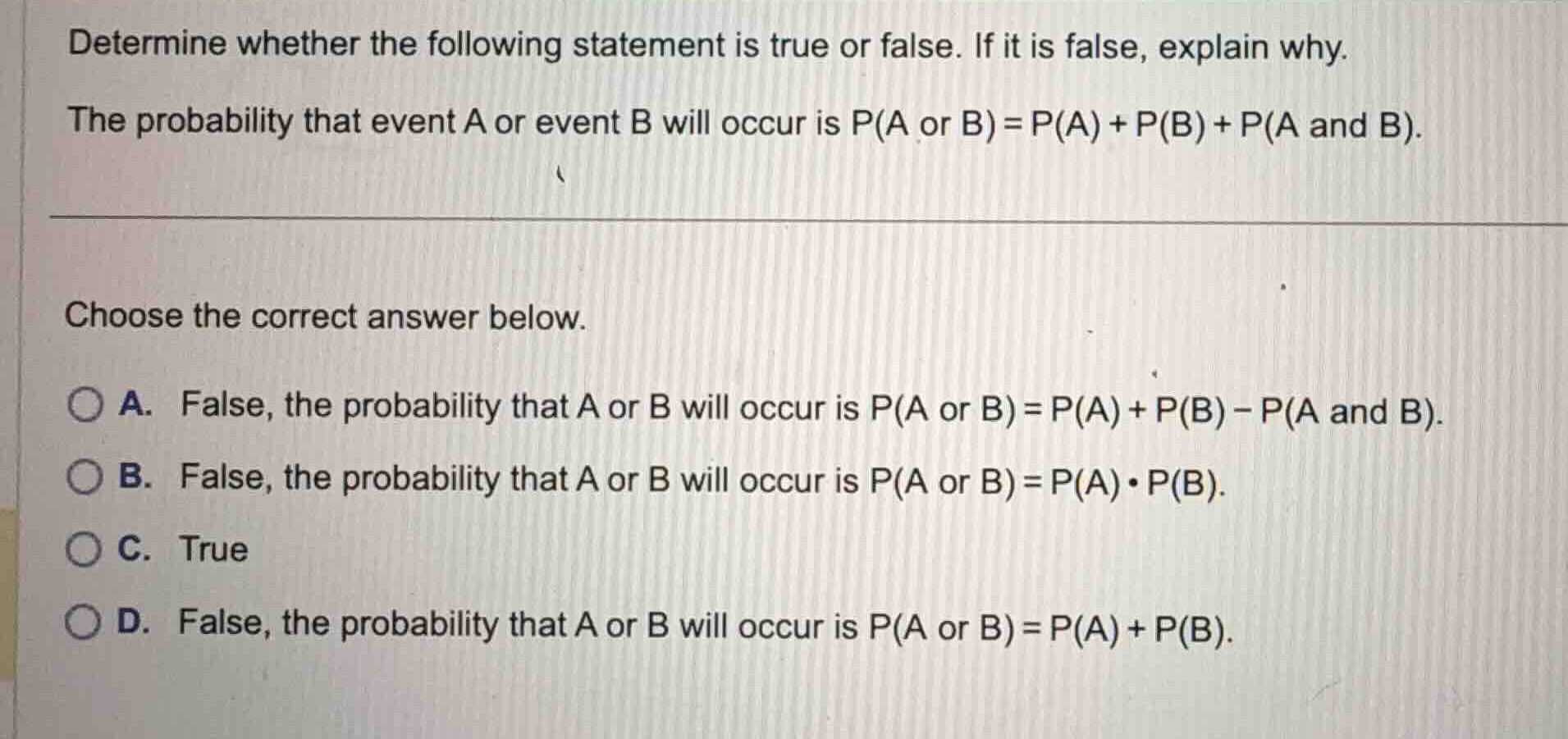
determine whether the following statement is true or false. if it is false, explain why.
the probability that event a or event b will occur is \\(p(a \text{ or } b) = p(a) + p(b) + p(a \text{ and } b)\\).
choose the correct answer below.
a. false, the probability that a or b will occur is \\(p(a \text{ or } b) = p(a) + p(b) - p(a \text{ and } b)\\).
b. false, the probability that a or b will occur is \\(p(a \text{ or } b) = p(a) \cdot p(b)\\).
c. true
d. false, the probability that a or b will occur is \\(p(a \text{ or } b) = p(a) + p(b)\\).
Analyze the given statement
Using the Compound Event knowledge point, we identify that the statement describes the probability of the union of two events, \(A\) or \(B\). The statement claims:
Apply the Addition Rule
Using the Probability Axioms knowledge point
Evaluate the options
Comparing our correct formula to the given choices:
- The original statement is false because it adds \(P(A \text{ and } B)\) instead of subtracting it.
- Option A correctly states that the statement is false and provides the correct subtraction formula.

Snap & solve any problem in the app
Get step-by-step solutions on Sovi AI
Photo-based solutions with guided steps
Explore more problems and detailed explanations
- (A) False, the probability that A or B will occur is P(A or B) = P(A) + P(B) - P(A and B). (Correct answer)
- (B) False, the probability that A or B will occur is P(A or B) = P(A) • P(B).
- (C) True
- (D) False, the probability that A or B will occur is P(A or B) = P(A) + P(B).