QUESTION IMAGE
Question
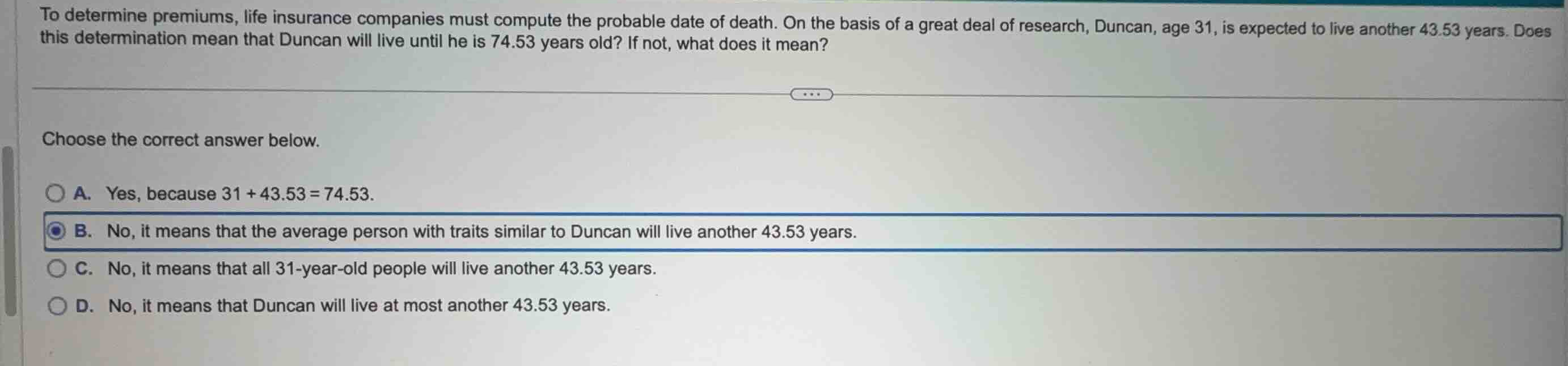
to determine premiums, life insurance companies must compute the probable date of death. on the basis of a great deal of research, duncan, age 31, is expected to live another 43.53 years. does this determination mean that duncan will live until he is 74.53 years old? if not, what does it mean?
choose the correct answer below.
a. yes, because 31 + 43.53 = 74.53.
b. no, it means that the average person with traits similar to duncan will live another 43.53 years.
c. no, it means that all 31-year-old people will live another 43.53 years.
d. no, it means that duncan will live at most another 43.53 years.
Analyze the meaning of expected value
The problem states that Duncan, age 31, is expected to live another 43.53 years. In statistics and actuarial science, an "expected" value represents a long-term average or mean value calculated from a large population. It does not guarantee an individual outcome. This relates to Empirical Probability where large datasets are used to find average trends.
Evaluate the options
- Option A suggests a deterministic outcome, which is incorrect because life expectancy is a statistical average, not a certainty.
- Option B correctly states that "expected to live" refers to the average person with similar characteristics (such as age, health, and lifestyle) living that much longer.
- Option C is incorrect because not all individuals of that age will live exactly the same amount of time.
- Option D is incorrect because "expected" does not establish a maximum limit on lifespan.

Snap & solve any problem in the app
Get step-by-step solutions on Sovi AI
Photo-based solutions with guided steps
Explore more problems and detailed explanations
- (A) Yes, because 31 + 43.53 = 74.53.
- (B) No, it means that the average person with traits similar to Duncan will live another 43.53 years. (Correct answer)
- (C) No, it means that all 31-year-old people will live another 43.53 years.
- (D) No, it means that Duncan will live at most another 43.53 years.